Showing posts with label museums. Show all posts

Monday, April 13, 2015

The American Museum Brontosaur - A History In Pictures

The wooden model used to explore poses for the original
brontosaur mount is now on display beside the
revised mount at the AMNH. Photo by the author.
Here's one more post to commemorate the revival of the name Brontosaurus for the beast formerly known as Apatosaurus excelsus. As I mentioned in my last post, the mounted skeleton of the so-called "Nine-Mile Quarry Brontosaur" at the American Museum of Natural History, while it may or may not actually be a Brontosaurus, is probably the most iconic version of this animal, overshadowing even the archetypal brontosaur skeleton at the Yale Peabody Museum.


This is in no small measure thanks to the efforts of problematic Hitler enthusiast and highly successful paleontology promoter Henry Fairfield Osborn. Osborn became the first curator of the Vertebrate Paleontology department at the AMNH in 1891 and quickly rose to prominence, becoming the president of the museum in 1908. Osborn worked quickly to create a world-class collection of dinosaurs for the museum, both launching his own expeditions to collect fossils for display and making significant trades and acquisitions, such as the collections of E.D. Cope.


Saturday, October 11, 2014

You're Doing It Wrong: Protobird Toys Edition

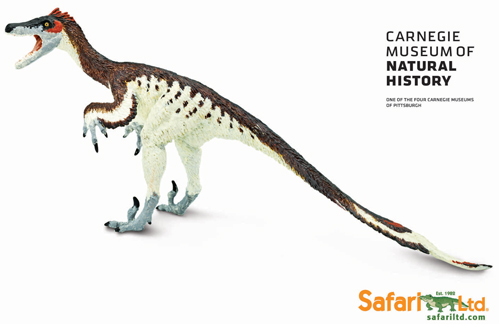
The new Carnegie Velociraptor figure.
I'm pretty slack when it comes to keeping up with my Twitter account, but if one thing can get me to break my one post per month general rule, it's "somebody is wrong on the Internet!" Or, in this case, "somebody made an inaccurate dinosaur model under the auspices of museum-approved accuracy!"

Let me preface this post with a few disclaimers. One, I have no problem with people making dinosaur art however they like. But I feel it's very important to draw a distinction between dinosaur art in general and paleoart. Creating a drawing, painting, or sculpture under the guise of paleoart implies that some degree of research went into the piece. When evaluating paleoart, critics are completely entitled to demand as rigorous an approach to accuracy as the evidence allows. Of course, speculation must be included to some degree, but the baseline expectation is always that basic facts and plausible inference will be taken into consideration.

Dinosaur art is a for of pop art, a purely artistic expression. Paleoart is a representation of a scientific hypothesis about the life appearance and behavior of an extinct organism.

This recent Twitter kerfuffle was due specifically to the debut of a new dinosaur figure in the Carnegie Collection produced by Safari Ltd. I've been a big fan of the Carnegie figures (and the sometimes nicer quality Wild Safari sister series) since I was a wee lad buying my first Carnegie Pteranodon in a little hobby shop for about $2, and pining over their massive Brachiosaurus. Carnegie figures have obvious appeal for scientifically-minded young dinosaur fans. First, most of them are made with a consistent scale (usually 1:40), so when you line them all up you can see how big each animal was compared to one another. Second, they are marketed as having the highest level of scientific authority: the Carnegie Museum stamp and assurances that hey are approved by actual paleontologists gives them the weight of authority and accuracy not found in many other toy lines. Sure, many of the older figures, including my Pteranodon, are now sorely out of date, but this is due largely to the Science Marches On effect rather than a basic, original inaccuracy.

However, like many paleoartists, the sculptors at Carnegie and related accuracy-minded/marketed toy lines seem to be having, well, let's say a little trouble adapting to the feathered revolution. Trained in the '80s and '90s drawing and sculpting Paulian, reptilian dinosaurs, it's been a steep learning curve for many of these artists to switch to bird-like, feathered dinosaurs, which many artists don't even realize requires a crash course in avian anatomy, rather than reptile or mammal anatomy, to get right. This is why expert consultants are so important in these projects--artists simply need help catching up with the latest research. Unfortunately, they're usually getting bad advice from "experts" who simply do not care.

The newest entry in the Carnegie Collection is the old favorite Velociraptor. Carnegie had previously released a scaly Velociraptor, but like many of their other models, they have commendably updated it to try and reflect current science. Unfortunately, it seems they mainly achieved this by slapping feathers over the basic original model with no regard for the fact that feathers inherently change the entire presentation and outline of an animal. Unlike fur or "protofeathers", which just fluff up the outline of an animal, feathers are more like a mobile exoskeleton that re-defines the entire body.

My own hypothesis, based on fossil and phylogenetic evidence as well as
inference from living analogues, about the life appearance of Velociraptor.
That being said, the Carnegie Velociraptor is not that bad overall and is very nicely sculpted, with an interesting and plausible color scheme. The feathers look fur-like, true, but this is not unprecedented among different lineages of large ground birds, and so is not unlikely in flightless protobirds (though they'd probably still be longer). The main problem here is the wing. Yes, wing. Like chickens and ostriches, protobirds possessed fully-fledged wings despite being flightless or nearly so, and retaining large claws on the fingers (yes, chickens, ostriches, and many other birds have hand claws--they are not some prehistoric protobird relic!).

Specifically, the wings in the new Velociraptor figure are very small, with short feathers, and are present only on the forearm, not the hand, making them only half a wing--literally, since they're issuing the primary feathers. We do not have direct evidence of primaries, but we have never found a single example of a maniraptoran that has secondaries but not primaries, and so it should be assumed they were there by default. As for secondaries, we have direct evidence in the form of quill knobs for this species. Quill knobs are not found in all feathered animals, let alone all flying birds, and seem to be associated with strong attachment either due to high-stresses during flight or other flapping behavior and/or especially large/long individual feathers.

Long story short: Not only did Velociraptor have wings, it probably had larger wings than many other dromaeosaurids. AFAIK not even Microraptor and Archaeopteryx had quill knobs to support their wings.

The new Carnegie figure, on the other hand, barely has wings at all. What went wrong?

Some insight can be gained by a recent series of incidents involving sculptor Dan LoRusso on the message board of the Dinosaur Toy Blog. LoRusso Is an amazing artist and is responsible for some of my all-time favorite dinosaur figures released in the Boston Museum of Science Collection by Battat (now being re-released with updates and new figures under the Terra brand). Collectors were understandably excited about the fact that the Battat series was coming back after nearly two decades, though the excitement was dampened a little by some obvious accuracy issues in the new figures, specifically when it came to the feathered species (or species that should have been feathered).

LoRusso was criticized online for producing a very well done but very inaccurate therizinosaur figure which completely lacked feathers. It would have fit right in with the excellent quality and Paulian style of the original series... back in 1994. But in 2014, when we have incontrovertible proof that therizinosaurs were not only feathered but that at least smaller species were very densely feathered, it is simply bizarre to see a featherless figure in a line that is being marketed as scientifically accurate. LoRusso stated that his consultants told him larger therizinosaurs would have been featherless. It's not LoRusso's fault that he somehow was able to sculpt a bald maniraptoran in the year 2013. Somebody who did not know what they were talking about and claiming to be an expert in paleoart just because they work in the related field of paleontology told him to do it, and he very reasonably believed them because they were an "expert", though obviously they had misrepresented themselves.

And there's the biggest problem and probably the answer to the question of what is going on with these strange and obvious inaccuracies. Paleoart consultants for major projects tend to be, often but not always, simply terrible. They seem not to know what they are talking about. Not only that, but second-hand reports suggest that they often simply do not care. Seriously: When asked about blatant inaccuracies creeping into paleoart-based projects like toys or books or even press releases, at least one anonymous paid paleontological consultant stated that they don't care what dinosaurs looked like in life, and so would presumably rubber-stamp any abomination that came across their desk.
Here's a prime, objective example: The Carnegie Collection Caudipteryx zoui figure. This species was first found in 1998, a complete skeleton with feather impressions. There are plenty of photos of Caudipteryx fossils that show crystal clear how the feathers attach and were ignored completely for this figure. The artist might have copied some inaccurate depiction rather than doing actual research or glancing at a fossil, and the consultant approved it because they didn't know or didn't care about the relevant details. The Carnegie Caudipteryx proves that consultants are utterly useless and often have no clue what they're talking about. Any one of us can compare the model with the fossil and show that the model is objectively wrong in major details. Look for yourself:

Caudipteryx wing fossil: note the primaries, longer than the hand, anchored along the second finger,
and lack of a clawed third finger.


Carnegie Collection Caudipteryx figure. Note the wing feathers anchored everywhere along the arm
EXCEPT on the second finger where they belong, and the incorrect number of fingers.
The wings/arms of this figure are wrong in just about every single way possible, and these are not minor details. Yet it's marketed as accurate and "paleontologist approved" in a series bearing the name of a major scientific institution!

It's not fair to ask all working paleontologists to know or care how their research into fossils translates into life appearance. Matching osteological and behavioral correlates with the structure and anatomy of living analogues could almost be considered a distinct field separate from actual paleontology. This is something paleoartists can and do think about and research constantly, but would almost never need to enter into the research when describing fossils. There's really no reason for working paleontologists to keep up to date with developments and research that go into paleoart.

The solution? Don't ask these paleontologists to consult! Just because someone is a paleontologist does not make them an expert on the life appearance of any given species of prehistoric organism. The examples cited above were, allegedly, all approved by "expert" consultants. This simply proves the consultants that are being employed are utterly failing at their job. I hate to say it, but there are legions of paleoartists and other dinosaur fans online who jump at the chance to criticize and nitpick and otherwise consult on these things for free. It's just that by the time the product is released, it's too late to do anything about inaccuracies. If companies that use paleoart would simply post concept art beforehand on, say, Facebook, they could probably get much better advice for free. Or, preferably, they could employ actual paleoartists as experts, hopefully artists who specialize in researching the life appearance of a given subject group of organisms.

Darren Naish, Mark Witton, and John Conway recently published an article on the (shameful) state of  paleoart as used in professional and commercial contexts. Companies like Safari Ltd. would do well to listen to their advice.

Thursday, June 24, 2010

Nyctosaurus Lost


Above: Private fossil dealer Rob Frithiof, just before Harrison Ford sucker punches him and Coronado's Cross nearly falls off the deck of the ship. Photo by Aaron Huey from Smithsonian Online, see link below.

Last month I covered an appearance by the famous giant-crested Nyctosaurus specimens in the Brazos Valley Museum in Texas, displayed along with a piece of my artwork (for which I was neither compensated nor, more importantly, notified). These crested specimens were first described by Chris Bennett in 2003. In his paper, Bennett noted that the specimens were in a private collection, usually shunned by scientists when describing new species; what if, after the initial description, other researchers are not allowed access to the specimens? Without the possibility of further independent study, the specimens are effectively lost to science.

In a way, we're lucky Bennett did what he did, because knowledge of these spectacular finds has inspired a mini-surge of research into pterosaur crest dynamics and function, as well as brought attention to the otherwise little-known Nyctosaurus, bringing it out from under the shadow of its contemporary cousin Pteranodon as arguably the more charismatic pterosaur. But private collections are private collections, and Bennett's worst fears have come true, according to a recent post on the Pterosaur.net blog.

Apparently, a little while ago, one of the crested Nyctosaurus specimens (KJ1 and KJ2 in Bennett's unofficial numbering scheme, KJ1 shown at right, photo by mavra_chang) showed up on eBay. We're talking the actual specimen here, not a cast (I'm not aware if any casts have been made of these guys). [Update 7/31/2012 - see comments below; apparently, casts have been made and distributed for at least KJ1]. It was snapped up by an unknown buyer and is currently lost to science. Pterosaurologist Mark Witton, who writes for the blog, didn't say what happened but noted that the other KJ specimen has also "dropped off the radar completely."

The KJ specimens were owned by Rob Frithiof, a real estate developer and part-time fossil collector based out of Texas, who organized the Brazos Valley exhibit (news story here) before the specimens were sold. Presumably, Frithiof, in a fit of pique after watching the first 10 minutes of Last Crusade one too many times, decided that "it belongs in a museum" and placed them there for a few weeks before auctioning some of the most interesting and impressive pterosaur specimens ever known off to some anonymous highest bidder. Frithiof was already infamous in the paleo community for his discovery and subsequent litigation over the juvenile tyrannosaur specimen "Tinker", over which he was cleared of all charges and retained ownership of the phenomenally important fossil. As of 2006, Frithiof had sent Tinker to a private prep lab in Pennsylvania to be prepped and mounted, but the lab went out of business, and the fossil is still sitting in storage as far as I know--also effectively off limits to science, but at least we know where the thing is.

You can read more about Frithiof in this Smithsonian article from last year. You'll never read anything about the crested Nyctosaurus specimens ever again, except in the context of history, unless some eBay buyer with too much money on his hands decides to heed Indy's famous plea better than Frithiof did. And so it goes.

Sunday, May 16, 2010

More Non-Dinosaurs! Oh no!

Back to dinosaurs soon, I promise.

I've been doing some research on
Nyctosaurus lately for my own web site and toward improving the Wikipedia article. The crest situation always confused me, because many traditional depictions of this pterosaur show it with a low, dorsal keel type crest on the snout, similar to some ctenochasmatoids. The well-preserved skulls of the famous gigantic-crested N. sp., however, don't show this feature, and neither to several other nyctosaur skulls. As it turns out, Chris Bennett, who has been working on a detailed osteology of Nyctosaurus, pointed out on the DML several years back that the "N. bonneri" style crest isn't real, an artifact of crushing mistaken for a crest and subsequently enhanced by preperators.

As for the Nyctosaurus sp. with the head like a sailing mast, older depictions showed it with the back-pointing boom much shorter than the up-pointing spar. However, the fossils of KJ1 and KJ2 (the crested specimens) appear to have broken booms, and Bennett 2003 states that the boom was at least 3/4 the length of the spar. Luckily this meme has taken off among paleoartists thanks to the efforts of Mark Witton, and John Conway updating his famously brilliant paintings of this species.

I've updated my own depiction here, as well as the version I had donated to Wikipedia. Oddly enough, I found the older version in a Flikr photo by mavra_chang accompanying a Nyctosaurus display at the Brazos Valley Museum of Natural History in Bryan, Texas. The version is CC licensed but that requires at least crediting my name somewhere. It's hard to tell if that happened there as the image is partially cropped, but they certainly didn't notify me or ask permission... Don't get me wrong, I'm stoked to have my stuff (however outdated) up in a frigging museum. Just, y'know, a heads up would have been nice.

Wednesday, August 19, 2009

PteroGoss

Above: Mark Witton explains why pterosaurs are so cool. Copyright BBC.

Nothing much to report in the way of good goss lately. It's been quiet in the world of dinosaurology... almost too quiet...

But not so if you're also a big pterodactyl geek. This is not PteroGoss but I'll link to a few awesome stories coming out lately...

Eudimorphodon rosenfeldi has been assigned to a new genus, Carniadactylus, in a sweet paper looking at relationships of primitive pterosaurs. The authors also consider the super-weird Raeticodactylus to actually be a synonym of the contemporary Caviramus. Here's the article from Wikipedia.

Mark Witton describes a new species of Tupuxuara, T. deliradamus! That translates as "crazy diamond," making it officially one of the most awesome pterosaur names that could also be a character in a Guy Ritchie film. Mark also sorted out the priority of Tupuxuaridae vs Thalassodromidae, which you can read about at his blog.

In other Mark Witton news, he's the subject of a new series of videos done by the BBC tracking the construction of several giant pterosaur models for an upcoming British exhibition. Check out TetZoo for more.

Above: Sketch of the upcoming outdoor pterosaur models at the Southbank Centre in London, for the Royal Society exhibition. Copyright BBC.

Lastly, today a new paper announced the discovery of the first known pterosaur landing tracks. The tracks suggest they landed like birds, feet-first, flapping their wings to stall before dropping onto all fours.

Tuesday, May 19, 2009

Four Wings Bad, Two Wings Good?

While helping to review a painting of Velociraptor posted to Gondolend, the artist brought up an outdated drawing of Sinornithosaurus she'd found among the top hits on Google, showing generally poor drawing skills and a likely inaccurate frond-tail of feather extending all the way to the hip (dromaeosaurs all seem to have had only a spray of vaned feathers at the tip of the tail, the rest being covered in down). This drawing is one of mine. As I've been updating my web site, I figured Sinornithosaurus should go to the top of the list for things to take a second stab at illustrating.

But how? In his book Dinosaurs of the Air, Greg Paul gave his sinornithosaurs something no fossils of them preserve--Microraptor-like wings on the back legs. It's a close relative of Microraptor, sure, but why do this with no evidence? In the travelling Feathered Dinosaurs exhibit I was lucky enough to see at the AMNH, the Liaoning diorama also contained a sinornithosaur with small, microraptorian hind wings. I checked the fossils again. Was I missing something? It seemed like a consensus was emerging with no published evidence. Sounds like some juicy behind the scenes goss was at work here.

It was. I present to you an unpublished specimen (NGMC 00-12-A, from Ji's thesis) of Sinornithosaurus (EDIT: Or is it a large, old Microraptor? See Mickey Mortimer's comments below) with what looks to be small wings on the hind legs.
Not only that, but as predicted by GSP and the AMNH model, it also appears to have full wings with primary (not just secondary as suggested by the preservation of the "Dave" specimen) wing feathers.

But... is it real? A few posters to DinoForum have admitted tentative wariness about even the hind-wing sporting Microraptor. After all, portions of the published Micro specimens are known to have been, ah, "enhanced" to make them more appealing to fossil collectors on the secondary fossil market (which is like half the Chinese economy and is only illegal in name). Sure, many specimens of Microraptor have been found with hind wings, but only two have been published on, and all came from private collectors. Specimens dug up by pros have lacked this feature, but are also more poorly preserved.

In the photo above, you can see that the feathered portion of the leg is on a separate piece of rock from the rest. Granted, specimens like this, at this size, are generally pretty fragmented, but it also gives fakers leeway to swap pieces in and out in order to make the piece more attractive. This practice isn't necessarily malicious, the enhancers just want to create a more artistic piece with no concern for science. Nor is it limited to China (remember Irritator? It got that name for a reason). Still, it's very prevalent there, to the point where many "museums" (mostly private collections that admit the public like the old Cabinets of Curiosity) contain mostly faked fossils. Professional museums in China, like the IVPP, are mainly clean from what I've heard. The pros are aware of this problem and I'd like to think most specimens that hit press are properly vetted, especially in the aftermath of Archaeoraptor. But when it comes to unpublished specimens, all bets are off, so be careful out there, paleoartists!

Long story short, I'll be re-illustrating Sinornithosaurus, but the hind wings will go in a separate layer, just in case...

[Top image: Very old, outdated Sinornithosaurus drawing by yours truly. All rights reserved.]
[second image from top: Sinornithosaurus by FunkMonk, lisenced.]

Wednesday, March 4, 2009

Save the Squatter!


Everybody and your mom (their mother?) is blogging about "The Squatter" finally getting published. This is the amazing trace fossil in St. George, Utah that shows not only the footprints of a dilophosaur-sized theropod, but a nearly complete lower-body impression. This is not where the dinosaur walked, but where it sat down to take a breather from constantly chasing things and roaring its fool head off (if every CGI dinosaur show on Discovery is to be believed). (They're not).

The impression includes the pubic boot it sat on, feet/metatarsals, tail, and--most importantly--hands. The hands prints were left side-on, offering the final piece of conclusive proof that theropods did not "pronate" the hands. They could not point palm down like dribbling a basketball, but like a bird wing, were locked with palms facing each other, like holding a basketball. This is something paleontology types have known for a long time based on anatomical studies but it's nice to have behavioral proof. Also nice to have it confirmed in such a primitive species, since many of said anatomical studies were based on more advanced, more bird-like species. Years ago when rumors of this find first hit the tubes, it was said to preserve feathers as well, but that's probably just a bunch of plant material it was sitting on. It's unlikely such a primitive dinosaur would have had feathers (they appear to be restricted to advanced coelurosaurs and birds).

So why does this fossil need saving? Well, it already narrowly avoided being intentionally destroyed in order to build the rear wall of the St. George Dinosaur Discovery Site Museum (ironic, eh?). Now the museum has built a section around the fossil in order to help preserve it from erosion, but it's still weathering ever so slowly, and the museum is too underfunded to really go to the lengths they need to preserve it over the long-term.

That's where we come in. This whole story was brought to by Sarah Spears, former employee of the museum, has put out a call for donations at her blog Gombessa Girl (which also has a more in-depth discussion of the specimen and its predicament).

So, dino fans, you can help save the Squatter by visiting http://www.dinosite.org and becoming a member, joining their Adopt-A-Track program, or buying some swag from the gift shop (which has some pretty cool casts of the dino tracks for sale).

Oh, and for you research-hungry gosshounds, the paper describing the Squatter is online for absolutely free at PLoS ONE, including CC licensed images like the awesome reconstruction here, by awesome wildlife artist Kyoht Luterman.