I started to get a little carried away in my previous post on longirostrisavisine tails, so I decided to split the finished post in half and use this one to delve a little more into the possible implications the odd tails and clawless wings of that group would have had on their flight styles.
As mentioned previously, longirostravisines, unlike most other enantiornitheans, lacked claws on all three of their manual digits, a trait apparently acquired separately of the Carinatae (Ichthyornis + modern birds). In the last post I speculated that this might have reflected a distinct flying (or at least landing) style. But how much do we really know about longipterygid flight?
In their recent paper, Close & Rayfield
attempted to correlate wishbone (furcula) shape with flight style. Many enantiornitheans in the analysis plotted together in a cluster well
separated from modern birds, but close to basal avialans like Confuciusornis which
are usually presumed to have been gliders. Oddly, in the Close & Rayfield
figure reproduced above, Rapaxavis (no. 103), a longirostravisine, clusters with the weirdo enantiornithean-style fliers, while more basal longipterygid Longipteryx (no.
98) groups with continuous-flapping fliers and is marked as an
ornithurine (something seems off here).
In another recent open-access
paper on Mesozoic bird flight styles, Wang et. al (2011), using wing element and primary feather length ratios, found Longirostrisavis to be a continuous-flapping flier, and Longipteryx
either a continuous-flapping or a flap-gliding flier, roughly the
opposite result of the Close & Rayfield furcula-based analysis.
The fact that two independent analyses using two distinct methods produced different results probably does not bode well for the precision of either method. Clearly, we need to figure out better methods to more reliably tests
flight styles in extinct birds.
Friday, November 2, 2012
Saturday, August 11, 2012
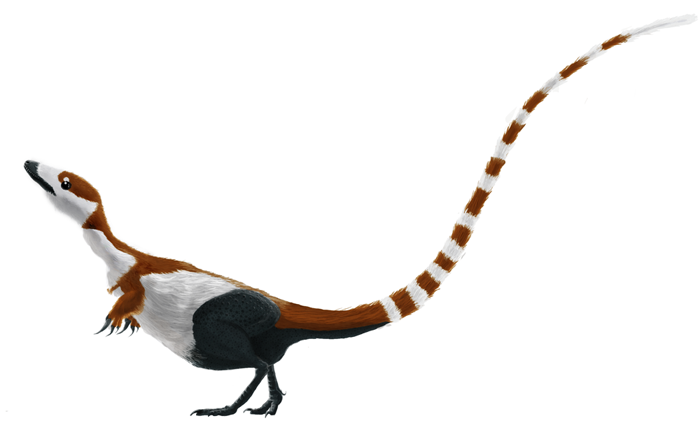
Did Sinosauropteryx Have "Protofeathers"?
![]() |
| Life restoration of the S. prima type specimen by M. Martyniuk |
Friday, August 10, 2012
The Strange Bird Dalianraptor cuhe
| Type specimen of D. cuhe, originally posted by Andrea Cau |
D. cuhe has spent the last several years as a species in obscurity, even among most paleontology enthusiasts. I recall my first glimpse of the type specimen, wondering over the seemingly-complete remains of an "undescribed possible dromaeosauird" in a low-res photo posted online in the early '00s. I can remember saving the image to my reference folder, hoping that one day I'd be able to update the file name. It's a fascinating animal, but... is it real?
Wednesday, August 1, 2012
The Tail of Shanweiniao
![]() |
| Fossil tail feathers of S. cooperorum, from O'Connor et al., 2009. |
S. cooperorum itself is most well-known for its elaborate tail made up of six ribbon-like feathers. Those feathers overlapped at the base, and may have acted as an air brake for precise landings with the feet on small branches. It's possible that most other enantiornitheans, which lacked long feathery tails and also retained wing claws, landed by simply smacking clumsily into tree trunks or brush and grabbing on with all four limbs.
Wednesday, July 25, 2012
Wrong for the Right Reasons
![]() | |
| Outdated restoration of a Protoceratops andrewsi nesting ground. Painting by Charles R. Knight, 1922. |
Tuesday, June 5, 2012
The Smallest (Mesozoic) Theropods
The online community of paleontology fans seems to have an unnatural preoccupation with size. Visit any dino-related message board, and you will find near-daily debates over which carnivorous theropod was bigger (or more specifically, longer). Carcharodontosaurus? Giganotosaurus? Tyrannosaurus? Hint: if the length estimates are within a meter of each other, the weight estimates vary widely, and the beasts in question are known only from one or two fragmentary skeletons, the correct answer is "eh, they're all about the same size, give or take." Also, Therizinosaurus and Deinocheirus, being wimpy herbivores, definitely do not count.
Less often, you may come across a discussion about which dinosaur was the smallest. These usually are not the heated debates you find with the mega-carnivores, but rather casual examination of minutiae and bringing up oft-forgotten species. Yes, everybody knows Compsognathus. But did you know the "chicken-sized" type specimen is a subadult or juvenile, and the referred French specimen is much larger? And anyway, Parvicursor was daintier by far. At 34cm (13in) long, Anchiornis was hailed as the smallest dinosaur when it was initially described, but subsequent specimens were larger (up to half a meter in length; still smaller than Compsognathus and slightly shorter than the ~40cm Parvicursor). Epidexipteryx, at a stubby, tail-free 25cm (10in) in length, was the shortest of them all, but its lack of a long tail means that it was a bit larger than the competition in mass. And anyway, isn't Epidexipteryx a bird?
![]() |
| Size comparison of select small non-pygostylian theropods. From left: Palaeopteryx thompsoni, "Ornithomimus" minutus, Parvicursor remotus, Epidexipteryx hui. By Matt Martyniuk, licensed. |
Sunday, April 1, 2012
What Is Enantiornis?
Enantiornis leali was among the first enantiornithes to be found, and the first to be recognized as a member of a unique lineage of "opposite birds" separate from modern birds (Gobipteryx minuta, now recognized as an advanced enantiornithe, was found earlier). But despite being such a widely recognized and historically important member of its namesake group, little can actually be said about this species in terms of ecology or life appearance. Of course, that can't stop us from trying to figure out as much as we can by examining the available evidence and ecological context of these long-dead birds.
Subscribe to:
Posts (Atom)