Saturday, November 24, 2012

Coming Soon: A Field Guide to Mesozoic Birds

The cover, featuring two
squabbling Boluochia
As some of you may have seen when I teased this on Facebook a few weeks ago, I've gone and written a book! With the pithy, concise title of A Field Guide to Mesozoic Birds and Other Winged Dinosaurs, this has been nearly three years in the making, and should be available soon through my website and Amazon.com.

As the name implies, the book is a heavily illustrated "field guide" style summary of known "birds" from the dinosaur era (including deinonychosaurians, caenagnathiformes, and avialans), focusing on most likely life appearances and highlighting what kinds of features may have distinguished each species in life. The book also contains a lengthy introductory section on bird evolution, and on the principles that help in reconstructing life appearance (such as feather arrangement, inferring coloration, distribution of feather types, etc.). Some of this is adapted from research I'd done previously for DinoGoss (such as the section on feather colors), but expanded and updated, and most of it consists of brand new material. The artwork is also pretty much all-new; while some of it had originally been uploaded to my DeviantArt profile (some of you may have seen my entry on caudipterids), most of those pieces ended up being completely re-drawn by the time the book was finished.

The Field Guide covers over 150 species, usually illustrated in multiple views (chosen based on ecology, and with dorsal-view wingspan profiles where appropriate), and each comes with one of my obligatory scale charts. By the time I was finished, I was surprised by how hefty the book turned out. The original conception for the book, as suggested by John Conway, had been to illustrate all "reconstructible" aviremigians--by that, I assume he meant stuff with pretty much complete skeletons. I tried to limit myself to anything with something both distinguishable and visible in life (and pretty much anything with any skull material) despite the urge to produce a few super-speculative pieces (one or two of which made it into the final cut). Anything that couldn't solidly be reconstructed based on skeletal evidence or at least decent phylogenetic bracketing is relegated to an appendix listing all excluded species, but even so, I was a bit surprised that I could manage nearly 150 pretty well-supported illustrations.

Unfortunately (or perhaps fortunately given that it would have taken me another two years to finish), I was just wrapping this book up when two surprising pieces of news surfaced--one, the discovery of pennaceous feathers in ornithomimosaurs, making all of Maniraptoriformes possible aviremigians, and news of a forthcoming study which finds microraptorians, unenlagiines, and troodontids to be avialans and scansoriopterygids to be basal coelurosaurs (potentially making most of coelurosauria aviremigians!). I did manage to include a little discussion of the former in the book, but it will be interesting to read the details of the latter in December. If Scansoriopteryx, which seems to have vaned wing feathers, is actually a fairly basal coelurosaur, a pretty massive supplementary volume may be in order.
Preview of an interior spread featuring Protarchaeopteryx and Caudipteryx.

As I mentioned above, the impetus for this project really came from John Conway, who suggested a guide to all aviremigians based on my field guide style drawings on dA. Unbeknownst to John, I had actually been planning a field guide to the Yixian fauna and flora at the time, but a really comprehensive guide to all Mesozoic "birds" seemed like too good an idea to pass up. John also suggested the idea to self-publish rather than seek traditional publication, which he has been discussing lately on his tumblr.

Due to the vagaries of the publication process, I don't have a definite release date yet, but barring any major hurdles the Guide should be available to order online in paperback before the end of December, so start writing those letters to Santa! Retail price is $36.95 plus shipping from Amazon US or CreateSpace Direct, and it will likely be available at around £25 from Amazon UK and around 36 from Amazon Europe.


Friday, November 2, 2012

The Flying Longipterygids

I started to get a little carried away in my previous post on longirostrisavisine tails, so I decided to split the finished post in half and use this one to delve a little more into the possible implications the odd tails and clawless wings of that group would have had on their flight styles.

As mentioned previously,  longirostravisines, unlike most other enantiornitheans, lacked claws on all three of their manual digits, a trait apparently acquired separately of the Carinatae (Ichthyornis + modern birds). In the last post I speculated that this might have reflected a distinct flying (or at least landing) style. But how much do we really know about longipterygid flight?

Fig. 10 from Close & Rayfield 2012, click to big it up. Note the three general clusters of continuous-flapping (red), soaring and flightless (yellow and gray), and bizarro enantiornithean style (green).

In their recent paper, Close & Rayfield attempted to correlate wishbone (furcula) shape with flight style. Many enantiornitheans in the analysis plotted together in a cluster well separated from modern birds, but close to basal avialans like Confuciusornis which are usually presumed to have been gliders. Oddly, in the Close & Rayfield figure reproduced above, Rapaxavis (no. 103), a longirostravisine, clusters with the weirdo enantiornithean-style fliers, while more basal longipterygid Longipteryx (no. 98) groups with continuous-flapping fliers and is marked as an ornithurine (something seems off here).

In another recent open-access paper on Mesozoic bird flight styles, Wang et. al (2011), using wing element and primary feather length ratios, found Longirostrisavis to be a continuous-flapping flier, and Longipteryx either a continuous-flapping or a flap-gliding flier, roughly the opposite result of the Close & Rayfield furcula-based analysis.

 The fact that two independent analyses using two distinct methods produced different results probably does not bode well for the precision of either method. Clearly, we need to figure out better methods to more reliably tests flight styles in extinct birds.

Saturday, August 11, 2012

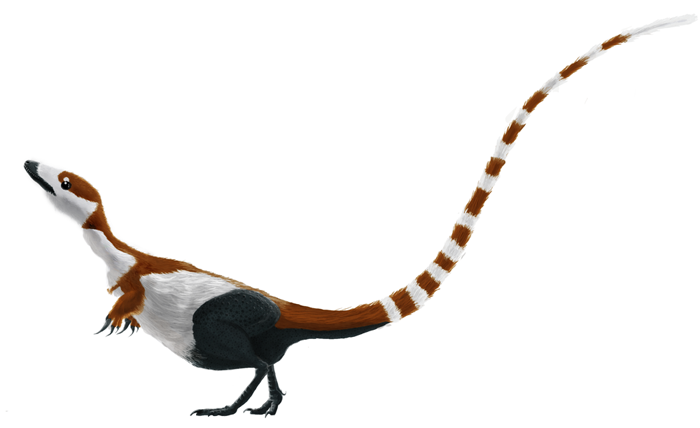
Did Sinosauropteryx Have "Protofeathers"?

Life restoration of the S. prima type specimen by M. Martyniuk
Over at Jaime Headden's blog The Bite Stuff, Jaime recently wrote a great article about the newly discovered basal coelurosaurian or orionidian Sciurumimus. The article touched on the fact that its feathers were reported as stage 1 (simple, unbranched filaments, often referred to as "protofeathers") in the parlance of feather development researcher Richard Prum. In the comments, Heinrich Mallison pointed out that they *look* like stage 1, but as Foth showed, crushed feathers (even those of modern birds) often look much more primitive than they are due to taphonomic effects. (I've mentioned before in a few places that it's really unfortunate Foth's important paper seems to have been mostly ignored by others writing about fossil feather types). Jaime defended this by saying that Sinosauropteryx, which is more derived, also is 'generally agreed' to have had stage 1 feathers. It's true that this is the general agreement in the literature, and it's also true that the general agreement has been challenged (effectively, in my opinion). I posted a reply to the article, but the fact that this keeps coming up lately has made me think that maybe I should be trying to publicize this more widely, so my comment is reproduced below along with some more commentary on the issue.

Friday, August 10, 2012

The Strange Bird Dalianraptor cuhe

Type specimen of D. cuhe, originally posted by Andrea Cau
I'm interrupting my regularly scheduled upcoming blog posts to bring some attention to a little-known Jehol bird: the strange 'jeholornithid'-grade species Dalianraptor cuhe.

D. cuhe has spent the last several years as a species in obscurity, even among most paleontology enthusiasts. I recall my first glimpse of the type specimen, wondering over the seemingly-complete remains of an "undescribed possible dromaeosauird" in a low-res photo posted online in the early '00s. I can remember saving the image to my reference folder, hoping that one day I'd be able to update the file name. It's a fascinating animal, but... is it real?

Wednesday, August 1, 2012

The Tail of Shanweiniao


Fossil tail feathers of S. cooperorum, from O'Connor et al., 2009.
As a follow-up to last month's post on the smallest Mesozoic theropods, here are a few additional observations on the small longipterygid Shanweiniao. Like other longirostravisines*, Shanweiniao cooperorum had reduced "hands" entirely lacking claws. This reduction of wing claws seems to have occurred independently of modern birds within this uniquely specialized group of enantiornitheans. (Euornitheans seem to have lost the bulk of their wing claws around the level of Carinatae, though many modern birds still retain at least keratinous claws on their wings, and longirostravisines may have as well).

S. cooperorum itself is most well-known for its elaborate tail made up of six ribbon-like feathers. Those feathers overlapped at the base, and may have acted as an air brake for precise landings with the feet on small branches. It's possible that most other enantiornitheans, which lacked long feathery tails and also retained wing claws, landed by simply smacking clumsily into tree trunks or brush and grabbing on with all four limbs.

Wednesday, July 25, 2012

Wrong for the Right Reasons

Outdated restoration of a Protoceratops andrewsi nesting
ground. Painting by Charles R. Knight, 1922.

Flipping through an old dinosaur book from the 1970s or early 1980s can be pretty fun. Nostalgia aside, it's great to see how far the science of paleontology has progressed in just a few decades, and also have a few laughs at the (from our modern perspective) outrageously outdated ideas and reconstructions we find. (David Orr's blog Love in the Time of Chasmosaurs has a great, long-running series covering "vintage dinosaur art" that lovingly pokes fun at some of the mistakes made by past palaeontographers.) Old dinosaur TV shows can be just as good. Last week, Mrs. M recorded a bunch of dinosaur shows for me which were airing on the Science Channel. I hadn't seen any of them before, and didn't realize until I hit play that I was in for a blast from the past. The shows were obviously old-school, narrated by Jeff Goldblum (I assumed these had come out around the time of The Lost World: Jurassic Park until one episode started discussing finds from later in the 1990s like Beipiaosaurus). One episode featured a segment on Roy Chapman Andrew's famous discovery of dinosaur eggs in the Gobi Desert, and the infamous misinterpretation of the eggs as belonging to Protoceratops rather than Oviraptor. This is just the kind of paleontological gaffe we paleo fans get schadenfreude out of today. After discussing the refuted hypothesis that an Oviraptor found on a nest of these eggs was first thought to be eating them rather than guarding them as later finds suggested, Mrs. M asked the obvious question: Why, given that this thing was found on top of the eggs, did they assume the eggs belonged to a different dinosaur?

Tuesday, June 5, 2012

The Smallest (Mesozoic) Theropods

The online community of paleontology fans seems to have an unnatural preoccupation with size. Visit any dino-related message board, and you will find near-daily debates over which carnivorous theropod was bigger (or more specifically, longer). Carcharodontosaurus? Giganotosaurus? Tyrannosaurus? Hint: if the length estimates are within a meter of each other, the weight estimates vary widely, and the beasts in question are known only from one or two fragmentary skeletons, the correct answer is "eh, they're all about the same size, give or take." Also, Therizinosaurus and Deinocheirus, being wimpy herbivores, definitely do not count.
Size comparison of select small non-pygostylian theropods.
From left: Palaeopteryx thompsoni, "Ornithomimus" minutus,
Parvicursor remotus, Epidexipteryx hui.
By Matt Martyniuk, licensed.
Less often, you may come across a discussion about which dinosaur was the smallest. These usually are not the heated debates you find with the mega-carnivores, but rather casual examination of minutiae and bringing up oft-forgotten species. Yes, everybody knows Compsognathus. But did you know the "chicken-sized" type specimen is a subadult or juvenile, and the referred French specimen is much larger? And anyway, Parvicursor was daintier by far. At 34cm (13in) long, Anchiornis was hailed as the smallest dinosaur when it was initially described, but subsequent specimens were larger (up to half a meter in length; still smaller than Compsognathus and slightly shorter than the ~40cm Parvicursor). Epidexipteryx, at a stubby, tail-free 25cm (10in) in length, was the shortest of them all, but its lack of a long tail means that it was a bit larger than the competition in mass. And anyway, isn't Epidexipteryx a bird?