Monday, December 10, 2012

All Yesterdays: Paleoart Enters A New Era

For me, one of the biggest biggest paleoart revelations in recent memory was seeing John Conway's digital painting of Diplodocus longus. Its Charles Knight-like "retro" atmosphere, scaly, lizard-like hide, and drooping tail betrayed every piece of received wisdom from the modern paleoart era, which Darren Naish has dubbed the "Age of Paul." Conway himself wrote in the description that the painting represented a "betrayal of the dinosaur renaissance" -- a move away from the sleek, slim, hyperkinetic dinosaurs of Bob Bakker and Gregory S. Paul and back toward a more subdued, naturalistic interpretation of prehistoric life.

In some ways, the pendulum of the dinosaur revolution has swung too far in the hot-blooded direction. Certainly dinosaurs were not the cold-blooded swamp dwellers of the 19th Century, but guess what--many of them probably did live in swamps (including the swampy backwater environments preserved in the Jiufotang Formation) and I bet a lot of them relented to gravity and let their distal tails sag every once in a while; indeed, many of them may even have slept, and I'm not just talking about Mei long! While these statements may seem obvious, such scenarios are rarely portrayed in art.

Sleeping Tyrannosaurus rex by John Conway, from All Yesterdays
In their new book All Yesterdays, Conway, Naish, and C.M. Kosemen usher in a new age of paleoart, and solidify a paradigm shift that makes Paul's classic book Predatory Dinosaurs of the World look as, if not inaccurate, as outdated-seeming as 19th Century dinosaur artwork. The book points out that the anorexic zombie dinosaurs of the Paulian Age are not necessarily the most accurate portrayals of dinosaurs, and that depending on the vagaries of soft tissue preservation and the range of unusual and atypical behaviors found in modern animals, dinosaurs may have looked and acted quite differently from the way they've been shown for the past few decades.

I've long been a proponent of this kind of re-imagining myself. When I first published my recent recon of Archaeopteryx, for example, many of the comments centered on how bird-like it looked relative to most other reconstructions. Really though, I thought it was pretty conservative--all I'd done was give it a reasonable amount of feathering, in an attempt to move it away from the half-bird half-lizard chimeras we usually see. But the stunning artwork presented in All Yesterdays is where the real avant-garde action is, from the tree-climbing protoceratopsids of the cover to the now-infamous, stylized painting of a rutting stegosaur attempting to mount a sauropod!

The final section of the book is even more fascinating and often hilarious. Subtitled "All Todays," it imagines a world in which Quaternary period species are known only from fossils, and future paleoartists try to imagine what they would have looked like in life, mostly from a Paulian-style aesthetic of retaining skeletal outlines wherever possible with minimal soft tissue.

All in all, All Yesterdays is an absolute must-have for anyone interested in the life appearance of dinosaurs and in the cultural context/assumptions inherent in how we reconstruct the past. The book is conveniently available in both eBook and print formats. I personally used the ibooks version for this review, which looks really great, but will definitely be buying a dead tree version in the future, as I think the gorgeous artwork it contains demands a place on my coffee table in all its large-format glory.

All Yesterdays is available in paperback and eBook editions (the Kindle edition seems to come highly recommended on social media, and can be viewed with the Kindle app on iOS and desktop even if you don't have the e-reader).

Saturday, December 8, 2012

A Field Guide to Mesozoic Birds: Now Available!

As you can see by the little ad over to the right of this post, my book on Mesozoic birds is now available in print and eBook/PDF formats! The book should be available in paperback from Amazon US and UK soon, and international distribution will follow soon after. For now, the paperback version can be purchased directly from CreateSpace and the pdf version from Lulu. Additional info and previews can be found here.

As I discussed in my last post about the book, this field guide style summary of our knowledge of Mesozoic winged dinosaurs covers over 150 species and includes appendices on all known species as well as a revised classification and clade definitions.

The Guide has been over two years in the making, so it's definitely nice to finally see it put together in its finished form! I'm pretty happy with the way the paperback came out, and I hope others will be able to get some use out of the anatomical guides and some enjoyment out of the life restorations. My primary goal with this book was to inspire people to see prehistoric birds as more than generic-looking set dressing for larger, more charismatic dinosaurs, and I have to say that it's pretty novel to have all well-known Mesozoic birds portrayed side by side. I hope this effort will help drive home just how diverse and varied in appearance these fascinating animals were!

If you enjoy the book, I hope you'll help spread the word by sharing the links on Facebook, G+, and Twitter, and feel free to let me know what you think by writing reviews!

Saturday, November 24, 2012

Coming Soon: A Field Guide to Mesozoic Birds

The cover, featuring two
squabbling Boluochia
As some of you may have seen when I teased this on Facebook a few weeks ago, I've gone and written a book! With the pithy, concise title of A Field Guide to Mesozoic Birds and Other Winged Dinosaurs, this has been nearly three years in the making, and should be available soon through my website and Amazon.com.

As the name implies, the book is a heavily illustrated "field guide" style summary of known "birds" from the dinosaur era (including deinonychosaurians, caenagnathiformes, and avialans), focusing on most likely life appearances and highlighting what kinds of features may have distinguished each species in life. The book also contains a lengthy introductory section on bird evolution, and on the principles that help in reconstructing life appearance (such as feather arrangement, inferring coloration, distribution of feather types, etc.). Some of this is adapted from research I'd done previously for DinoGoss (such as the section on feather colors), but expanded and updated, and most of it consists of brand new material. The artwork is also pretty much all-new; while some of it had originally been uploaded to my DeviantArt profile (some of you may have seen my entry on caudipterids), most of those pieces ended up being completely re-drawn by the time the book was finished.

The Field Guide covers over 150 species, usually illustrated in multiple views (chosen based on ecology, and with dorsal-view wingspan profiles where appropriate), and each comes with one of my obligatory scale charts. By the time I was finished, I was surprised by how hefty the book turned out. The original conception for the book, as suggested by John Conway, had been to illustrate all "reconstructible" aviremigians--by that, I assume he meant stuff with pretty much complete skeletons. I tried to limit myself to anything with something both distinguishable and visible in life (and pretty much anything with any skull material) despite the urge to produce a few super-speculative pieces (one or two of which made it into the final cut). Anything that couldn't solidly be reconstructed based on skeletal evidence or at least decent phylogenetic bracketing is relegated to an appendix listing all excluded species, but even so, I was a bit surprised that I could manage nearly 150 pretty well-supported illustrations.

Unfortunately (or perhaps fortunately given that it would have taken me another two years to finish), I was just wrapping this book up when two surprising pieces of news surfaced--one, the discovery of pennaceous feathers in ornithomimosaurs, making all of Maniraptoriformes possible aviremigians, and news of a forthcoming study which finds microraptorians, unenlagiines, and troodontids to be avialans and scansoriopterygids to be basal coelurosaurs (potentially making most of coelurosauria aviremigians!). I did manage to include a little discussion of the former in the book, but it will be interesting to read the details of the latter in December. If Scansoriopteryx, which seems to have vaned wing feathers, is actually a fairly basal coelurosaur, a pretty massive supplementary volume may be in order.
Preview of an interior spread featuring Protarchaeopteryx and Caudipteryx.

As I mentioned above, the impetus for this project really came from John Conway, who suggested a guide to all aviremigians based on my field guide style drawings on dA. Unbeknownst to John, I had actually been planning a field guide to the Yixian fauna and flora at the time, but a really comprehensive guide to all Mesozoic "birds" seemed like too good an idea to pass up. John also suggested the idea to self-publish rather than seek traditional publication, which he has been discussing lately on his tumblr.

Due to the vagaries of the publication process, I don't have a definite release date yet, but barring any major hurdles the Guide should be available to order online in paperback before the end of December, so start writing those letters to Santa! Retail price is $36.95 plus shipping from Amazon US or CreateSpace Direct, and it will likely be available at around £25 from Amazon UK and around 36 from Amazon Europe.


Friday, November 2, 2012

The Flying Longipterygids

I started to get a little carried away in my previous post on longirostrisavisine tails, so I decided to split the finished post in half and use this one to delve a little more into the possible implications the odd tails and clawless wings of that group would have had on their flight styles.

As mentioned previously,  longirostravisines, unlike most other enantiornitheans, lacked claws on all three of their manual digits, a trait apparently acquired separately of the Carinatae (Ichthyornis + modern birds). In the last post I speculated that this might have reflected a distinct flying (or at least landing) style. But how much do we really know about longipterygid flight?

Fig. 10 from Close & Rayfield 2012, click to big it up. Note the three general clusters of continuous-flapping (red), soaring and flightless (yellow and gray), and bizarro enantiornithean style (green).

In their recent paper, Close & Rayfield attempted to correlate wishbone (furcula) shape with flight style. Many enantiornitheans in the analysis plotted together in a cluster well separated from modern birds, but close to basal avialans like Confuciusornis which are usually presumed to have been gliders. Oddly, in the Close & Rayfield figure reproduced above, Rapaxavis (no. 103), a longirostravisine, clusters with the weirdo enantiornithean-style fliers, while more basal longipterygid Longipteryx (no. 98) groups with continuous-flapping fliers and is marked as an ornithurine (something seems off here).

In another recent open-access paper on Mesozoic bird flight styles, Wang et. al (2011), using wing element and primary feather length ratios, found Longirostrisavis to be a continuous-flapping flier, and Longipteryx either a continuous-flapping or a flap-gliding flier, roughly the opposite result of the Close & Rayfield furcula-based analysis.

 The fact that two independent analyses using two distinct methods produced different results probably does not bode well for the precision of either method. Clearly, we need to figure out better methods to more reliably tests flight styles in extinct birds.

Saturday, August 11, 2012

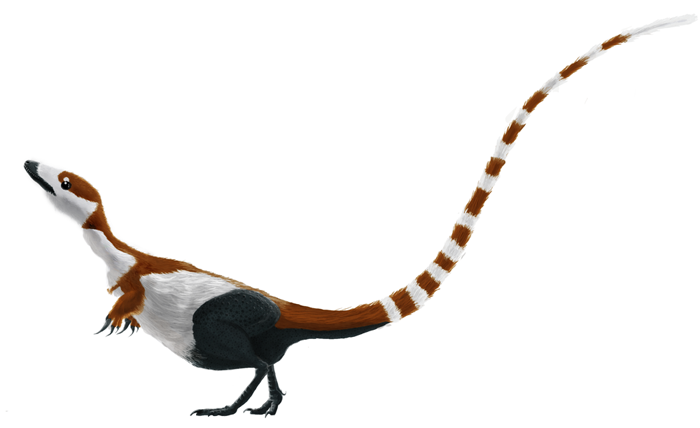
Did Sinosauropteryx Have "Protofeathers"?

Life restoration of the S. prima type specimen by M. Martyniuk
Over at Jaime Headden's blog The Bite Stuff, Jaime recently wrote a great article about the newly discovered basal coelurosaurian or orionidian Sciurumimus. The article touched on the fact that its feathers were reported as stage 1 (simple, unbranched filaments, often referred to as "protofeathers") in the parlance of feather development researcher Richard Prum. In the comments, Heinrich Mallison pointed out that they *look* like stage 1, but as Foth showed, crushed feathers (even those of modern birds) often look much more primitive than they are due to taphonomic effects. (I've mentioned before in a few places that it's really unfortunate Foth's important paper seems to have been mostly ignored by others writing about fossil feather types). Jaime defended this by saying that Sinosauropteryx, which is more derived, also is 'generally agreed' to have had stage 1 feathers. It's true that this is the general agreement in the literature, and it's also true that the general agreement has been challenged (effectively, in my opinion). I posted a reply to the article, but the fact that this keeps coming up lately has made me think that maybe I should be trying to publicize this more widely, so my comment is reproduced below along with some more commentary on the issue.

Friday, August 10, 2012

The Strange Bird Dalianraptor cuhe

Type specimen of D. cuhe, originally posted by Andrea Cau
I'm interrupting my regularly scheduled upcoming blog posts to bring some attention to a little-known Jehol bird: the strange 'jeholornithid'-grade species Dalianraptor cuhe.

D. cuhe has spent the last several years as a species in obscurity, even among most paleontology enthusiasts. I recall my first glimpse of the type specimen, wondering over the seemingly-complete remains of an "undescribed possible dromaeosauird" in a low-res photo posted online in the early '00s. I can remember saving the image to my reference folder, hoping that one day I'd be able to update the file name. It's a fascinating animal, but... is it real?

Wednesday, August 1, 2012

The Tail of Shanweiniao


Fossil tail feathers of S. cooperorum, from O'Connor et al., 2009.
As a follow-up to last month's post on the smallest Mesozoic theropods, here are a few additional observations on the small longipterygid Shanweiniao. Like other longirostravisines*, Shanweiniao cooperorum had reduced "hands" entirely lacking claws. This reduction of wing claws seems to have occurred independently of modern birds within this uniquely specialized group of enantiornitheans. (Euornitheans seem to have lost the bulk of their wing claws around the level of Carinatae, though many modern birds still retain at least keratinous claws on their wings, and longirostravisines may have as well).

S. cooperorum itself is most well-known for its elaborate tail made up of six ribbon-like feathers. Those feathers overlapped at the base, and may have acted as an air brake for precise landings with the feet on small branches. It's possible that most other enantiornitheans, which lacked long feathery tails and also retained wing claws, landed by simply smacking clumsily into tree trunks or brush and grabbing on with all four limbs.