Showing posts with label criticism. Show all posts

Sunday, April 30, 2017

Review: Dino-Riders Struthiomimus by TycOMG IT HAS FEATHERS


Quick Facts
1988 Dino-Riders Struthiomimus action figure WITH FEATHERS. IN 1988.
Size: 20cm of feathered glory.
Scale: Scales on the feet, feathers up top. Also, 1:12.
Sculpted by: The wokest of all 1980s dinosaur toy sculptors.
Produced by: Tyco (obviously with a lot of help from Bob Bakker).

No need to adjust your TV sets folks, this is a mass-produced dinosaur toy made in 1988 that is covered in feathers. Not like lame, Primal Carnage, Jurassic Park 3, cool-guy dragon with a mohawk. Natural looking feathers.

This is why Dino-Riders was the best thing about the '80s (sorry, He-Man). Dino-Riders gave us aliens from the future riding armored mind-controlled dinosaurs blasting a thousand lasers at other armored dinosaurs who were not mind controlled but who were just in it because they cared about justice, and the toy versions of these things looked more naturalistic and scientifically accurate (for the time) than anything in Jurassic World.


I'm going to use this particular review to drop some history.

Wednesday, April 12, 2017

You're Doing It Wrong: Pteranodon Bills

Your bill's looking a little puny, there, buddy.
(Painting by Heinrich Harder, 1912, public domain).
Everybody knows Pteranodon. Quick, stop to imagine it! It's easy, because it's the most often-illustrated and well known pterosaur to the general public (though today's marketing departments often call it a pterodactyl, following it's original, century-out-of-date classification).

But hold on. That image you have in your head right now, of a big pterosaur with a long crest and a mid-length pointy beak? That's likely wrong, and may be just as much a hybrid as those Flintstones-style creatures with pteranodont crests and Rhamphorhynchus tails.

How do we know? Let's talk about Dawndraco.

Wednesday, April 5, 2017

Review: Dino-Riders Pterodactyl by Tyco

Quick Facts
1987 Dino-Riders Pterodactyl action figure
Size: 20cm (wingspan)
Scale: 1:3 or 1:4
Sculpted by: unknown
Produced by: Tyco

Pterodactylus antiquus has a special place in history as one of the first ever prehistoric reptiles to be subjected to scientific study. It's one of the best known pterosaurs, with many complete specimens known to science, and it ended up lending its name to the entire group of pterosaurs to which it belongs (Pterodactyloidea). In fact, "pterodactyl" has become a common nickname for all pterosaurs, thanks in part to the fact that nearly all pterosaurs were considered species of Pterodactylus during the 19th century.

Despite the importance of pterodactyls, very few toy versions of them have been produced (in fact I don't know of any other than this one and one made by Starlux - if you know of more, let me know in the comments!). Sure, there are lots and lots (and LOTS) of toys out there claiming to be "pterodactyls", but the vast majority of these are actually other species of pterosaur, most often Pteranodon. A lot of older "pterodactyl" toys from the 1950s - 1980s are weird hybrids of the Pterosaurs' Greatest Hits, like pteranodonts with teeth, or with Rhamphorhynchus tails. But almost none of them are the classic, the original, the one and only pterodactyl. That's probably not a coincidence or a mistake - like the "velociraptors" in Jurassic Park that were really Deinonychus, pterodactyls have a cool name attached to a somewhat wimpy animal. Most pterodactyl fossils are tiny, with wingspans of only a few feet. Larger specimens do exist, but these skin-winged critters don't seem to have grown any bigger than a large seagull. Personally, I think that's part of their charm - I can't help but picture flocks of them squabbling over dead squids any time I watch gulls at the beach. But in terms of raw awesomeness, they certainly can't compete with 20 foot beasts like Pteranodon.

One of the very few pterodactyl toys that's actually a REAL pterodactyl is this one from Tyco. Produced in 1987 and released in 1988 at part of the Dino-Riders line, this pterodactyl came with a 2" action figure and a little hang glider accessory, but I won't be worrying about those here. Despite it's age, this is still one of my favorite pterosaur toys and holds up reasonably well even today. Let's get into some details...

Saturday, May 28, 2016

You're Doing It Wrong: Microraptor Tails and Mini-Wings

Type specimen of Zhenyuanlong, doing its best Archaeopteryx impression.
Just a short PSA today, and once again, it's about a paleoart meme that has outstayed its welcome.

Microraptor was the first time we got a good look at the feather pattern of dromaeosaurids. This is a big problem for two reasons. One, microraptors were small. That means that artists who were looking at them to extrapolate for bigger, more famous "raptors" could easily and somewhat justifiably write off their huge wings as a product of their size. Sure, we thought, microraptors had big wings, but they're tiny animals. Surely the bigger, more terrestrial dromaeosaurids didn't need such big wings. They probably still had wings, but they'd be smaller. Why would Velociraptor need such proportionately huge wings if it couldn't fly or glide?

Meme number two: that tail. I admit to being one of the first to go overboard when I fell, head over heels, for the "puff tailed dromeosaur" fossil (now the holotype of Cryptovolans, a synonym or close relative of the Microraptor) back around 2000. This was the first evidence we had of the tail feather style in dromeosaurids (or evidence that they even had remixes and rectrices at all. Remember When Dinosaurs Ruled America? That was plausible at the time it was being made). Naturally, having Microraptor plus Caudipteryx showed that the ancestral condition of pennaraptorans was a fan of feathers at the tip of the tail, not a fuzzy Sinosauropteryx like tail or a fully-vaned Archaeopteryx like tail. So artists ever since have been drawing dromeosaurids and troodontids and oviraptorosaurs with microraptor tails.

But that turned out to be wrong! It's an accident of history. We're now learning that Microraptor and Caudipteryx are weirdos.

Saturday, October 11, 2014

You're Doing It Wrong: Protobird Toys Edition

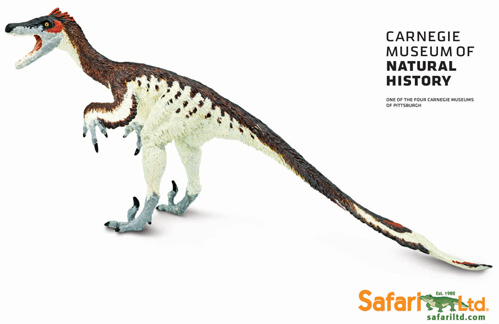
The new Carnegie Velociraptor figure.
I'm pretty slack when it comes to keeping up with my Twitter account, but if one thing can get me to break my one post per month general rule, it's "somebody is wrong on the Internet!" Or, in this case, "somebody made an inaccurate dinosaur model under the auspices of museum-approved accuracy!"

Let me preface this post with a few disclaimers. One, I have no problem with people making dinosaur art however they like. But I feel it's very important to draw a distinction between dinosaur art in general and paleoart. Creating a drawing, painting, or sculpture under the guise of paleoart implies that some degree of research went into the piece. When evaluating paleoart, critics are completely entitled to demand as rigorous an approach to accuracy as the evidence allows. Of course, speculation must be included to some degree, but the baseline expectation is always that basic facts and plausible inference will be taken into consideration.

Dinosaur art is a for of pop art, a purely artistic expression. Paleoart is a representation of a scientific hypothesis about the life appearance and behavior of an extinct organism.

This recent Twitter kerfuffle was due specifically to the debut of a new dinosaur figure in the Carnegie Collection produced by Safari Ltd. I've been a big fan of the Carnegie figures (and the sometimes nicer quality Wild Safari sister series) since I was a wee lad buying my first Carnegie Pteranodon in a little hobby shop for about $2, and pining over their massive Brachiosaurus. Carnegie figures have obvious appeal for scientifically-minded young dinosaur fans. First, most of them are made with a consistent scale (usually 1:40), so when you line them all up you can see how big each animal was compared to one another. Second, they are marketed as having the highest level of scientific authority: the Carnegie Museum stamp and assurances that hey are approved by actual paleontologists gives them the weight of authority and accuracy not found in many other toy lines. Sure, many of the older figures, including my Pteranodon, are now sorely out of date, but this is due largely to the Science Marches On effect rather than a basic, original inaccuracy.

However, like many paleoartists, the sculptors at Carnegie and related accuracy-minded/marketed toy lines seem to be having, well, let's say a little trouble adapting to the feathered revolution. Trained in the '80s and '90s drawing and sculpting Paulian, reptilian dinosaurs, it's been a steep learning curve for many of these artists to switch to bird-like, feathered dinosaurs, which many artists don't even realize requires a crash course in avian anatomy, rather than reptile or mammal anatomy, to get right. This is why expert consultants are so important in these projects--artists simply need help catching up with the latest research. Unfortunately, they're usually getting bad advice from "experts" who simply do not care.

The newest entry in the Carnegie Collection is the old favorite Velociraptor. Carnegie had previously released a scaly Velociraptor, but like many of their other models, they have commendably updated it to try and reflect current science. Unfortunately, it seems they mainly achieved this by slapping feathers over the basic original model with no regard for the fact that feathers inherently change the entire presentation and outline of an animal. Unlike fur or "protofeathers", which just fluff up the outline of an animal, feathers are more like a mobile exoskeleton that re-defines the entire body.

My own hypothesis, based on fossil and phylogenetic evidence as well as
inference from living analogues, about the life appearance of Velociraptor.
That being said, the Carnegie Velociraptor is not that bad overall and is very nicely sculpted, with an interesting and plausible color scheme. The feathers look fur-like, true, but this is not unprecedented among different lineages of large ground birds, and so is not unlikely in flightless protobirds (though they'd probably still be longer). The main problem here is the wing. Yes, wing. Like chickens and ostriches, protobirds possessed fully-fledged wings despite being flightless or nearly so, and retaining large claws on the fingers (yes, chickens, ostriches, and many other birds have hand claws--they are not some prehistoric protobird relic!).

Specifically, the wings in the new Velociraptor figure are very small, with short feathers, and are present only on the forearm, not the hand, making them only half a wing--literally, since they're issuing the primary feathers. We do not have direct evidence of primaries, but we have never found a single example of a maniraptoran that has secondaries but not primaries, and so it should be assumed they were there by default. As for secondaries, we have direct evidence in the form of quill knobs for this species. Quill knobs are not found in all feathered animals, let alone all flying birds, and seem to be associated with strong attachment either due to high-stresses during flight or other flapping behavior and/or especially large/long individual feathers.

Long story short: Not only did Velociraptor have wings, it probably had larger wings than many other dromaeosaurids. AFAIK not even Microraptor and Archaeopteryx had quill knobs to support their wings.

The new Carnegie figure, on the other hand, barely has wings at all. What went wrong?

Some insight can be gained by a recent series of incidents involving sculptor Dan LoRusso on the message board of the Dinosaur Toy Blog. LoRusso Is an amazing artist and is responsible for some of my all-time favorite dinosaur figures released in the Boston Museum of Science Collection by Battat (now being re-released with updates and new figures under the Terra brand). Collectors were understandably excited about the fact that the Battat series was coming back after nearly two decades, though the excitement was dampened a little by some obvious accuracy issues in the new figures, specifically when it came to the feathered species (or species that should have been feathered).

LoRusso was criticized online for producing a very well done but very inaccurate therizinosaur figure which completely lacked feathers. It would have fit right in with the excellent quality and Paulian style of the original series... back in 1994. But in 2014, when we have incontrovertible proof that therizinosaurs were not only feathered but that at least smaller species were very densely feathered, it is simply bizarre to see a featherless figure in a line that is being marketed as scientifically accurate. LoRusso stated that his consultants told him larger therizinosaurs would have been featherless. It's not LoRusso's fault that he somehow was able to sculpt a bald maniraptoran in the year 2013. Somebody who did not know what they were talking about and claiming to be an expert in paleoart just because they work in the related field of paleontology told him to do it, and he very reasonably believed them because they were an "expert", though obviously they had misrepresented themselves.

And there's the biggest problem and probably the answer to the question of what is going on with these strange and obvious inaccuracies. Paleoart consultants for major projects tend to be, often but not always, simply terrible. They seem not to know what they are talking about. Not only that, but second-hand reports suggest that they often simply do not care. Seriously: When asked about blatant inaccuracies creeping into paleoart-based projects like toys or books or even press releases, at least one anonymous paid paleontological consultant stated that they don't care what dinosaurs looked like in life, and so would presumably rubber-stamp any abomination that came across their desk.
Here's a prime, objective example: The Carnegie Collection Caudipteryx zoui figure. This species was first found in 1998, a complete skeleton with feather impressions. There are plenty of photos of Caudipteryx fossils that show crystal clear how the feathers attach and were ignored completely for this figure. The artist might have copied some inaccurate depiction rather than doing actual research or glancing at a fossil, and the consultant approved it because they didn't know or didn't care about the relevant details. The Carnegie Caudipteryx proves that consultants are utterly useless and often have no clue what they're talking about. Any one of us can compare the model with the fossil and show that the model is objectively wrong in major details. Look for yourself:

Caudipteryx wing fossil: note the primaries, longer than the hand, anchored along the second finger,
and lack of a clawed third finger.


Carnegie Collection Caudipteryx figure. Note the wing feathers anchored everywhere along the arm
EXCEPT on the second finger where they belong, and the incorrect number of fingers.
The wings/arms of this figure are wrong in just about every single way possible, and these are not minor details. Yet it's marketed as accurate and "paleontologist approved" in a series bearing the name of a major scientific institution!

It's not fair to ask all working paleontologists to know or care how their research into fossils translates into life appearance. Matching osteological and behavioral correlates with the structure and anatomy of living analogues could almost be considered a distinct field separate from actual paleontology. This is something paleoartists can and do think about and research constantly, but would almost never need to enter into the research when describing fossils. There's really no reason for working paleontologists to keep up to date with developments and research that go into paleoart.

The solution? Don't ask these paleontologists to consult! Just because someone is a paleontologist does not make them an expert on the life appearance of any given species of prehistoric organism. The examples cited above were, allegedly, all approved by "expert" consultants. This simply proves the consultants that are being employed are utterly failing at their job. I hate to say it, but there are legions of paleoartists and other dinosaur fans online who jump at the chance to criticize and nitpick and otherwise consult on these things for free. It's just that by the time the product is released, it's too late to do anything about inaccuracies. If companies that use paleoart would simply post concept art beforehand on, say, Facebook, they could probably get much better advice for free. Or, preferably, they could employ actual paleoartists as experts, hopefully artists who specialize in researching the life appearance of a given subject group of organisms.

Darren Naish, Mark Witton, and John Conway recently published an article on the (shameful) state of  paleoart as used in professional and commercial contexts. Companies like Safari Ltd. would do well to listen to their advice.

Wednesday, July 16, 2014

People Think Feathered Dinosaurs Don't Look Scary. They're Right.

This short article on io9 pretty well encapsulates an area of frustration for artists and scientists in the age of feathered theropods.
Ooh, I'm shakin' in my boots.
Photo by Simon Rumble, licensed.
The implication is, right from the title, that it's common knowledge most depictions of feathered T. rex are not cool. Feathered theropods are widely derided by the public because feathers make these scary reptilian monsters less scary. In a recent Facebook discussion, I took one of those "short pelt raptor" images to task for inaccuracy (you know, the kind that pays lip service to the idea of feathered theropods, but with the minimum possible change to the classic silhouette, with a cat-like short pelt rather than a bird-like poof of feathers engulfing the body). In my reply I kind of hypothesized that there's an evolutionary psychology* reason for our aversion to feathered theropods and our cat-like concessions to the idea.

As Andrea Cau has pointed out, paleoartists (myself included), consciously or not, often employ all kinds of subtle tricks to make feathered theropods look "cool". Leaving the face scaly and reptilian is a popular trick; his body might say "Big Bird", but his face tells you he means business. Face fully feathered? Introduce an eagle-like lowered "brow" or some kind of eyebrow analogue so his facial expression can look "mean". Make sure his mouth is open or he's prominently displaying his other weapons in a ninja-like fighting stance. And be sure if you make him colorful, use high contrast, red and black if possible, and light it so his face is in shadow--that way you know he's thinking evil thoughts. This might also allow you to add eye shine making the eyes look like demonic embers! (check back to the io9 article and see how many of these points that T. rex hits).


In the comments to the io9 article, there were the predictable bouts of resistance to the idea that T. rex could have had feathers at all. "It was too large! Large mammals don't have so much fur in hot climates!" The problem with comparisons to large mammals is that feathers are very different in structure from fur, and have very different insulating properties. Fur is mainly used to keep an animal warm, but thanks to the fact that feathers grown in adjustable, planar layers, and are better at trapping and regulating air flow, many large birds use their feathers to very effectively keep themselves cool by circulation while blocking the skin from absorbing direct sun. It may actually have been disadvantageous for a large animal to lose its feathers, especially if it lived in a hot sunny climate. The fully-feathered Yutyrannus was not significantly smaller than any but the largest T. rex. Most T. rex specimens fell short of the 6.8 tons estimated for the most gargantuan known adults like Sue, that is certainly not the species average size!


But, there was one comment that played right into my ego-psych hypothesis. The commenter basically stated that we know juvenile T. rex had feathers, but there's no reason to think adults kept them. Except even that premise is wrong. 
There is in fact zero direct evidence to support the hypothesis that T. rex juveniles had feathers, let alone that they had them and then lost them. It's simply easier for people to assume that a baby animal, which is supposed to be cute, had feathers, which we psychologically associate with cute animals. 

Are one of these things is not as scary as the other?
Illustrations by M. Martyniuk, all rights reserved.

It is actually less of a stretch (i.e. more parsimonious) to hypothesize that based on its phylogenetic bracket, T. rex had feathers and retained them throughout its life, than the hypothesis that T. rex was born with feathers, lost them because they became disadvantageous at some unspecified weight, then through some unknown developmental pathway replaced its feathers with the kind of thick, scaly skin it is usually depicted with and would need to protect itself from the sun/injury if it lacked feathers. But this convoluted thinking is easier for people to accept because T. rex is the king of all monsters, and monsters are by definition not cute.**

The sad fact is, T. rex may not have looked all that cool. I think John Conway and others have brought this up before. It, and many if not most other dinosaurs, may very well have looked really, really stupid to us. Nature doesn't care if an animal looks intimidating to a species that evolved 66 million years later in a completely different environmental context alongside a vastly different set of predators. Our brains are programmed to find mammalian and reptilian predators scary at least in part* because we evolved alongside these and our survival depended on it. We had no such pressure for most kinds of birds***, and maybe coincidentally, we find very few kinds of birds the least bit intimidating. We have to be told/shown that a cassowary is even capable of being dangerous, and people still constantly trot this out as a surprising fact, despite the fact that it has very few physical differences from a Velociraptor, other than being much larger! 


So, if your average Joe met a non-avialan theropod in real life, the reaction might be less like any of the raptor scenes in the original Jurassic Park and more like Newman vs. the cute, colorful, silly, hopping (read: bird-like) dilophosaur - bemusement leading to injury.

* I know evo psych is mostly made up of untestable just-so-storys. But it's still fun to think about.


** That's sarcasm. Tyrannosaurs were not monsters, they were plain old regular animals. A lesson people forget from the original Jurassic Park (probably because they're not actually depicted hat way in the movie, despite the fact that the characters talk about it).


***Raptors seem to be the exception. Probably because they preyed on early humans, and maybe also because of their mean-looking "eyebrows"?


Sunday, May 18, 2014

Review: Papo Archaeopteryx


Like many paleontology fans, I have a pretty big collection of little plastic dinosaur toys. Most of these I got when I was a kid and have held onto since, but every so often a nice looking model is released that is too cool to pass up. This new Archaeopteryx figurine from Papo was one of them.

Sunday, September 8, 2013

Iridescence in Simple Feathers - The Case of the Blue Troodon

Iridescent feathers in troodontids - possible? Image by Matt Martyniuk, all rights reserved.
(Supreme dino fans may recognize the pose even from this small clip...)
I've written a lot about the various ways feathers get their color in order to create some rough guidelines for paleoartists restoring feathered stem-birds. I recently had a quick discussion over at DeviantArt with one of the best currently-working paleoartists around, Emily Willoughby, over the plausibility of a blue Troodon. Note that it has a few other anatomical issues that make it somewhat less than a fully accurate rendition, but is the coloration one of them? I wasn't sure, so I did a little extra digging to find out. As usual, this research is cursory and I welcome any additional input on research or details I may have overlooked.

Sunday, September 1, 2013

You're Doing It Wrong : Dino Foot Scales

Above: Our subject matter.
It's often said by those who support a strict phylogenetics-based system of naming life that it's only by restricting well-known names from neontology (the study of modern organisms) to crown groups can we avoid making unjustified assumptions about members of stem-groups.

These kinds of unjustified assumptions have been rampant in the history of studying stem-birds. Archaeopteryx has traditionally been depicted, incorrectly, with a reversed hallux, and occasionally even with beak-like structures, simply because it's a "bird", and those are features all birds have. Except Archaeopteryx is not a true "bird", it's a stem-bird, more closely related to birds than to any other living animal group, but not a member of the group that includes all modern birds. It's fair to assume that an extinct member of the duck lineage, like Vegavis, had a bill, but that's not necessarily so for, say, Patagopteryx, despite the fact that it is usually referred to as a "bird".

Modern bird feet, by Philip Henry Gosse, 1849, public domain. Note overlapping scutes on
the top surfaces, and pebbly, polygonal reticulae on the bottom surfaces.

Most paleoartists have absorbed these kinds of warnings, and do a good job of avoiding obvious errors based on typology, the assumption that all species in a certain "type" share "key characteristics." But there are some typological memes in the bird lineage that are more pernicious, possibly because their actual evolution is something most artists don't think about very much.

Take, for example, the bird-like scutes that are almost universally illustrated covering the tarsus (upper foot/lower hind limb) of dinosaurs. Is there any evidence that these were actually present in any given group of non-theropod stem birds? Well... no. Not that I'm aware of (if you know differently, please comment!).

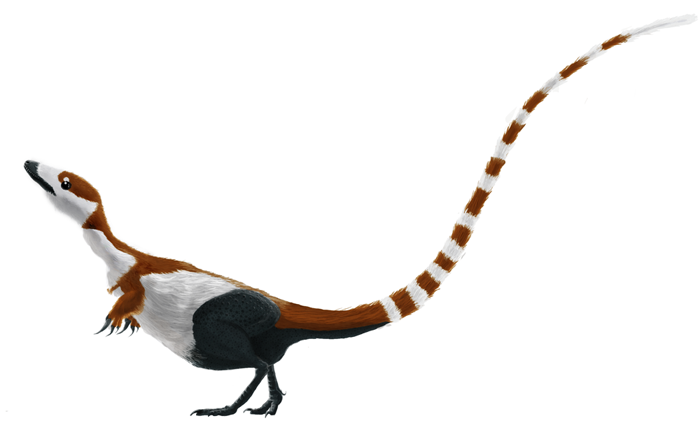
Sinosauropteryx prima with tarsal scutes.
Image by Matt Martyniuk,  licensed.
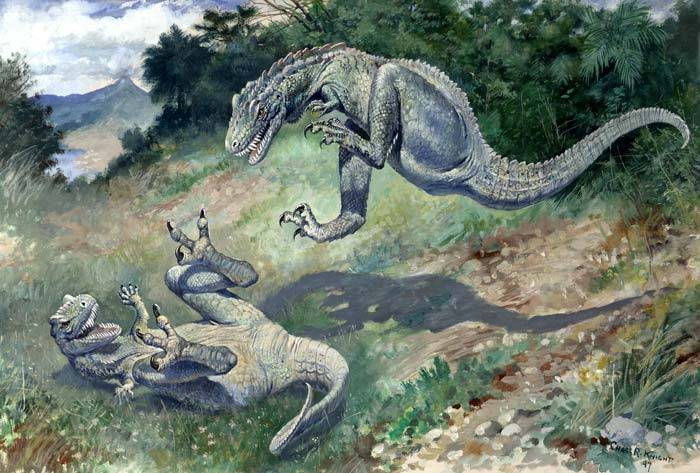
I'm not sure when this meme began, and if it's related to the Dinosaur Renaissance when the link between birds and dinosaurs was re-established. Looking at some Charles Knight paintings, such as his famous "Leaping Lealaps", it appears that the feet of his theropods were scaled based on modern lizards (more on the differences between lizard scales and other types of "scales" below). Bakker's influential early restoration of Deinonychus does not include any obvious scutes on the feet or tarsus. Mark Hallet, on the other hand, did include what look like oblong bird-like scutes on his theropods. At any rate, it's hard to deny that "bird feet" are typical of almost all modern reconstructions of dinosaurs, including my own, and are not limited to theropods. Bird-feet are often restored on ornithischians and even pterosaurs.

Of course, like many paleo-memes that developed during the 1980s, the main idea seems to be using this as a flourish to make otherwise scaly dinosaurs seem more bird-like. And thanks to skin impressions, we know that many dinosaurs had scales, right?

Tuesday, June 4, 2013

You're Doing It Wrong: CGI Feathered Dinosaurs

YIKES.
Promotional still from When Dinosaur Roamed America,
Discovery Channel 2001
CGI dinosaurs have come a long way since Jurassic Park. Unfortunately, due to the discovery that these animals were far more bird-like than reptile-like, that direction is straight down a seemingly bottomless pit. For many CGI artists and animators, the key concept that is presenting a very steep learning curve is the idea that these animals need to be restored as feathered dinosaurs, not "dinosaurs with feathers." It looks like many people modeling feathered dinosaurs start out by rendering a featherless dinosaur and then using various modeling or rendering tricks to add the feathers. As you'll see below, this never, ever works.

Saturday, May 11, 2013

The Validity of Lambeosaurus - Anybody Know A Good Lawyer?

Reconstruction of Didanodon altidens specimen ROM 794 (aka Lambeosaurus lambei,
aka Procheneosaurus praeceps) by Matt Martyniuk, all rights reserved.
I've talked a lot on this blog about my personal justifications for using "old fashioned" names for many groups or species of stem-birds. In many cases, names which were in common use during the 19th and early 20th centuries were replaced later by one or two influential scientists for reasons which don't really hold up when you look at the codes that govern naming in biology. For example, Manospondylus gigas may currently be the correct name for the theropod we know and love as Tyrannosaurus rex, but this possibility has almost never been discussed because everybody assumes it's a nomen oblitum - a name out of use for so long that it becomes automatically invalid under the International Code of Zoological Nomenclature (ICZN). Note the word "assume"--as I've written before, most people, even working scientists, don't really know what criteria must be met to classify a name as obsolete.

The name of one very well-known dinosaur is in such a sorry state that it's like the Manosponylus / Tyrannosaurus debacle squared. The genus Lambeosaurus, a well-known hadrosaurid with a distinctive squared-off crest with a backward-pointed prong, was named twice prior getting its popular moniker, and neither of those names can be considered obsolete, since they were both coined during the 20th century.

The first name given to fossil material (in this case a jaw) now universally attributed to Lambeosaurus was Didanodon. In a 2006 review of hadrosaurs, Lund and Gates stated (without discussion) that the genus and its type species, Didanodon altidens, were nomina nuda, or "naked names" lacking the proper description necessary to establish them. But is this really the case?

Friday, March 29, 2013

Who Cares About "Dinosaurs"?

Question: Who cares about dinosaurs?

Short Answer: Marketing departments and monster movie fans.

Above: Not what most people think of when you say "dinosaur."
(Ashdown Maniraptoran by Matt Martyniuk, all rights reserved).

Long Answer:
This is a philosophical issue that's been on my mind for a while now, inspired by some recent and heated debates over the content of the Dinosaur article at Wikipedia. It also seems to be simmering in the background of a lot of discussions about the recent suggestion that Jurassic Park 4 will not feature modern, scientifically accurate dinosaurians.

Saturday, August 11, 2012

Did Sinosauropteryx Have "Protofeathers"?

Life restoration of the S. prima type specimen by M. Martyniuk
Over at Jaime Headden's blog The Bite Stuff, Jaime recently wrote a great article about the newly discovered basal coelurosaurian or orionidian Sciurumimus. The article touched on the fact that its feathers were reported as stage 1 (simple, unbranched filaments, often referred to as "protofeathers") in the parlance of feather development researcher Richard Prum. In the comments, Heinrich Mallison pointed out that they *look* like stage 1, but as Foth showed, crushed feathers (even those of modern birds) often look much more primitive than they are due to taphonomic effects. (I've mentioned before in a few places that it's really unfortunate Foth's important paper seems to have been mostly ignored by others writing about fossil feather types). Jaime defended this by saying that Sinosauropteryx, which is more derived, also is 'generally agreed' to have had stage 1 feathers. It's true that this is the general agreement in the literature, and it's also true that the general agreement has been challenged (effectively, in my opinion). I posted a reply to the article, but the fact that this keeps coming up lately has made me think that maybe I should be trying to publicize this more widely, so my comment is reproduced below along with some more commentary on the issue.

Wednesday, July 25, 2012

Wrong for the Right Reasons

Outdated restoration of a Protoceratops andrewsi nesting
ground. Painting by Charles R. Knight, 1922.

Flipping through an old dinosaur book from the 1970s or early 1980s can be pretty fun. Nostalgia aside, it's great to see how far the science of paleontology has progressed in just a few decades, and also have a few laughs at the (from our modern perspective) outrageously outdated ideas and reconstructions we find. (David Orr's blog Love in the Time of Chasmosaurs has a great, long-running series covering "vintage dinosaur art" that lovingly pokes fun at some of the mistakes made by past palaeontographers.) Old dinosaur TV shows can be just as good. Last week, Mrs. M recorded a bunch of dinosaur shows for me which were airing on the Science Channel. I hadn't seen any of them before, and didn't realize until I hit play that I was in for a blast from the past. The shows were obviously old-school, narrated by Jeff Goldblum (I assumed these had come out around the time of The Lost World: Jurassic Park until one episode started discussing finds from later in the 1990s like Beipiaosaurus). One episode featured a segment on Roy Chapman Andrew's famous discovery of dinosaur eggs in the Gobi Desert, and the infamous misinterpretation of the eggs as belonging to Protoceratops rather than Oviraptor. This is just the kind of paleontological gaffe we paleo fans get schadenfreude out of today. After discussing the refuted hypothesis that an Oviraptor found on a nest of these eggs was first thought to be eating them rather than guarding them as later finds suggested, Mrs. M asked the obvious question: Why, given that this thing was found on top of the eggs, did they assume the eggs belonged to a different dinosaur?

Friday, November 11, 2011

"Behold the Tyrannosaurus and his rival, the Triceratops!" Scientific Grammar for the 21st Century

A gorilla is a type of primate. The gorilla is a primate. Gorilla is a primate. Gorilla gorilla is a primate. Hominidae is a group of primates. We use such oddly varying ways of talking about taxa. Image by Pierre Fidenci, licensed.

Recently, an illustration of an Allosaurus was selected as an upcoming picture of the day at Wikipedia. Before going live, the POTD folks asked the article editors to suggest improvements to the caption they had written (based on the text already in the Allosaurus article, which is a featured article at Wikipedia and thus thoroughly checked for errors). Here is the original caption written by the POTD editors:

"An artist's rendition of the gape of an Allosaurus species of dinosaur, based on the research of paleontologist Robert T. Bakker. Allosaurus was an active predator of large animals, and had the ability to open its jaws extremely wide. Studies suggest that it used its skull like a hatchet against prey, attacking open-mouthed, slashing flesh with its teeth, and tearing it away without splintering bones."

The obvious error there is that it describes Allosaurus as a "species of dinosaur" when it is in fact a genus. So, just change the first sentence to "An artist's rendition of the dinosaur genus Allosaurus" and it's fixed, right? Pretty much any science writer or paleontologist you talk to would say yes. The following was proposed as a correction:

"An artist's rendition of the dinosaur genus, Allosaurus, with it's jaws open fully, based on the research of paleontologist Robert T. Bakker. Allosaurus was an active predator of large animals, and probably had the ability to open its jaws extremely wide. Studies suggest that it used its skull like a hatchet against prey, attacking open-mouthed, slashing flesh with its teeth, and tearing it away without splintering bones."

But isn't there a problem with referring to a genus in the singular that way? Though many dinosaur genera are monotypic, a "genus" is still technically a group of animals, no different from a "family" or an "order." Let's re-write the same caption, but replace Allosaurus with Allosauridae:


"An artist's rendition of the dinosaur family, Allosauridae, with it's jaws open fully, based on the research of paleontologist Robert T. Bakker. Allosauridae was an active predator of large animals, and probably had the ability to open its jaws extremely wide. Studies suggest that it used its skull like a hatchet against prey, attacking open-mouthed, slashing flesh with its teeth, and tearing it away without splintering bones."

This caption obviously makes little grammatical sense, because we  intuitively recognize that the family Allosauridae is collective (despite the fact that, like the genus Allosaurus, it is usually thought to contain only one species). But the genus Allosaurus is also collective, and for that matter, the species Allosaurus fragillis is a collection of populations and individuals.

But these strange constructions are nearly universal in science writing, including (especially) formal science writing. In a way, this is a bit of an archaism. Think of the archaic-sounding phrasing in some old children's books, like "Tyrannosaurus: he was the king of the dinosaurs! His mortal enemy was Triceratops." Referring to an entire genus as a "he" ties into the anthropomorphic "roles" we assign dinosaurs ("Tyrannosaurus: he's a bad guy. Triceratops: he's a good guy). Mark Witton has previously written about this effect here. Similarly, referring to genera or even species in the singular places them in the same league as Godzilla: single, towering, fantastical monsters, rather than categories of normal animals.

Referring to an animal as "the this" or "the that" is a another archaism."The Tyrannosaurus was the dominant predator of his time." "The gorilla is the largest living primate." This is more correct than some of the other examples, but also strikes me as stodgy and archaic. Here's a quote from a 1985 paper: "The gorilla is more closely related to man than the chimpanzee is". Wouldn't "gorillas are more closely related to humans than chimpanzees are" seem more suited to the 21st (or even 20th) Century?

But Tyrannosaurus is not that animals' name. It's the name of that animals' genus, the group which contains it.That animal is "a" Tyrannosaurus, it is not the genus Tyrannosaurus itself. Alternately, it is "a tyrannosaur", but it is not simply "tyrannosaur." Using lowercase "common names" is one easy solution, but one that can create a different kind of confusion. Is a "tyrannosaur" a Tyrannosaurus or any tyrannosaurid? Is Daspletosaurus a genus of tyrannosaur? This isn't a perfect example because there's no group named "Tyrannosauria", at least not yet. But think of how we use "dinosaur" instead of "dinosaurian", when it could just as easily be referring to the genus Dinosaurus. One solution would be to use such common names the way we do for living animals: common name followed by clarification. "This is a picture of a tyrannosaur (Tyrannosaurus rex)." "That is a picture of a tyrannosaur (Daspletosaurus torosus)."

Here's my take on the example caption, using a more precise way of conveying the same ideas:

"An artist's rendition of an Allosaurus fragilis with it's jaws open fully, based on the research of paleontologist Robert T. Bakker. Allosaurus were active predators of large animals, and probably had the ability to open their jaws extremely wide. Studies suggest that they used their skulls like hatchets against prey, attacking open-mouthed, slashing flesh with their teeth, and tearing it away without splintering bones."

"An" Allosaurus fragilis: it is an image depicting a member of that species, not an image of the "species" itself. Allosaurus "were" active predators, pleural, because Allosaurus is a grouping of dinosaurs. In my opinion, these slight changes in phrasing give a much more naturalistic feel to the description. It's clear that we're talking about a type of animal in the real world, not enumerating the abilities of an individual Pokemon character.

Isn't it time we put some more thought into how we write about taxa? I think we should be trying to frame dinosaurs as parts of nature, not exceptions to it. Would it be helpful to change the way we talk about taxa, or is the existing method too entrenched and well-understood by those who will obviously know what you're talking about to bother?

Monday, October 10, 2011

Release the -- Nah. Forget It.


Above: Shonisaurus, favorite paintbrush of giant mythological cephalopods.

In a move that should surprise no one, media outlets have picked up and are running with possibly the stupidest, most blatantly ridiculous scientific "discovery" since the Cambrian mini-men.

Let's break this down. There is a bonebed consisting mainly of Shonisaurus vertebrae which are interpreted as having been deposited in deep water. In some odd twist of fate, the disarticulated vertebral columns of these elongate giant ichthyosaurs were (somehow!) fossilized in long rows. A reasonable person would look at this and think, "it's almost as if vertebrae are stacked in rows inside the body or something."

An unreasonable person, like paleontologist(?) Mark McMenamin, would look at this and think "A sentient giant squid arranged these vertebrae like that in order to create a self portrait of its tentacles!"

I'm sorry you had to subject your brain to that hypothesis.

How such a travesty of logic made it into the abstracts of the 2011 GSA Annual Meeting in Minneapolis, I don't know, but if the scientific publication process works at all, it will not make it through peer review in a real journal. But, of course, that won't stop the media from credulously reporting every word as "new science" because, hey, everybody likes a good "Release the Kraken!" headline.

Most disappointing is that even Science Daily, usually pretty good with the science reporting, ran this story without even a hint of skepticism. Not even a single quote from another scientist to say "um yeah, in case you didn't read what you just wrote, this is obvious BS." For shame.


Monday, August 29, 2011

All Aboard!

Readers of this blog will definitely be familiar with all the standard complaints about dinosaur documentaries these days. Even old classics like Walking With Dinosaurs were heavily criticized by paleontology enthusiasts at the time for being too heavy on drama and too light on science. As a paleoartist, I love shows that attempt to reconstruct prehistoric life in a natural way, and all the necessary speculation that entails. But people are justified in pointing out that this doesn't exactly do wonders for public understanding of science.

Sure, shows like WWD or even more sensationalist 'monster movie' type programs like Jurassic Fight Club create plenty of interest in paleontology and foster enthusiasm in young paleo fans, who can certainly be forgiven for being into the 'cool factor' and less into the hard science, which may well come with time. But these documentaries also blur the line between science, educated speculation, and pure fantasy. Use of talking head segments helps, but without weaving the science behind the entertainment into the body of the program, many people simply disregard it.

Worse, producers have a tendency to edit the token scientist sound bites in a way which fosters stereotypes of scientific authority - talking heads are shown explaining that "yes, what you just saw is true" rather than explaining how we know this stuff in the first place, which is where the actual science is. Science is a process, not a set of facts spouted off by guys sitting in labs. Most dinosaur documentaries pay lip service to science as an excuse to sell entertainment, plain and simple.

There is one very surprising exception: By far, the best dinosaur show produced in the last ten years in terms of actual science content is a cartoon aimed a preschoolers.

Produced by Craig Bartlett with the Jim Henson Company for PBS and first airing in 2009, Dinosaur Train has now clocked in 40 episodes over two seasons. The aim of the series is to present science to young children in a way that is accessible and entertaining, and in that DT succeeds where pretty much every other dinosaur TV show in the past has failed.

Each episode features two separate stories, all following the adventures of a Pteranodon family (included their adopted sibling, Buddy the T. rex, which is, based on the opening credits sequence, apparently the first recorded instance of nest parasitism in a non-avian theropod). The adventures consist of daily rides on the Dinosaur Train, a Doc Brown-esque vehicle which is capable of travelling to any time or place in the Mesozoic era (even under water in later episodes). Right off the bat, this provides ample opportunity to teach kids the basic (yet still occasionally missed or messed up in other media) idea that dinosaurs were often separated from each other by huge spans of time. I particularly liked the clever bit in one episode where the kids go to visit the one of the first dinosaurs, Eoraptor; reaching the end of the track somewhere in the Late Triassic, they have to get out and transfer to an old-style push-handle rail cart to go the rest of the way!

The geographic separation of different dinosaurs is also emphasized, and in another cute touch dinosaurs are often given accents based on their country of origin. This theme of, essentially, biostratigraphy was the subject of an entire episode in which the Pteranodons attend a block party with their immediate neighbors (the ones featured on the show in their home time, before getting on the train). The neighbors include a Styracosaurus, Lambeosaurus, Daspletosaurus, a Euoplocephalus and Hesperornis. Savvy readers will probably recognize this as the Dinosaur Park Formation fauna, and while Pteranodon itself is the only one out of place there by a few million years, it's impressive to see a kid show try to get this kind of detail right while teaching a more basic lesson (that every member of a community has a role or niche).

It's also funny to watch how the later plays out in the middle of an anthropomorphic, cartoon universe. On one hand, it's refreshing to the large theropods treated as characters who are friendly with the herbivores and not background monsters like in Disney's Dinosaur. On the other, this fact makes it even funnier/weirder in episodes that discuss the defensive tactics of some herbivores; for example, a group of stegosaurs have to group up and fend off a comically insane-acting, marauding allosaur. This kind of kid's-TV-paradox becomes even more acute in the episodes on marine fauna. I have to hand it to the producers for featuring such obscure critters as ancient fish and ammonites as characters, but it's also disconcerting in that almost every episode features the pteranodonts devouring heaps of these same fish! A bit like the Simpsons episode with Homer in an "Under the Sea" musical number gobbling down horrified anthropomorphic sea cucumbers? The producers do a good job keeping this kind of thing segregated, and I doubt the target audience would ever notice the inconsistency.

The best thing about the format of Dinosaur Train is that nearly every episode highlights and explains the scientific process in a really very deft and simple way that I think small children can understand, or at least in a way that gets them thinking scientifically at an early age. Buddy, the main T. rex character, is a very curious type who is always bugging the smart, train-conducting Troodon to answer questions his explorations raise. In case the show made it too charming and understandable to notice what's going on here, these are the first two steps of the scientific method--Buddy explores the word and forms questions based on what he sees. With the help of the conductor, the kids then do some research for background information on the topic, and then--get this--the kids explain to each other (and the audience) what a hypothesis is: "an idea you can test!"

I don't want to sound condescending, but I've met adult science enthusiasts who seemingly have not yet grasped how science really works. Many casual dinosaur fans seem to think they need to find an idea and defend it to the death. Dinosaur Train teaches children that they should think about the world around them, then ask questions. They should think of possible answers to their questions, and then try to prove themselves wrong! This is done so brilliantly it's almost sad to realize how easy it is to teach scientific thinking to people, most of whom have no idea what science is or how it operates, let alone to little kids.

My favorite example of the show's handling of the scientific process is in the episode where the kids travel to Jurassic Germany to visit an Archaeopteryx. The conductor explains to them that Archaeopteryx is the first bird, and Buddy develops an hypothesis: if she is a bird, he reasons, she can fly and lives in a nest, like other the birds he's seen in his own time period. The conductor knowingly encourages him to test his hypothesis by talking to the Archaeopteryx. To Buddy's surprise, despite the fact that she is a "bird", and has wings, she does not have a nest and can't fly! Instead, the Archaeopteryx demonstrates how she can use her wings to run up a tree (first instance of WAIR portrayed in a dinosaur show?) and then can glide down after insects. Buddy's hypothesis was disproved, but he learned some even more interesting things by testing it. If only this kind of message could somehow be applied to standard, "adult" dinosaur shows.


If the show itself doesn't amply demonstrate scientific concepts to children, each episode is followed by an epilogue featuring paleontologist Scott Sampson (who also has a blog, The Whirlpool of Life) explaining the main points again and giving some additional facts (some aspects of the show that rely heavily on anthropomorphism are sometimes hilariously shot down by a debbie-downer type stickler who pops out and says, for example, "Fact: Troodons did NOT play hockey!" followed by a chorus of disappointed kids).

To follow in the stickler's footsteps (would it be Dinogoss if I didn't?), I did see some missed opportunities in the premise of the show. It's impossible and silly to criticize a cartoon for accuracy ("Daffy Duck does NOT fold his wings correctly!"), but paleo fans will no doubt notice some glaring ones in the main cast. The Troodon are conspicuously lacking in feathers, and the Pteranodon appear to have bat-like wings (a condition not shared by other pteorsaurs in the show). This is a little baffling as the science consultants must have a very big hand in the production--most aspects of each episode, from colorful, feathered Velociraptor to Styracosaurus using their spikes for display rather than combat, are obviously based on the kind of up to the minute research only people active in the paleo community could provide.

I'm betting that the main cast were designed and set in place before the consultants effectively took over--some later episodes show that the conductor is feathered, his feathers are just under is hat. His catch-phrase is the rather belabored "Bless my scales and feathers!", probably modified at the behest of Sampson or another consultant taken aback by a Troodon, of all species, exclaiming "Bless my scales!" The family life of the pteranodonts rings false not for blatant inaccuracy, but for the fact that it's just the kind of interesting facts the bulk of the episodes would fall over themselves to include--the sexual dimorphism that could have been present between mom and dad, the fact that the eggs were likely buried rather than laid in a bird-like nest, etc. But none of this really takes away from the core value of the show as a tool for teaching science.

For paleo fans, there seem to be some 'inside joke' type moments as well. Buddy was elated in one episode to be inducted into the "Theropod Club" . The club basically consists of a bunch of theropods getting together and patting themselves on the back for being by far the coolest dinosaurs - to the consternation of his friends. Nick Gardner could sympathize! Even here, though, the educational message is clear; it not only teaches kids what a theropod is, but often makes a point to explain why birds are also considered to be members. Buddy, apparently a budding comparative anatomist, is also prone to getting really excited over "comparing features", to the point that in at least one episode, when the kids were suggesting games to play during a long train ride, his suggestion to compare features with other dino passengers was met with groans and eye-rolls (maybe the pterosaur kids are more in the geological school--they do like to collect rocks, and at least one entire episode has been dedicated to geology rather than dinosaurs themselves).

At any rate, this is in my opinion the best science show made for young kids, at least those still too young for Bill Nye, and I'd encourage any dinosaur fans to check it out. Despite the target age range, it's fun to see how the new discoveries we follow on a day to day basis are being communicated effectively to the next generation.

Monday, May 2, 2011

I'm Doing It Wrong: More on _Hesperornis_


Following the last post on beak anatomy in toothed birds like Hesperornis regalis, I have been coming across some confusion online about another aspect of this ancient diving bird's anatomy. This factoid shows up in a lot of sources (including the official web site for a certain CGI-based TV show) but never, it seems, with a solid reference. I have been trying to dig into this issue myself and am finding out some interesting new info on the anatomy of this bird, to the point that one of my in-progress drawings had to be halted and revised. More on this in an upcoming post, but for now, see if you can figure out what's wrong with this picture:

Wednesday, January 26, 2011

Scientific Anachronism and why Biostratigraphy Matters


Image: Stegosaurus confronts Tyrannosaurus, from Walt Disney's Fantasia. Such anachronistic views of paleontology could never form the basis of peer-reviewed literature, could they?

A new study (Carbone, Turvey &Bielby, 2011) suggests T. rex could not have been a pure scavenger.

Yeah, I know. This is already the universally accepted position of modern paleontologists. Of course T. rex scavenged if it could, but there is ample reason to think (and ample fossil support backing this up) that it hunted as well. Even the originator of the scavenging thoery, Jack Horner, has basically admitted that he only came up with it as a way to get young people to think critically about their own preconceptions (obviously, he has never met any young paleontology fans. I'd have given up that strategy after I witnessed my first T. rex vs. Spinosaurus debate).

However, as Denver Fowler pointed out on the DML today, drawing an obvious conclusion is the least of the paper's problems.

I recently participated in at least two paleoart discussion threads in which really awesome artists showed off some mind-blowingly fantastic paintings depicting the Jehol biota. I know first hand that both artists are completely on the ball and know their stuff. But both made common errors in the often neglected field of biostratigraphy.

In one, a Sinornithosaurus watches as two Microraptor glide down from the trees. These are two similar animals from around the same time and place. However, there is no evidence that they ever met. All known fossils of Microraptor come from the Jiufotang formation, dated to 120 million years ago, plus or minus 700k years. The youngest Sinornithosaurus fossils are from the upper Yixian formation, dated to around 122 million years ago. The timespan and environment are grossly similar, but 2 million years is still a long time in a world where most dinosaur species, if not genera, don't span more than a couple million years (and the ones that do are probably egregiously over-lumped, like Iguanodon).

Another painting portrayed a Yixian formation scene with Yixian ornithopods and Yixian insects being fed on by Jeholopterus, a pterosaur which lived in the Daohugou biota, in beds dating to at least 150 million years ago, a full 25 million years before the Yixian faunas existed. The error here was probably based on a confused history of dating the formations (old sources placed the Yixian in the late Jurassic), and many sources, both professional and popular, which tended to conflate the various Chinese feather-preserving formations into one amorphous pseudo-fauna.

Artistic depictions throwing together prehistoric animals from disparate times are obviously nothing new. Walt Disney Pictures has done this at least twice, first and most famously in Fantasia (Stegosaurus meets T. rex meets Pteranodon), and later and more flagrantly in Dinosaur (I can't think of any two animals in that movie that were actually contemporaries, and many didn't even live together on the same continent).

This is somewhat excusable when it's done for the sake of art (as long as that art isn't passed off as being scientifically rigorous). But this kind of disregard for, or generalization of, biostratigraphy can creep into science and completely foul up your results.

In Carbone et al. 2011, the authors attempt to calculate the amount of potential carcasses that would have been available to scavenging Tyrannosaurus rex in its environment to make their case. Their lists of T. rex contemporaries are reproduced in part below:

Species and body masses of carnivorous non-avian theropod dinosaurs of Late Cretaceous North America
Dromaeosaurus albertensis
Richardoestesia gilmorei
Richardoestesia isosceles
Saurornitholestes
Velociraptor sp.
Troodon formosus
Chirostenotes elegans
Chirostenotes pergracilis
Nanotyrannus lancensis
Albertosaurus sarcophagus
Tyrannosaurus rex

Species and body masses of herbivorous dinosaurs of Late Cretaceous North America
Parksosaurus warreni
Prenocephale edmontonensis
Ornithomimus velox
Struthiomimus sp.
Thescelosaurus garbanii
Thescelosaurus neglectus
Leptoceratops gracilis
Montanoceratops sp.
Pachycephalosaurus wyomingensis
Edmontosaurus annectens
Edmontosaurus regalis
Edmontosaurus saskatchewanensis
Lambeosaurus sp.
Parasaurolophus walkeri
Edmontonia rugosidens
Ankylosaurus magniventris
Triceratops horridus
Alamosaurus sanjuanensi

The authors state, "our species list is treated as representing a consistent sympatric faunal unit across this region for the purposes of analysis." But they absolutely don't represent that.

If you have even a little bit of a handle on Late Cretaceous biostratigraphy, or the paleoecology of T. rex, you may notice a few problems with these lists. Namely, the fact that they are complete messes, incorporating erroneous or outdated taxonomic assignments or over-generalizations of the geologic column.

This kind of data crunching would require taxa to be broken down on an environment-by-environment basis. That is, in order to be meaningful, all included taxa have to be demonstrated to be contemporaries. Most of the taxa in those lists were not, or can't be said to have been with any confidence.

To be fair, some of the mistakes are due to very new research, some of which has only appeared in abstracts or mentioned briefly in papers. For example, while Edmontosaurus regalis is widely reported from the late Maastrichtian Hell Creek and Lance formations, this is mainly by default, skeletons that are not identifiable to the species level. Ongoing stratigraphic and taxonomic work by Nicolas Campione has shown that E. regalis was actually not a contemporary of E. annectens, and specimens assignable to that species are only known from lower strata. The validity of E. saskatchewanensis, which is from the same stratographic level as T. rex, is pretty dubious. E. annectens is its likely synonym.

Parasaurolophus is known exclusively from the Campanian-age Dinosaur Park Formation, over five million years before the earliest known T. rex fossils. Same goes for Lambeosaurus. While the former was tentatively identified in the Hell Creek by Sullivan & Williamson (1999), this was based on very fragmentary remains that almost certainly belong to Edmontosaurus instead. Montanaceratops is from the St. Mary River Formation, dated to the early Maastrictian and also pre-dating T. rex.

Some cases are even more nuanced. Alamosaurus did coexist with T. rex, but not with many of the other listed species. Current indications are that the southern part of North America during the late Maastrichtian supported a different fauna from the north, comprised many of species which are related to, but distinct from, their northern counterparts. Alamosaurs, for example, did not coexist with Triceratops, but Ojoceratops (assuming they're distinct). It didn't coexist with Torosaurus latus (which the authors apparently lump with Triceratops), but with "Torosaurus" utahensis. Indications are that these beds are a bit earlier than the late Maastrichtian as well, so while Alamosaurus lived alongside Edmontosaurus, it was E. regalis rather than E. annectens.

The carnivores don't fare much better. Most are tooth taxa, like Troodon (another Dinosaur Park critter from the Campanian). While "Troodon" teeth are known from the same beds as T. rex, they're almost certainly not Troodon formosus. The same goes for Dromaeosaurus. However, these are taxonomic issues, not biostratigraphic ones, and don't really affect species count--whatever we name them, there were at least one troodontid and at least two dromaeosaurids present (though the authors erroneously list both Velociraptor and Saurornitholestes, based on the same specimens, first referred to the former and then the later, both incorreclty). Not so for the inexplicable inclusion of Albertosaurus. I can figure out where these other misplaced species came from, but I don't know of any albertosaur remains having been reported from Lancian-age deposits. Anybody? Either way, it's almost certainly an error (as is making Nanotyrannus a distinct taxon, but that's another story).

So you can see why failing to understand which dinosaurs lived together, specifically, can have major implications for actual science. This kind of paper also illustrates why it's a bad idea to keep non-diagnostic genera around as nomina dubia and not sink them into their better known, probably-synonymous counterparts or simply designate neotypes from the good material. These authors avoided pitfalls like including Thescelosaurus infernalis (=T. sp.), Manospondylus gigas (=Tyrannosaurus rex), Aublysodon molnari (=Tyrannosaurus rex), Thespesius occidentalis (=Edmontosaurus annectens), Trachodon mirabilis (=Edmontosaurus annectens), or Agathaumas sylvestris (=Triceratops horridus), but those taxa aren't doing science any favors by cluttering the playing field.

Here's my preliminary attempt to clean up their faunal lists, based on a Lancian-age, northern ecosystem: (updated thanks to additional information provided by Mickey Mortimer in the comments. note that I'm following the authors in not including avialans)
Dromaeosaurinae sp.
Zapsalis abradens
Richardoestesia gilmorei
Richardoestesia isosceles
Troodontidae indet. spp. (multiple species)
Pectinodon bakkeri
Paronychodon sp.
Avimimidae sp.
Chirostenotes elegans
Chirostenotes? sp.
Tyrannosaurus rex (=Manospondylus gigas)
Struthiomimus sedens
Ornithomimus velox
Ornithomimidae sp. (="Orcomimus")
Dromeiceiomimus sp.
Alvarezsauridae sp.
Therizinosauridae sp.
Thescelosaurus garbanii
Thescelosaurus neglectus
Leptoceratops gracilis
Pachycephalosaurus wyomingensis
Edmontosaurus annectens (=Thespesius occidentalis)
Edmontonia schlessmani (=Denversaurus schlessmani)
Ankylosaurus magniventris
Torosaurus latus?
Triceratops horridus (=Agathaumas sylvestrus?)


References:
* Campione, N.E. (2009). "Cranial variation in Edmontosaurus (Hadrosauridae) from the Late Cretaceous of North America." North American Paleontological Convention (NAPC 2009): Abstracts, p. 95a.

Thursday, July 15, 2010

Chicken vs. Egg


Above: Whichever came first, they're equally delicious. Egg photo by Fir0002/Flagstaffotos, licensed. Chicken photo by 3268zauber, licensed.

Today I read possibly one of the dumbest science news articles of all time, or at least the most condescending. Somewhere in here is news of an interesting study. English scientists have isolated the protein responsible for the formation of hard-shelled eggs in chickens, a step forward in developmental science that could potentially yield applications for materials science. So, how to make sure this mildly interesting study grabs the attention of Joe Six-pack? Put out a press release to every major media outlet claiming to have solved the "age old problem" (really?) of which came first, the chicken or the egg?

The Chicken and the egg: Ancient mystery solved?

Not only is this silly eyeball-grabbing headline a blatant attempt to pander to the lowest common denominator and point out what a complete joke science reporting has become, it assumes the absolute worst about the reader's level of science comprehension and interest. And it's obviously completely wrong!

The articles in question "argue" that because a protein for forming eggshells is found inside chickens, this proves that the chicken came before the egg.

Not only is this severely flawed logic, you don't need a discovery to prove the answer one way or the other: If you really want an answer to this rhetorical philosophical conundrum, it's obvious using simple logic and knowledge of how evolution works.

Let's define some terms first. I think implicit in this old riddle is the fact that we're talking about chickens Gallus gallus and chicken eggs here, specifically.

Nothing in the report suggests that proteins for hard shells originated with modern chickens. In fact, we know from observation that all other bird species, including those more primitive than chickens, lay hard-shelled eggs (though as PZ Myers points out in the link below, they often use a different protein). We know based on fossil evidence that hard-shelled eggs were laid by not only non-avian theropods but also sauropods and ornithischians. In contrast, softer shelled eggs are found in crocodilians and pterosaurs. So we know that the hard-shelled egg this protein (or the genes coding for it or similar proteins) allows evolved among ornithodirans sometime after pterosaurs diverged but before ornithischian and saurischian dinosaurs split. So, let's ballpark it to the early-mid Triassic period for the appearance of hard-shelled eggs. Even allowing for the broadest possible definition of "chicken" (Galliformes), the earliest you can say chicken-like creatures walked he earth is the late Cretaceous, when the stem-anseriform Vegavis lived (so we know that the chicken line must have split from the duck line by that time).

That covers the hard shelled egg in general, which clearly came long before the chicken. What about modern chickens specifically and their eggs? This gets down to the biological species concept, of which there are many and they all overlap. Is a chicken anything that can successfully breed with any random clucker down at the farm? If so, we're getting into some sticky concepts of ring species and sub-species here, which just muddy the waters, especially when ancestral species are taken into account. Let's just say for our purposes, a "chicken" means the type specimen of Gallus gallus domesticus, and its specific genome. The species this bird belongs to, however you define it, diverged from an ancestral population that we can say was non-chicken. The relevant mutations or changes in allele frequency that define the line between chicken and non-chicken almost certainly did not occur inside the living adult non-chicken and were then passed on to its offspring in some kind of Lamarckian evolutionary event. Rather, they would have taken place in the cell divisions leading to the formation of the first true chicken egg.

Put more simply, a non-chicken did not spontaneously transform into a chicken via some kind of Fantastic Four style cosmic wave, and it did not spring spontaneously with all its essential chickenness in place from the head of Zeus. Rather, a non-chicken had to have laid an egg containing a chicken embryo. Can this be said to be a chicken egg, if it was laid by a non-chicken? I'd day yes, as it contains a chicken. Though ultimately, maybe this classic paradox is better left to philosophers after all.

PZ Myers of Pharyngula has done his own write-up on this travesty of science reporting and goes into more detail on the protein angle, well worth a read here. PZ says that "you simply can't make the conclusion the reporter was making here" but, given the prevalence of this exact conclusion in other articles from other news sources, everybody is simply copying one idiot science writer or, more likely, this conclusion was actively promoted by a press release. I can't decide which would be worse.

EDIT: This is getting hilarious. No, not the plethora of tragically inevitable comments from creationists, but watching the American media slowly realize that every single one of their science writers who allowed this nonsense to be repeated on their pages are being laughed at by people who took middle school biology, even in their own comments. Case in point: A single editor's note has been made on the CNN Article headline: "Maybe." Not, "Sorry, our so-called journalists are too stupid to recognize an obvious load of crap when they see it, or at the very least point out the crap being served to them in press release form. The people responsible have been fired and we're hiring a literate this time."

Just, "Maybe. Maybe not. Reality: you decide!"

*head-desk*