Wednesday, April 22, 2009

Not Deinocheirus, but still pretty cool

Along with Xiongguanlong, another new theropod was announced today in Proceedings B: A giant ornithomimosaur!

(not Deinocheirus).


No, it's not the quasi-mythical giant-armed wonder, but it's still a pretty big ornithomime. Named Beishanlong grandis, is not only big, but fairly primitive as ornithomimes go. It's similar to Harpymimus, though without a skull, we can't tell whether or not it had teeth and to what extent. Clues from the post-cranial skeleton, however, place it in between Shenzhousaurus and Garudamimus. This is pretty interesting as it shows that ornithomimids evolved very large size at least three times (and depending on where Deinocheirus falls out, maybe four). Other large ornithomimes include Gallimimus bullatus from Mongolia, and Struthiomimus sedens from Canada. Beishanlong was larger than both of these, weighing in at 626 kg compared to 440 kg for Gallimimus. By my reckoning that makes it the largest ornithomimosaur known (except, of course, big D.).

Image here is from the FMNH press kit.

The Despot

Today is a biggie for dino fans: at least three new species were announced and several dino-related papers published. Since we all know theropods are the best and everybody loves T. rex, I'll cut right to the quick:

First up is a brand new tyrannosauroid from China, Xiongguanlong baimoensis. Tyrannosaurs are of course known as "tyrant lizards," but Jaime Headden has coined another term for basal, small tyrannosauroids that fall outside the family Tyrannosauridae proper: despots. Xiongguanlong (pronounced SH'ONG-gwan-long) is a despot on the verge of becoming a tyrant, unlike its sort-of-namesake, the much earlier and more primitive Guanlong. As you can see in the skeletal drawing here (from the Field Museum press kit), it also has a very narrow, almost spinosaurian skull (the authors describe it as "longirostrine", or long-snouted). This helps muddy up the presumed straight-line (ha!) evolution of tyrannosaur skulls from lightweight, boxy primitive forms to heavyweight, bone-crushing advanced forms (though at least one proper tyrant, Alioramus, also has a fairly narrow snout).

One fun thing to do when new dinosaurs get lots of media attention to the point people are sending out press kits (what, was Paul Sereno involved in this?) is to laugh at the silly "science" journalists employed by most newspapers and see just how much they misunderstood what the scientists told them. In all fairness, most media hype about new dinosaurs is just that, and the scientists are sometimes complicit in this. After all, what's exciting about a new find for scientists because it clears up some small details of evolution might be lost on the general public unless they see it as filling in some MAJOR gap (people love "missing links" even though there's no such thing, every species is a link to some other species).

Here's an example from the BBC News story on Xiongguanlong:
  • "Tyrannosaurus rex may have had much smaller ancestors"

No kidding? You mean it didn't evolve from even larger tyrannosaurs? Not to mention all the media hype two years ago over Guanlong, which was... a small ancestor of T. rex. Or Appalachiosaurus before that. Or Dilong before that. Eotyrannus before that. The caption aside, the text mainly puts this in the right context--it's not a new discovery that tyrannosaurs had small ancestors. What's significant is that it fills in a gap between the Late Jurassic and Early Cretaceous despots and the Late Cretaceous tyrants, hailing as it does from the middle of the Cretaceous Period. That's why, I guess, the story on ScienceNews dubbed it the "Goldilocks Tyrannosaur."

Anyway, I'm still working on getting this paper and reading more than just the abstract and Makovicky's comments in news articles, so I'll keep an eye on the threads to see if any more fun info on despots comes up.

Monday, April 6, 2009

What's In A Name? Brontosaurus Returns?

To elaborate on the previous story:
As you all probably know, the reason the name Brontosaurus was abandoned in the first place is that it turned out to be a subjective junior synonym of Apatosaurus. (NB: It was NOT because it was a chimera. The whole "wrong head" thing is a separate issue and overstated anyway. That head was a decent educated guess at the time!) Basically, Apato was named first, people decided they belonged to the same genus (note: not species), and so the name Brontosaurus was sunk since it was coined second.

[Image: Apatosaurus mount at the AMNH. According to he SV-POW goss mentioned previously, this will remain Apatosaurus even after Brontosaurus is resurrected. Photo by Erika & Shannon, from Wikipedia, some rights reserved.]

If you're really observant and know something about taxonomy, you can see why this was not an open and shut case or a definitely permanent change. First of all the synonymy was subjective, not objective. Apato and Bronto appeared to belong to the same genus, but were not named for the same exact specimen, so the synonymy was more of an opinion. Especially given that it was generic, not specific synonymy. When species get sunk, it tends to stick. Whether two species belong to the same genus, however, is entirely dependent on whether you're a lumper or a splitter. Tom Holtz coined the term "genericometer" for the mental device people use to demarcate genera, and to illustrate just how subjective it is. With a finely-tuned genericometer, every genus only has one species (often over-splitting taxa). Loosen the settings on yours, and suddenly Daspletosaurus torosus is looking a lot like it should get renamed Tyrannosaurus torosus (probably a case of over-lumping).

This whole business has been simplified somewhat by phylogenetic taxonomy. Broadly, when all taxa should also be clades, it's easy enough to split and lump based on relationships. Daspletosaurus is less closely related to Tyrannosaurus than a few other species, so if you lump one you must lump all (or else the taxon Tyrannosaurus would become polyphyletic, an unnatural grouping), which doesn't make much sense and is not very useful in communicating about dinosaurs.

[Image: Drawing of the Brontosaurus skeleton by O.C. Marsh, 1896. Public domain.]

On the other hand, Apatosaurus and Brontosaurus are each others closest relatives, so you're not leaving anything out by lumping them. It forms a natural group, so it makes sense.

Or do they form a natural group? When a new paper was published on Supersaurus in 2007, the authors pointed out that it shared many features with apatosaurs, and belonged to the clade Apatosaurinae. In an offhand way with little elaboration, they mentioned Supersaurus has some characters that link it to Apatosaurus louisae in particular. This is significant, since that's the non-Brontosaurus species. If Supersaurus is closer to A. louisae than to A. excelsus (aka Brontosaurus), that means Apatosaurus would not form a natural group unless Supersaurus was also sunk into Apatosaurus, which, like in the tyrannosaur example, makes little sense.

Word on the tubes is that this is exactly the case. Supersaurus is likely closer to Apatosaurus than either are to Brontosaurus, and that means Brontosaurus needs to be brought back as a valid name. Sources say exactly this is in the works now, and a new paper will show that Supersaurus does indeed split up the Apatosaurus band. Look for news media sources trumpeting the return of one of the most famous dino names ever in the next year or so.

Stay tuned for more Bronto- related news, Brontosaurus, and otherwise... (hint hint?).

Thursday, March 19, 2009

Fire up the BBQ, Fred Flintstone:

Hear that? There's like a rumbling on the horizon, a "suuwassa" if you will...

Brontosaurus is on it's way back.

At least, if the SV-POWers that be have anything to say about it.

Vague, tantalizing comments here.

[Image: Apatosaurus excelsus by ДиБгд from Wikipedia, modified by N.Tamura and M.Martyniuk, public domain.]

Wednesday, March 18, 2009

Mystery Wednesday Solved... Feathered Ornithischians?


Just when you thought the picture of feather evolution was getting clearer... enter Tianyulong, the feathered heterodontosaurid.

...WHAT??

You heard me. Read about the new find at Ed Young's blog.

[Image: Tianyulong confuciusi, credit Li-Da Xing]

So what does it all mean? I doubt there'll be any consensus, but the authors do a pretty good job of showing that, like the feathers of Sinosauropteryx and Beipiaosaurus, these structures are hollow and not collagen. So were all dinosaurs (or ornithodirans as a whole, dinosaurs + pterosaurs) feathered, and many lost feathers and re-grew scales? The distribution is now making it look like all these structures (ceratopsian quills, ptero-fuzz, feather,s protofeathers and now ornithischian fibres) are homologous--that is, they all derive from a common, ancestral structure. However, I think it's more likely that these started out at bristle-like quills, and evolved into softer, more fuzzy pelts in a few lineages independently, the small, active ones that would be pre-disposed to adapting these inherited quills.

But what do I know? I'll keep you posted on what ideas start getting inevitably tossed around.

Tuesday, March 17, 2009

Coelurosaur Ghosts!


Ok, so this isn't really news, but I thought it would be an interesting topic for the Goss to review: Coelurosaur ghost lineages. Rumors abound of coelurosaurs creeping their way back out of the Late Jurassic and Cretaceous where they belong, and into the murky shadows of the Early Jurassic or even Triassic. Nobody has ever gotten a glimpse of such specters, but little bits of evidence that can't be explained away so easily keep poking little, irritating holes in our picture of how the lineage that lead to birds came about. Spooky!
[Top image: Nothronychus by NTamura, lisenced. Modified by M.Martyniuk]

You all know coelurosaurs: those little (ok, not so little) carnivorous (but not all of them, or maybe even most) dinosaurs (in all likelihood). The first coelurosaurs were discovered in the Late Jurassic Solnhoffen and Morrison formations, familiar little critter like Compsognathus, Coelurus, Ornitholestes, and Archaeopteryx (thanks to phylogenetic nomenclature, birds are classified as coelurosaurs too), all found during the 19th Century. In the 20th Century, coelurosaur discoveries exploded. Turns out, coelurosaurs really flourished in the Cretaceous, with the dromaeosaurids ("raptors"), troodontids, oviraptorosaurs, ornithomimosaurs, therizinosaurs, alvarezsaurs, and tyrannosaurs pretty much monopolizing the theropod game. Despite the diversity of fossils and number of specimens, however, the evolution of these dinosaurs is a bit murky. We have a generally good idea of how they were all related on a large scale (Tyrannosaurs and coelurids are the most primitive, followed by ornithomimids, alvarezsaurids, therizinosaurids, oviraptorosaurs, deinonychosaurs and birds). The problem is the timing.

The most advanced coelurosaur lineage is Avialae, the birds, and their close relatives the deinonychosaurs. These groups reached their apeces in the Cretaceous, but we know they were around in the Late Jurassic thanks to Archaeopteryx. So how could avialan birds, which are more advanced than the deinonychosaurs, have been around before the deinonychosaurs?

The answer: ghost lineages. These are segments of the dinosaur family tree that we know must exist thanks to phylogenetic studies of relationships, but for which no fossils have been found so far. Often, fossils are found later to prove the relationship studies right. For example, there's a Late Jurassic troodont from about the same time as Archaeopteryx currently in press (nicknamed "Lori"). Lori proves the ghost lineage was right: the more advanced Archaeopteryx was not around before the more primitive troodonts, in fact they lived at the same time, and troodonts (and by extension, all the other Cretaceous coelurosaur groups) probably go back even further than that.

But how much further? The earliest definite coelurosaurs on record come from the Dauhugou Beds of China, which depending on who's doing a study this week, date to either about the same time as Archie or a few million years earlier. Coelurosaurs from here include Scansoriopteryx and Pedopenna. Pedopenna, interestingly enough, is a basal paravian, essentially what you'd expect the ancestor of troodontids and Archie to look like. Not too surprising. Based on this, and the presence of dromaeosaur-like teeth from the Middle Jurassic, we'd expect that the common ancestor of all coelurosaurs lived around the Middle Jurassic, about 170 million years ago.

So ghost lineages exist, and we still have a very poor record, if any, of the other coelurosaur groups over this time span. But in general, the ghosts seem to be appeased. Or are they?

Enter Eshanosaurus. When described in 2001, the scientists were baffled. This specimen, a long lower jaw and teeth, looked for all the world like a therizinosaurid. Not a therizinosaur in general mind, but a member of the advanced clade Therizinosauridae, more advanced than primitive, Early Cretaceous therizinosaurs like Falcarius. This would not be very surprising if it hadn't been for one thing: the bone hailed from the Early Jurassic, 60 million years before the previous, earliest known therizinosaur. Uh oh.
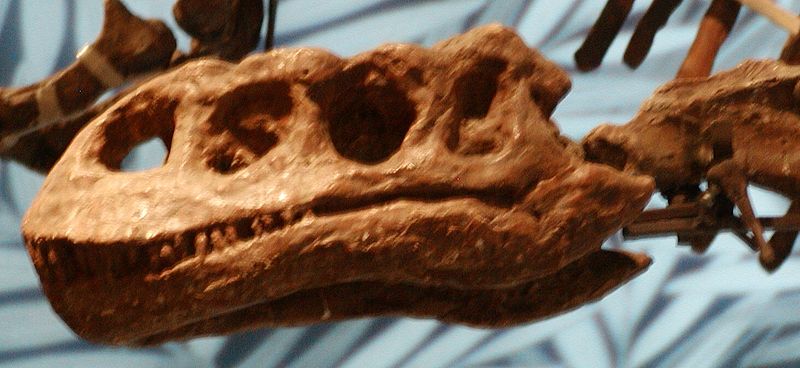
The Eshanosaurus jaw was found beneath a bonebed of the prosauropod Lufengosaurus. Mystery solved, you may say. Prosauropods and therizinosaurs have famously been confused in the past. Their skulls and dentition tend to be similar. Jim Kirkland thought so, and in a 2001 review said one aspect of the teeth, a mid-line ridge, screamed prosauropod. But he hadn't seen the specimen himself, and was going from a bit of unpublished goss (in scientific circles, when you use goss in an official, published paper it's called "personal correspondence", or pers. cor.). The authors of Eshanosaurus themselves, Zhao and Xu, had thought of the prosauropod thing, and tried every method to test that hypothesis, but could only rule it out.

[Image: Skull of Lufengosaurus, photo by FarleyKatz, licensed.]

Now for more pers. cor. The debate raged on for years, and still nobody has published a real rebuttal to the idea that Eshanosaurus is a ridiculously early therizinosaur. In fact, according to comments posted on Darren Naish's blog, Xu is sticking by his identification, and so are Richard Butler and Paul Barrett (the later a bona-fide prosauropod expert). Barrett has seen the specimen personally, and says it's no prosauropod. It's a therizinosaur.

Could it be, that therizinosaur existed throughout the entire Jurassic and even into the Late Triassic, and left no fossils (that we've found anyway)? That seems to be the case. Talk about a ghost lineage.

Incidentally, that same comments section discusses Larry Witmer's (2001, 2002) assessment of the infamous Triassic "bird" Protoavis. Likely a chimera made of a jumble of bones from all kinds of animals, Witmer seems adamant that, at the very least, the braincase of Protoavis is too coelurosaurian to ignore. And Witmer's opinion is nothing to be sneezed at, he's only the guru of dinosaur skull anatomy. Well, if therizinosaurs lived in the Early Jurassic, a Late Triassic coelurosaur doesn't seem so far fetched after all.

In conclusion, it looks like there's no good reason to think Eshanosaurus is not a coelurosaur, ghost lineages or no, and lots of good reasons to think it probably is unless other evidence proves otherwise. But what does all this mean for dinosaur evolution as a whole? If coelurosaurs, or even maniraptorans were stomping around the Late Triassic, shortly after dinosaurs first appeared, it would seem dinosaurs radiated much, much more quickly than anybody had thought, unless they have their own ghost lineage back into the mid-Triassic. Either that, or Steven Czerkas (2002) was right about Scansoriopteryx and it's mysteriously closed acetabulum (the hole in the hip for which an open state has always been a key characteristic of all dinosaurs). Maybe coeulurosaurs brached off of the dinosaurian tree much earlier than our cladograms would like us to think. Only more fossils will tell.

- Czerkas, S.A., and Yuan, C. (2002). "An arboreal maniraptoran from northeast China." Pp. 63-95 in Czerkas, S.J. (Ed.), Feathered Dinosaurs and the Origin of Flight. The Dinosaur Museum Journal 1. The Dinosaur Museum, Blanding, U.S.A.
- Witmer, L.M. (2001). "The role of Protoavis in the debate on avian origins"; pp. 537-548 in Gauthier, J., and Gall, L.F. (eds.), New Perspectives on the Origin and Evolution of Birds. Yale University Press, New Haven.
- Witmer, L.M. (2002). "The debate on avian ancestry: phylogeny, function, and fossils"; pp. 1-29 in Chiappe, L.M., and Witmer, L.M. (eds.), Mesozoic Birds: Above the Heads of Dinosaurs. University of California Press, Berkeley.
- Xu, X., Zhao, X. and Clark, J.M. (2001). "A new therizinosaur from the Lower Jurassic Lower Lufeng Formation of Yunnan, China." Journal of Vertebrate Paleontology, 21(3): 477–483.

What's Coming Wednesday?


From the DML:
"As exciting as this week has already been with new dinosaur stories (e.g., Hesperonychus), I just want to put everyone on alert to keep an eyeball on Nature starting Wednesday afternoon for a breaking new dinosaur story, and believe me, you won't see it coming...!"

...or Thursday?
"Isn't this supposed to be coming out a little later? I recall the end of the embargo being set for the 19th."

Deinocheirus? Lori? Amphicoelias? Feathered brachiosaur? Stay tuned for coverage of this cryptic new goss as it unfolds!