Showing posts with label anatomy. Show all posts

Friday, August 31, 2018

The Many Crests of Pterodactylus

Little Pterodactylus,  from the late Jurassic period of Bavaria, was one of the first pterosaurs ever discovered (a story you can read all about in my book Beasts of Antiquity). Represented by numerous juvenile and subadult specimens, it's among the better understood pterosaurs as well, especially if you include a few controversial specimens that have recently been argued to represent distinct genera such as Aerodactylus (a conclusion many pterosaur specialists remain skeptical of, but that's a topic for another post).

Although many Pterodactylus specimens preserve soft tissue, one pretty important aspect of their biology is NOT so well understood - their crests. In the past few decades, it has become apparent that crests of one kind or another are a hallmark of most pterodactyloid pterosaurs (and even a good number of non-pterodactyloids). Crests were first reported for Pterodactylus itself by Doderlein in 1929, but it was almost never depicted with a crest in art afterwards. The first-ever crested Pterodactylus was probably a toy. In 1988, Tyco released a crested Pterodactylus toy as part of their "Dino-Riders" line. Though produced under the supervision of Bob Bakker, it's unclear whether or not the crest was based on Bakker's inside knowledge of pterosaurs or was just a lucky guess added to give a fairly plain pterosaur toy more flair. Bakker himself had illustrated Pterodactylus without any crests in The Dinosaur Heresies several years earlier. Despite the fact that Peter Wellnhofer described a lappet "crest" (see below) for Pterodactylus in 1970, and even figured this specimen in his popular 1996 book The Illustrated Encyclopedia of Prehistoric Flying Reptiles, illustrations in that same book depicted Pterodactylus as crestless.

Photo of Pterodactylus specimen BSP 1929 I 18, from Wellnhofer 1996. You can see a thin occipital lappet extending diagonally up from the back of the skull.

The dubious Tyco example aside, the concept of a crested Pterodactylus didn't really reach the popular consciousness (and had apparently been forgotten by science, much like several other "modern" ideas about pterosaurs that were really discovered by 19th and early 20th century German paleontologists) until the first ultraviolet florescence studies done by Eberhard Frey and Helmut Tischlinger in the late 1990s and early 2000s. They produced what, at the time, seemed like a very bizarre reconstruction of a pterosaur, especially one like Pterodactylus which was somewhat famous for being the 'crestless one' (as opposed to its more famous, crested cousin, the giant Pteranodon). The illustration that was sent out in press materials about the early UV studies showed a shaggy mane of filaments on the neck, big, floppy webbed feet, a throat pouch, and a big, teardrop-shaped crest that extended above and behind the eyes. Clearly, the UV analysis had totally overhauled our image of Pterodactylus.

Frey and Tischlinger's reconstruction of Pterodactylus based on UV studies.

Or did it? The actual UV papers are still difficult to come by online, so early on it was difficult if not impossible for many paleoartists to examine the source material themselves. In the mean time, Frey's Pterodactylus became the gold standard for accuracy, with savvy artists beginning to incorporate the mane, webbed feet, and distinctive crest into their own work, all based not on any photos or diagrams of fossils, but simply on Frey's pencil drawing. Here's my own early take on the "new" Pterodactylus. Note that, in order to try and be a little different, I applied the UV soft tissue findings to a different specimen, the holotype of Pterodactylus brevirostris (which may actually be a juvenile Ctenochasma!).
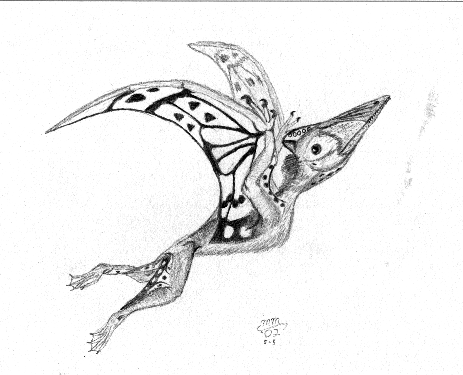

Note that this was done in June 2002, shortly after the publication of Frey's English-language work summarizing the UV findings of the past few years. I later sketched out a version based more directly on Frey's original drawing:

A couple of things turned out to be... maybe not wrong, per se, but definitely speculative and not directly evidence-based, about the Frey-style Pterodactylus.

For one, that shaggy mane. Pterodactylus did indeed have a coat of unusually long pycnofibres on its neck. And by "unusually long", I mean that they are nearly half a centimeter long (compared to a ~10 cm long neck), unlike most of the incredibly tiny fibers coating the rest of the body. The "mane", therefore, would probably have appeared as a particularly fuzzy, bristly section of a short, dense coat.

As for the crest, none of the specimens show an oval shaped crest extending above and behind the eyes. What the few specimens we have of the crest show is actually two discrete crests or crest-like structures. The main crest, as preserved, is roughly triangular, with its peak just in front of the eyes. A second structure protrudes behind the skull. This has been called the "occipital lappet", and was first noticed by Wellnhofer in 1970. Superficially, the lappet resembles a small version of the crest of Pteranodon. Or, maybe more appropriately, the rear spar of the crest of Tupandactylus. In that tapejarid, the crest is comprised of two bony supports. One, roughly triangular in shape, above the snout. The other, a long horizontal spike, extends behind the skull. In between was an enormous, rounded crest composed of keratin or some other rigid soft tissue. The two "obvious" crests are merely the support struts for these larger structures. Frey imagined that in life, the triangular crest above the eyes and the occipital lappet may have been joined together into this kind of single structure, the apparent shape of the crests as preserved being an artifact of decomposition or post-mortem breakage. This interpretation has been followed by a majority of artists since, as a Google Image search will show.

You can see that an image search for "Pterodactylus crest" brings up some fossils and diagrams, 2 reconstructions of Pteranodon (of course), 1 of an ornithocheirid (somebody got confused?), 1 old-fashioned reconstruction with no crest, 3 different reconstructions with a triangular crest and separate lappet (one of which is my own), and 9 reconstructions with a Frey-style joined crest (again including one of my own!). 
Mark Witton, in his 2013 book Pterosaurs, was influential in popularizing an even larger tapejarid-like crest, which he included both in his reconstructions and skeletal diagrams. His reasoning for taking the Frey-style crest to the next level was based mainly on the general rule that pterosaur crests tend to be larger than they appear.

There are some important differences, though, that we should consider before speculating too much about a tapejarid-style crest in Pterodactylus. First, the two are not particularly close relatives, and tapejarid-like crests have not yet been found in any other pterodactyloid groups. Given the enormous crest diversity among pterosaurs, I'm not sure it's appropriate to assume they were all basically big ovals and differences are just preservational. Some other pterosaurs unrelated to Tupandactylus did have big, rounded crests, but these were more like semicircles erupting from the skull, not extending behind it or significantly above it (like wukongopterids and even some ctenochasmatoids closer to Pterodactylus itself). One other example of "enormous crest supported by bony struts" has been proposed in the form of Nyctosaurus, but despite some spectacular looking restorations out there, it's unlikely those enormous spars supported any soft tissue.

The huge, oval-shaped crest of Tupandactylus was supported by long bony crests that graded into soft tissue, unlike the totally soft crests of Pterodactylus. Photo from the AMNH pterosaur exhibit by Lisa Brormann.
Second, the supposed spars of the Pterodactylus crest are not made of bone! The reason Tupandactylus and other tapejarids can have those huge oval crests sitting on their heads is because they have bony supports. Even the smaller species like Tapejara wellnhoferi has a significant hard, bone-based component to its (possibly) large oval crest. In Pterodactylus, not only is the main crest comprised entirely of soft tissue with an unusually minimal amount of bone as an underlying base, the occipital lappet is not made of keratin at all. Upon close examination of the internal structure of the lappet, it seems to be supported internally by twisted fibers similar to those that make up the pycnofibre coat. The lappet would not have been flat in life, like the crest of Pteranodon, but conical. The fact that it is composed internally of fibers may imply that it was flexible, a result that would explain why it is preserved in different positions in different specimens (some curving upward, some straight). The lappet seems to have been more an extension of the skin integument than a typical crest, sort of like the wattles and caruncles of a turkey.

Possible crest reconstructions for Pterodactylus (based on specimen BSP 1929 I 18). Clockwise from top: Crest and lappet as preserved; joined crest after Frey 2002; joined crest after Witton 2013; minimally extended unjoined crest.
Diagram by M. Martyniuk 2018, all rights reserved. 
It's entirely possible that future specimens will show that we have Pterodactylus crest shapes wrong, or that the main crest was in some way attached to the lappet. But given the evidence right now, that interpretation is one of the less likely possibilities. A few prominent paleoartists who helped popularize the tapejarid-style crest have since produced lappeted ones, including Mark Witton and John Conway, both of whom, intriguingly, depicted the lappet as just part of the larger pycnofiber assemblage - Conway as an extension of the "mane", Witton as part of a larger set of display fibers). You can read more about Witton's new Pterodactylus reconstruction on his blog.

All of these reconstructions still go a bit beyond the known evidence by depicting large, flamboyant crests. As they probably should - Witton was correct when he pointed out that pterosaur crests were probably larger, in general, than traditionally thought. All of our crested Pterodactylus specimens are also sub-adult, so even though the soft tissue crests we have preserved seem to be pretty small, it's likely the crest would have gotten at least a little bigger with maturity. We just don't know how much bigger.

Reconstruction of a subadult Pterodactylus by M. Martyniuk.

Wednesday, April 12, 2017

You're Doing It Wrong: Pteranodon Bills

Your bill's looking a little puny, there, buddy.
(Painting by Heinrich Harder, 1912, public domain).
Everybody knows Pteranodon. Quick, stop to imagine it! It's easy, because it's the most often-illustrated and well known pterosaur to the general public (though today's marketing departments often call it a pterodactyl, following it's original, century-out-of-date classification).

But hold on. That image you have in your head right now, of a big pterosaur with a long crest and a mid-length pointy beak? That's likely wrong, and may be just as much a hybrid as those Flintstones-style creatures with pteranodont crests and Rhamphorhynchus tails.

How do we know? Let's talk about Dawndraco.

Saturday, May 28, 2016

You're Doing It Wrong: Microraptor Tails and Mini-Wings

Type specimen of Zhenyuanlong, doing its best Archaeopteryx impression.
Just a short PSA today, and once again, it's about a paleoart meme that has outstayed its welcome.

Microraptor was the first time we got a good look at the feather pattern of dromaeosaurids. This is a big problem for two reasons. One, microraptors were small. That means that artists who were looking at them to extrapolate for bigger, more famous "raptors" could easily and somewhat justifiably write off their huge wings as a product of their size. Sure, we thought, microraptors had big wings, but they're tiny animals. Surely the bigger, more terrestrial dromaeosaurids didn't need such big wings. They probably still had wings, but they'd be smaller. Why would Velociraptor need such proportionately huge wings if it couldn't fly or glide?

Meme number two: that tail. I admit to being one of the first to go overboard when I fell, head over heels, for the "puff tailed dromeosaur" fossil (now the holotype of Cryptovolans, a synonym or close relative of the Microraptor) back around 2000. This was the first evidence we had of the tail feather style in dromeosaurids (or evidence that they even had remixes and rectrices at all. Remember When Dinosaurs Ruled America? That was plausible at the time it was being made). Naturally, having Microraptor plus Caudipteryx showed that the ancestral condition of pennaraptorans was a fan of feathers at the tip of the tail, not a fuzzy Sinosauropteryx like tail or a fully-vaned Archaeopteryx like tail. So artists ever since have been drawing dromeosaurids and troodontids and oviraptorosaurs with microraptor tails.

But that turned out to be wrong! It's an accident of history. We're now learning that Microraptor and Caudipteryx are weirdos.

Saturday, February 21, 2015

The Evolving View of Stegosaurus

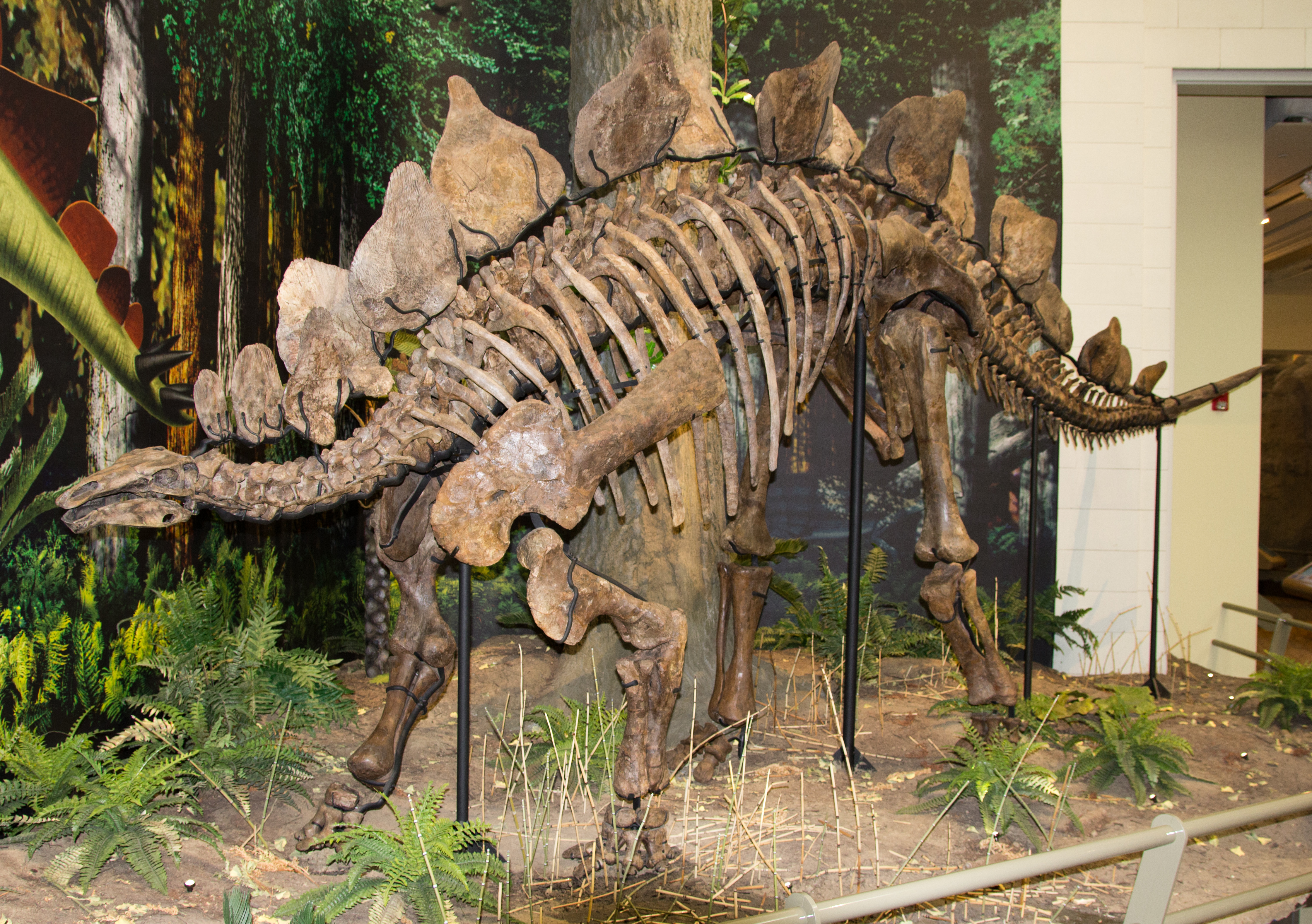
Mounted skeleton of Stegosaurus ungulatus at the Carnegie Museum. The tail, plate, and spike arrangement have been updated in this mount to reflect current thinking following the study by Carpenter (1998). Photo by Perry Quan, CC-By-SA 2.0.
Seeing as how I've been working on restorations of two different stegosaur species this month, I thought I'd write up a quick review of the most famous aspect of these iconic dinosaurs: Their big, triangular plates. For a complete overview of the history and interpretation of Stegosaurus, be sure to see Ken Carpenter's 1998 paper.

Interpretation of the life appearance of stegosaurs has changed several times since they were discovered by O.C. Marsh in 1877. The first stegosaur fossil (belonging to the species S. armatus) were found near the town of Morrison, Colorado, but the specimen was disarticulated and only a few of the plates were preserved. Initially, Marsh thought that these plates played flat along the animal's back, forming a sort of turtle-like shell, or like the tiles on a roof (hence the name Stegosaurus, which means "roofed lizard"). Marsh also initially believed that stegosaurs were aquatic, due to this turtle-like appearance, but also that they would have walked on two legs on land.

Sunday, June 15, 2014

What Does T. rex Say?

"Hissssssssssssssssss!"
T. rex holotype specimen. Photo by Scott Robert Anseimo, CC BY-SA 3.0.
It's an iconic scene in every dinosaur movie: the huge, conquering carnivorous theropod rears back and lets out a terrifying bellow. Sound effects artists spend huge amounts of time sampling vocalizations from various animals to create just the right mix to create an unfamiliar, otherworldly roar. And, of course, everybody knows that pterodactyls let out harsh, echoing, prehistoric sounding screeches.

But how close to reality are these sounds? Do we have any ways of using science to figure out what dinosaurs and other stem-birds may have sounded like? Do we have evidence that they made sounds at all?

Sunday, May 18, 2014

Review: Papo Archaeopteryx


Like many paleontology fans, I have a pretty big collection of little plastic dinosaur toys. Most of these I got when I was a kid and have held onto since, but every so often a nice looking model is released that is too cool to pass up. This new Archaeopteryx figurine from Papo was one of them.

Sunday, September 8, 2013

Iridescence in Simple Feathers - The Case of the Blue Troodon

Iridescent feathers in troodontids - possible? Image by Matt Martyniuk, all rights reserved.
(Supreme dino fans may recognize the pose even from this small clip...)
I've written a lot about the various ways feathers get their color in order to create some rough guidelines for paleoartists restoring feathered stem-birds. I recently had a quick discussion over at DeviantArt with one of the best currently-working paleoartists around, Emily Willoughby, over the plausibility of a blue Troodon. Note that it has a few other anatomical issues that make it somewhat less than a fully accurate rendition, but is the coloration one of them? I wasn't sure, so I did a little extra digging to find out. As usual, this research is cursory and I welcome any additional input on research or details I may have overlooked.

Sunday, September 1, 2013

You're Doing It Wrong : Dino Foot Scales

Above: Our subject matter.
It's often said by those who support a strict phylogenetics-based system of naming life that it's only by restricting well-known names from neontology (the study of modern organisms) to crown groups can we avoid making unjustified assumptions about members of stem-groups.

These kinds of unjustified assumptions have been rampant in the history of studying stem-birds. Archaeopteryx has traditionally been depicted, incorrectly, with a reversed hallux, and occasionally even with beak-like structures, simply because it's a "bird", and those are features all birds have. Except Archaeopteryx is not a true "bird", it's a stem-bird, more closely related to birds than to any other living animal group, but not a member of the group that includes all modern birds. It's fair to assume that an extinct member of the duck lineage, like Vegavis, had a bill, but that's not necessarily so for, say, Patagopteryx, despite the fact that it is usually referred to as a "bird".

Modern bird feet, by Philip Henry Gosse, 1849, public domain. Note overlapping scutes on
the top surfaces, and pebbly, polygonal reticulae on the bottom surfaces.

Most paleoartists have absorbed these kinds of warnings, and do a good job of avoiding obvious errors based on typology, the assumption that all species in a certain "type" share "key characteristics." But there are some typological memes in the bird lineage that are more pernicious, possibly because their actual evolution is something most artists don't think about very much.

Take, for example, the bird-like scutes that are almost universally illustrated covering the tarsus (upper foot/lower hind limb) of dinosaurs. Is there any evidence that these were actually present in any given group of non-theropod stem birds? Well... no. Not that I'm aware of (if you know differently, please comment!).

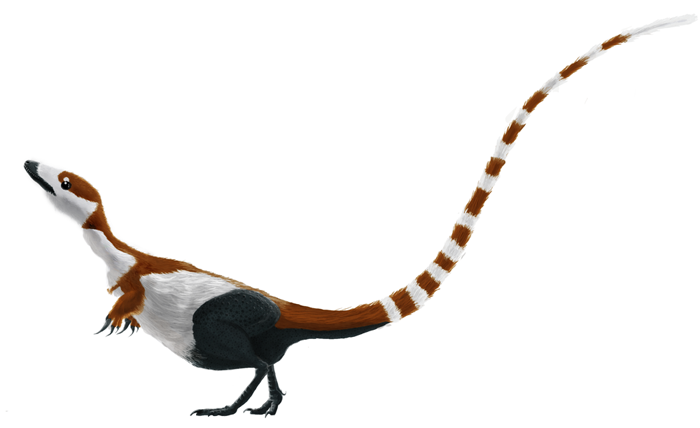
Sinosauropteryx prima with tarsal scutes.
Image by Matt Martyniuk,  licensed.
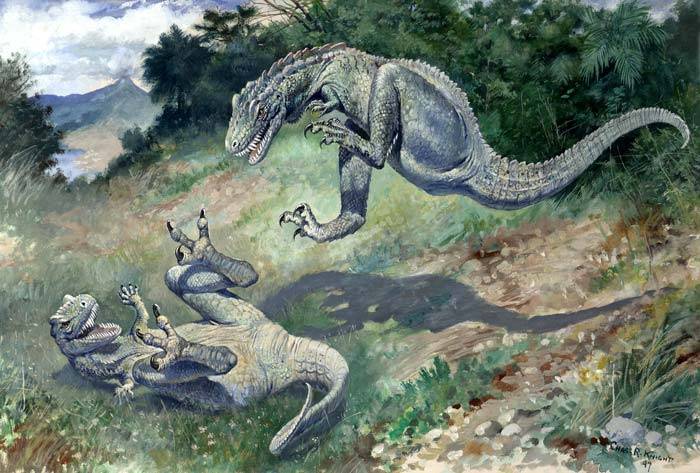
I'm not sure when this meme began, and if it's related to the Dinosaur Renaissance when the link between birds and dinosaurs was re-established. Looking at some Charles Knight paintings, such as his famous "Leaping Lealaps", it appears that the feet of his theropods were scaled based on modern lizards (more on the differences between lizard scales and other types of "scales" below). Bakker's influential early restoration of Deinonychus does not include any obvious scutes on the feet or tarsus. Mark Hallet, on the other hand, did include what look like oblong bird-like scutes on his theropods. At any rate, it's hard to deny that "bird feet" are typical of almost all modern reconstructions of dinosaurs, including my own, and are not limited to theropods. Bird-feet are often restored on ornithischians and even pterosaurs.

Of course, like many paleo-memes that developed during the 1980s, the main idea seems to be using this as a flourish to make otherwise scaly dinosaurs seem more bird-like. And thanks to skin impressions, we know that many dinosaurs had scales, right?

Tuesday, June 4, 2013

You're Doing It Wrong: CGI Feathered Dinosaurs

YIKES.
Promotional still from When Dinosaur Roamed America,
Discovery Channel 2001
CGI dinosaurs have come a long way since Jurassic Park. Unfortunately, due to the discovery that these animals were far more bird-like than reptile-like, that direction is straight down a seemingly bottomless pit. For many CGI artists and animators, the key concept that is presenting a very steep learning curve is the idea that these animals need to be restored as feathered dinosaurs, not "dinosaurs with feathers." It looks like many people modeling feathered dinosaurs start out by rendering a featherless dinosaur and then using various modeling or rendering tricks to add the feathers. As you'll see below, this never, ever works.

Saturday, August 11, 2012

Did Sinosauropteryx Have "Protofeathers"?

Life restoration of the S. prima type specimen by M. Martyniuk
Over at Jaime Headden's blog The Bite Stuff, Jaime recently wrote a great article about the newly discovered basal coelurosaurian or orionidian Sciurumimus. The article touched on the fact that its feathers were reported as stage 1 (simple, unbranched filaments, often referred to as "protofeathers") in the parlance of feather development researcher Richard Prum. In the comments, Heinrich Mallison pointed out that they *look* like stage 1, but as Foth showed, crushed feathers (even those of modern birds) often look much more primitive than they are due to taphonomic effects. (I've mentioned before in a few places that it's really unfortunate Foth's important paper seems to have been mostly ignored by others writing about fossil feather types). Jaime defended this by saying that Sinosauropteryx, which is more derived, also is 'generally agreed' to have had stage 1 feathers. It's true that this is the general agreement in the literature, and it's also true that the general agreement has been challenged (effectively, in my opinion). I posted a reply to the article, but the fact that this keeps coming up lately has made me think that maybe I should be trying to publicize this more widely, so my comment is reproduced below along with some more commentary on the issue.

Wednesday, August 1, 2012

The Tail of Shanweiniao


Fossil tail feathers of S. cooperorum, from O'Connor et al., 2009.
As a follow-up to last month's post on the smallest Mesozoic theropods, here are a few additional observations on the small longipterygid Shanweiniao. Like other longirostravisines*, Shanweiniao cooperorum had reduced "hands" entirely lacking claws. This reduction of wing claws seems to have occurred independently of modern birds within this uniquely specialized group of enantiornitheans. (Euornitheans seem to have lost the bulk of their wing claws around the level of Carinatae, though many modern birds still retain at least keratinous claws on their wings, and longirostravisines may have as well).

S. cooperorum itself is most well-known for its elaborate tail made up of six ribbon-like feathers. Those feathers overlapped at the base, and may have acted as an air brake for precise landings with the feet on small branches. It's possible that most other enantiornitheans, which lacked long feathery tails and also retained wing claws, landed by simply smacking clumsily into tree trunks or brush and grabbing on with all four limbs.

Sunday, April 1, 2012

What Is Enantiornis?

Enantiornis leali was among the first enantiornithes to be found, and the first to be recognized as a member of a unique lineage of "opposite birds" separate from modern birds (Gobipteryx minuta, now recognized as an advanced enantiornithe, was found earlier). But despite being such a widely recognized and historically important member of its namesake group, little can actually be said about this species in terms of ecology or life appearance. Of course, that can't stop us from trying to figure out as much as we can by examining the available evidence and ecological context of these long-dead birds.

Monday, December 5, 2011

Waddle, _Achillobator_, Waddle!

Above: Revised illustration of Achillobator giganticus with corrected leg proportions. Scale bar = 500 mm. By Matt Martyniuk, all rights reserved.

"I've hunted most things that can hunt you, but the way these things move..."
"Fast for a biped?"
"Cheetah speed. Fifty, sixty miles an hour if they ever got out into the open, and they're astonishing jumpers."

This quote from the original Jurassic Park film did much to cement the image of dromaeosaurids, the raptor* dinosaurs, in the public consciousness as fleet-footed hyper predators. Despite being nearly 20 years old, this portrayal has by and large remained unchanged in popular culture, with raptors often stock monsters with near-supernatural murderous abilities in everything from tongue-in-cheek xkcd comics to (I hope) tongue-in-cheek made for SyFy movies.

*Yes, I'm going to commit a cardinal sin and refer to dromies as "raptors". "Raptor" in ornithology refers to most predatory birds, even those that hunt on the ground (the Raptor Research Foundation considers Secretarybirds to be raptors). Since dromaeosaurids were both predatory and birds under any sane definition of the word, there should be no problem referring to them as an extinct group of raptors.

But were raptors really particularly fast? Bipedal running speed in digitigrade animals (that is, those that walk on their toes like birds rather than their ankles like humans) is usually roughly determined by the ratio of the lower leg bones (the tibia/tibiotarsus) to the upper foot bones (the metatarsus). The longer the upper foot is in length compared to the lower leg, the faster an animal could run. Therefore, we would expect the fastest theropod dinosaurs to be those with the longest metatarsi relative to tibiae.

A prime example of a theropod specialized for running very very quickly are the parvicursorines. This specialized group of alvarezsaurids (strange theropodan insectivores with stout, powerful arms each bearing one very large claw) has among the longest lower leg to upper leg ratio of any Mesozoic dinosaur group.  Looking at the statistics compiled by Mickey Mortimer at The Theropod Database (a phenomenal resource I turn to so often I really should just make it my browser's home page), the type specimen of Parvicursor remotus (see leg diagram here) has a femur 52.6 mm long, a tibiotarsus about 75.6 mm long, and a metatarsus 58 mm long. The functional lower leg is 113 mm long, well over twice the length of the upper leg. More importantly, the lower leg and upper foot bones were fairly close to being equal in length. This animal was clearly a speed demon.

How does this compare to raptors? If, as Jurassic Park claimed, raptors were exceptionally fast, we would expect them to have similarly long lower legs. The terrifyingly human-sized raptors in JP were a Hollywood invention, but we do know of raptor species slightly smaller and slightly larger than they were.

On the smaller side were the famous Deinonychus antirrhopus. According to TTD, the femora of one relatively complete specimen measured 248 mm, with a tibia 324 mm long, and a metatarsus 151 mm long. Again, the total lower leg length is nearly double the upper leg. But the upper foot bones were only half as long as the lower leg bones.

The "fast raptor" meme was started by John Ostrom himself, when he first described Deinonychus in 1969. This was merely speculation on his part, as the hind limb was not completely known in the first specimens. Ostrom actually changed his opinion in later papers, finding that the femur was shorter than he'd initially thought, and that the foot bones were surprisingly short compared to other dinosaurs. Not only was Deinonychus not particularly fast, it probably could not have been nearly as fast as most other small theropods, including modern flightless birds, let alone cheetahs.

Another very popular type of raptors are advanced giant dromaeosaurines (Utahraptor and Achillobator). I recently found myself revising an older drawing of an Achillobator giganticus, which were, as mentioned above, only slightly larger than the Jurassic Park raptors. Many young dinosaur fans are very attached to these species in part because they're much larger than most other raptors, and because they had a slightly anthropomorphized novel written about them by Bob Bakker shortly after JP was released (Raptor Red). As a result, these big birds have a cachet in the collective consciousness similar to the generally more famous Deinonychus and Velociraptor--that of super-fast, agile and intelligent predators.

However, when finishing up my revised drawing, I had to double check the proportions several times to make sure I wasn't screwing it up. To my amazement, the legs, particularly the lower legs and upper foot bones, looked almost laughably short. Again according to TTD, the femur of A. giganticus measures 505 mm long, the tibia 490 mm long, and the metatarsus a paltry 234 mm long--less than half the length of the tibia. Not only is the metatarsus much, much shorter than the tibia, the entire lower leg in only marginally longer than the femur! The first thing that struck me wen looking at my own reconstruction was that this looked like the dromaeosaurid equivalent of Majungasaurus, those abilisaurids with the ludicrously short legs (which, coincidentally like Achillobator, have been suggested to be made up of chimeric specimens). It is also reminiscint of another stout-legged dromaeosaurid species, Balaur bondoc. While Balaur have been suggested to be possibly herbivorous due to these strange proportions, partial jaws and some teeth of Achillobator confirm that they were carnivores. But with legs like those, it's hard to imagine these creatures behaved the way the public imagines raptors to have done, chasing down fast moving prey. Frankly, it's hard to imagine Achillobator doing much beyond waddling across Nemegtian lake shores hunting turtles in epic slow-motion chases.

For the record, no described specimen of Utahraptor preserves both a femur, a tibia, and a metatarsus, so it's impossible to say whether or not they had the same squat proportions (unless somebody has some more detailed information on the numerous undescribed specimens in the BYU collections). For now, it would be safe to assume that they, too, would have been a laughing stock if they were caught trying to run.

Ok, but why would predatory animals have such stubby legs? There is a lot of evidence that dromaeosaurids were specialized for hunting big game, often animals larger than themselves. Deinonychus are infamous for their association with large ornithopods Tenontosaurus tilletti, and while evidence suggests they mainly targeted juveniles (Forster 1984), these were still much larger in terms of weight than even adult Deinonychus. Velociraptor are known to have grappled with the larger Protoceratops, and even a rumored specimen of a Microraptor apparently preserves evidence that they tackled prey larger than themselves. The short legs, especially the short foot bones, seem to be linked with the function of the large sickle-claw, making lack of speed a trade-off for improved ability to grapple and kill large game. Dinosaurs like Tenontosaurus and Protoceratops probably weren't particularly fast-moving themselves, making this sacrifice in speed worthwhile for the chance to down a massive animal that could provide a whole lot of food.

In the end, while the raptor chase scenes in Jurassic Park remain some of the most exciting parts of the movie, they require a significant amount of disbelief to be suspended; after all, it would be more realistic but slightly less suspenseful if Laura Dern had been able to evade the raptors in the power bunker by simply breaking into a light jog.

Friday, September 16, 2011

Feathers ARE Color

A lot of my posts lately have been dedicated to color in prehistoric feathers (primer here). As a  paleontographer, it's hard not to get excited about finding new ways to more accurately and naturally depict long-gone animals, and I know a lot of you reading this feel the same way. It can also be frustrating knowing the basic color palate we're dealing with, but having specific data from only a handful of species to draw inspiration from. I've already seen, not surprisingly, a few illustrations of Microraptor, Xiaotingia, etc. that basically mimic Anchiornis down to the spangles. We're so conditioned to follow phylogenetic bracketing that it's tempting to use what little info we have, and extrapolate it to close (and even not so close) relatives. This can apply to larger feather patterns as well; as I mentioned in this post, it's fine to extrapolate Microraptor-style feathering to Velociraptor, but it's not the ONLY way to do it, nor is it even necessarily the most plausible for a creature of such different size and ecosystem, as many online critics of Dinosaur Revolution would have you believe ;)

With that in mind, I want to start with a disclaimer: this kind of info only gets you so far. I'm not setting out to write the inerrant Bible of paleoart in these types of posts. Yes, all the evidence we have of dromaeosaurs shows full, lush feathering equivalent to small modern birds. But then again, we're dealing with small prehistoric birds here. Yes, we can interpret feather coloration and use inferences from modern birds and biochemistry to say what colors are likely and which are unlikely; but we can't always identify structural color in fossils, and we have yet to identify carotenoids, and many small dinosaurs we think of as "carnivorous" might well have trended more toward omnivory, insectivory, etc., or other unforeseeable pathways to those tasty, tasty bright yellow pigments.

Ok, preamble out of the way, the point of this post is to provide a general way I've used, and others can use, to try to make somewhat educated guesses about coloration in prehistoric birds which have not yet been analyzed for color pattern.

A few people pointed out to me when this recent paper by Wogelius et al. came out, in which the research team was able to identify color patterns in some Mesozoic birds using chemical markers rather than direct observation of melanosomes, that their reconstruction of Confuciusornis based on these findings was pretty similar to the restoration I'd done a while earlier.


Above: Restoration of Confuciusornis by Richard Hartley, from the press release. Below: My own earlier restoration of C. sanctus.


The two are pretty similar in the broad pattern: dark head, body, and coverts, white or light-colored wings with more black on the secondaries than the primaries. Now, so far this is only one data point, so I don't want to draw too many conclusions. But I was not simply guessing when I restored C. sanctus that way back in 2009.

The trick is to understand what you're looking at when you see a fossil feather. These are often referred to as 'impressions', but often the impressions are only part of the story, or even completely absent from the fossil. The breakthrough that led Vinther , Prum and others to figure out how to suss out feather color, was in realizing what fossil feathers are made of.

As Prum summarized on the Skeptics Guide to the Universe podcast a few years back, traditional wisdom held that the dark, 'carbonized' looking fossil feathers were the result of bacteria. Now, some old-school feather impressions, like those from Solnhoffen and the Santana formation, do contain nice, deep, actual impressions. These look very different from the stuff you find in the Jehol (compare the fossil feathers of the Berlin Archaeopteryx with the holotype of Microraptor gui). But most fossil feather,s including the famous single-feather holotype of Archaeopteryx and most Jehol stuff, are dark stains in the rock. Under the microscope, these looked to early researchers to be made up of fossil bacteria which had eaten away the feather keratin during decomposition.


Above: Photograph of an unsubscribed Anchiornis specimen by Robert Clark, from National Geographic, showing clear color patterns matching those predicted by Vinther et. al.

What Prum, Vinther, etc. showed in recent years is that this is flat-out wrong. Those granules are not bacteria--they're melanin! When you look at a fossil feather, most of the time, you're looking directly at the color pattern of the feather itself, the keratin and everything else having long since disappeared. This is especially apparent in very well-preserved fossils; for example, the beautifully preserved new Anchiornis specimen above is essentially proof of Vinther's hypothesis, which had previously been based on more obscured differences in shade. This is where my method of eyeballing it falls flat--I'd never have gotten the correct pattern from the specimen Vinther was looking at without really close physical examination. You need really nice specimens for it to conceivably work, or you have to Dave-Peters the heck out of low-res images trying to spot differences in contrast on the feathers.

Luckily, Confuciusornis was a safe bet, because so many specimens are known, and you can start to see patterns emerge. Many of the best specimens tend to have a very dark halo of feathers around the body and arms, with the wing feathers very faint, even sometimes difficult to see at all. Knowing that dark feathers means dense melanin = dark coloration, and light color = lack of melanin = light color, it was easy to come up with a good guesstimate of the life coloration. This was first inspired by Longrich's work on Sinosauropteryx, showing that the apparent bands in the tail were due to color patterning, which was later supported by published studies.

Obviously this is not a foolproof method. But it's a good place to start for artists who may want to add a little evidence-based thinking to their reconstructions, even if the evidence itself is wide open to interpretation. At the very least, if a good specimen has obvious areas of light and dark, I'd personally restore that pattern in a life illustration. It may end up being wrong, but it's better than pure speculation.


Monday, May 30, 2011

Know When To Fold 'Em


Above: Maximum wrist folding for the theropods studied by Sullivan et al. 2010. Not to scale.


(Cross-posted from Art Evolved)

To continue talking about aspects of maniraptoran anatomy that can be a bit vaguely defined in the minds of paleoartists, I'm going to write a bit on the issue of wrist folding. As most of you will know, a major characteristic of maniraptorans is the semi-lunate carpal, the half-moon shaped bone in the wrist that allows the blade of the hand (metacarpal 3) to fold backward toward the forearm (ulna). While this is common knowledge among paleo buffs and artists, what seems to be less understood is exactly how tightly the hand (and in aviremigians, the wing) could actually fold up. I myself have never been too clear on the issue, and there don't seem to be many papers addressing this. But in the last few years, a few papers have come along that can help shed light on the subject. The first was Senter 2006, which studied the full range of motion in the forelimbs of two dromaeosaurs, Deinonychus and Bambiraptor. The second was Sullivan et al. 2010, which examined the range of motion in the wrist of several species representing each major group of non-avialan maniraptorans.

Both papers, however, present geometric data that can come across as a bit inaccessible for your average artist, so I'm going to try to break down their conclusions for those of us who are more visual thinkers. The Sullivan paper, in particular, discusses the degree to which the wrist could fold, but doesn't necessarily provide diagrams or even final angle between the metacarpals and ulna for each species that could be used as a simple reference. I've done my best to translate their findings into the image at the top of this post, using modified skeletal diagrams by Scott Hartman and Jaime Headden.


Above: Anatomy of a maximally folded wing of the Wild Turkey Meleagris gallopavo, modified from Sullivan et al. 2010
The degree of wrist folding is controlled by two wrist bones. The cuneiform, on the inside where the wrist meets the bottom of the distal ulna, provides an inner limit. The cuneiform blocks the hand from actually touching the ulna. The radiale, on the outside of the fold, forms the surface which the wrist cannot fold beyond. This is basically a little process anchored to the tip of the radius where the top part of the hand articulates. The hand can obviously not fold beyond the angle of the radiale, or the animal would dislocate its wrist. Therefore, the angle the articular surface of the radiale forms with the ulna is used as the key factor in determining maximum wrist folding by Sullivan et al. Again, see my interpretation at the top for how their results likely translate into life position.
The results show that in almost all maniraptorans, the wrist could not be folded to the same degree as modern birds (for comparison, see the photo of the turkey wing above, which is at its own maximum folding point). Note that in actual, functional angle of folding in the turkey is 57 degrees between MCII (where the feathers attach) and the ulna. To see how this translates into a live animal, here's a photo of wild turkeys nicely showing the way the feathers fold (photo by D. Gordon E. Robertson, from Wikipedia, licensed):
The wrist is located about where the coverts form the point of a triangle, following the line formed by the border of the the brown secondary (ulna) feathers and white banded primary (metacarpus) feathers. Note that with the wrist folded at a 57 degree interior angle, the feathers (especially the secondaries, which help cover the primaries when folded) are basically stacked one on top of the other with little to no fanning out at the tips. This is because the feathers also have some ability to move at their bases, and can themselves fold relative to their anchor bones through muscle and ligament action.

Looking at the aviremigians in the diagram up top, it is apparent that their wrists could not fold tightly enough to fold the wing feathers to the same degree as a modern turkey. Small deinonychosaurs like Sinovenator and Bambiraptor could achieve close to a 100 degree angle (see image of Bambiraptor wing folding above, from Senter 2006), but larger ones like Deinonychus seem to have lost some of that folding ability, presumably for increased use of the forelimbs in predation. Indeed, if Deinonychus retained long remiges, they would hardly have been able to fold at all, and would have been permanently fanned out (not that this would have gotten in the way of grabbing prey, as Senter pointed out). This lack of ability to tightly fold the wrists may have posed a significant problem for those species with very long remiges, like Microraptor gui. Dave Hone, who was a co-author of the Sullivan paper, discussed alternative ways they could have kept their remiges free of the ground at his blog last year.

In pygostylians, the degree of wrist folding began to approach that found in modern birds. Eoconfuciusornis, for example, could fold its wing to about the same degree as a turkey. Where it gets weird is in the oviraptorosaurs. As I mentioned in my post on the Ashdown maniraptoran, oviraptorosaurs (at least the small basal ones like Caudipteryx) seem to have been capable of folding their wings far beyond what is possible for even many modern birds. It's unclear why this is so, especially as the remiges of Caudipteryx, while clearly for display, are not exactly very long compared to the body. Certainly its wings were much smaller than those of paravians, which would have presumably had more need to fold them up. I've seen this mentioned as possible evidence in support of the hypothesis that oviraptorosaurs are in fact avialans, and that the extreme folding of the wrist was inherited from flying ancestors, though I can't think of where. Sullivan et al. do note that more than folding up the remiges to keep them safe from wear and tear, wing folding is an important part of the avian flight stroke, and it makes sense that it would have become more developed in flying forms.

Anyway, we've only got a handful of specimens that have been specifically studied in regards to the degree of wrist folding, and there may well be exceptions in each maniraptoran group, where certain lineages independently evolved a greater or lesser degree of wrist folding from their ancestors as seems to have happened in therizinosaurs, where the derived Alxasaurus can fold its wrist more than the basal Falcarius, and deinonychosaurs, where the relatively derived Deinonychus can fold its wrist less than the more basal Bambiraptor. So this guide shouldn't be considered as a set of hard and fast rules, but rather a starting point for artists who want to make their restorations as plausible as possible.

Finally, a few days ago I posted a teaser for this post challenging people to determine what aspect of the above Deinonychus illustration was incorrect. By now it should be clear that the wrist is folded too far back. Appropriately enough, the first one to nail it was the artist, Nobu Tamura, himself! Commenter A.G. came close, speculating that it was due to the orientation of the glenoid, but that has more to do with the range of motion of the upper arm and how far it could extend into a bird-like flapping position, rather than the way the wing folds up. Good job guys!

References
* Senter, P. (2006). "Comparison of Forelimb Function Between Deinonychus And Bambiraptor (Theropoda: Dromaeosauridae)". Journal of Vertebrate Paleontology, 26(4): 897–906.
* Sullivan, C., Hone, D.W.E., Xu, X. and Zhang, F. (2010). "The asymmetry of the carpal joint and the evolution of wing folding in maniraptoran theropod dinosaurs." Proceedings of the Royal Society B, 277(1690): 2027–2033.

Tuesday, May 3, 2011

Restoring _Hesperornis_


Wow, lots of great responses to Monday's challenge! Some of you came very close to the particular aspect of the anatomy I was thinking of, though nobody got the specifics. However, many of you brought up additional issues with the reconstruction so I'll address some of those observations below before I get to the real answer.

1. Trish brought up the Coot-like lobed feet. While not the major fix I had in mind, this is also something I had already changed in the new version. The toes of Hesperornis are extremely similar to Grebes in terms of their anatomy, so while no soft tissue impressions of the toes exist for this group, it is almost certain that the toes were lobed rather than webbed (as in Loons and many other diving birds). I had initially based my illustration on this model, which restores the toe lobes divided into somewhat Coot-like segments. However, given the similarity to Grebes, it's probably a safer bet to go with a Grebe-like foot, with non-segmented, asymmetrical lobes (that is, like the flight feathers of birds, the 'vane' of each lobe would be small on the outside edge of the toe but broad on the inside edge). As this was still a work in progress when I began the revisions, I didn't yet add to the podotheca (foot skin covering) with its distinct scutes, but skin impressions from Parahesperornis show that they were present and, again, fairly Grebe-like in appearance.


Above: The feet of Hesperornis probably looked very similar to those of this Grebe.

2. Nobu Tamura pointed out that I bungled my interpretation of the leg integument. Good catch! In my own defense the text of Williston 1896 (which described skin and feather impressions in a specimen now referred to Parahesperornis) isn't exactly clear on the issue and the figure doesn't help much. Williston wrote: "I count twenty-six [metatarsal scutes] on the slab, and to the back part of the bone, while impressions of the feathers will be seen on the opposite side. These feathers were evidently long, reaching nearly to the phalangeal articulation". I remembered this as saying that the feathers essentially cover the tarsometatarsus and that the scutes were present close to the phalanges, but re-reading it sounds more like the MTs were only partially covered in long feathers (on the proximal part of the bone?) while the scutes were present across the distal part. The feathers were long enough to reach the toes, forming some very odd 'bellbottoms' around the scaly part of the metatarsus. I've tried to make this more clear in the new version.

3. Several people suggested that the wings are too prominent/visible, and honestly I'm not sure about this one. I don't know of any research on forelimb musculature that could suggest whether they were external or internal to the body wall, or whether or not they'd be useful in steering or something. I suppose we artists have license to go either way on this one right now, but as you can see I've de-emphasized them in the new version. The old one began to strike me as too Penguin-like, suggesting (even subconsciously) a role in propulsion that was probably not there in life.

4. Marco Tedesco wondered if the orange feathers on the head were incorrect. I have previously blogged about the likelihood of certain feather colors based on diet and structure. However, I don't think Hesperornis would have had much trouble sinking its teeth into some carotenoids to deepen the chestnut hue possible through melanin alone into a richer orange. We know that many cephalopods (including, apparently, some ammonites with preserved pigment) contain deep red carotenoid pigmentation, as do many fish, both of which may have been parts of hesperornithine diet. And in fact, these are colors found in modern Penguins. While on the subject of color, I chose to give Hesperornis a distinct, Penguin-like counter-shaded pattern. It seems to me that counter-shading gets apparently stronger in several independent lineages of diving birds, with more specialized diving forms (Penguins, Loons, Auks) wearing similar black/white colors (at least among breeding males) while less specialized forms (ducks, etc.) are counter-shaded with more subtle earth tones. Hesperornithines are probably the most specialized diving birds of all time (Zinoviev 2010) so it made sense to me to give them generally Penguin or Auk-like coloration.

Ok, now on to the "real" answer. Several people got this pretty close. It does indeed involve the hindlimb anatomy, including the position of the femur, the degree of sprawl in the legs and, ultimately, the life posture and ability to move around on land.

Several online sources have stated that Hesperornis was unable to walk, and must have instead slid around on its belly when on land. As I hinted in the last post, the Web site for the BBC show Sea Monsters (and possibly the show itself which I haven't seen) flat out states that they couldn't walk. But as we all know, TV documentaries are not exactly reliable sources. I tried and (initially) failed to find any support for this in the literature, aside from Marsh's own speculation in his famous Odontornithes monograph: "It may be fairly questioned whether it could even be said to walk on land, although some movement on shore was of course a necessity."

Two pieces of information can be combined to give the answer, the second of which also strongly impacts any life restoration, on land or swimming/diving. First, while the feet of hesperornithines are extremely Grebe-like, the rest of the hind limb anatomy is very similar to that of Loons (Reynaud 2005). Like Loons, hesperornithines had very long tibiotarsi, very short femora, and a high-angle hip socket with a very limited range of motion. Essentially, this means that the upper legs of Hesperornis were locked into a sprawl, which would have made standing upright very awkward. Loons rarely walk upright, and in fact I can't find any images online of such behavior. Loons also will push themselves along on their bellies, "flopping and dragging" as one site describes it (image above from birdinginformation.com)

Now, while the femur was basically immobile, it still had a role in contributing propulsive forces, as demonstrated by the arrangement of muscle attachments, which allowed it to conduct strong backward force through the leg. This is quite a feat because, (finally the answer to the challenge!) as in Loons, the entire, laterally projecting femur, the knee joint, and most, if not all of the tibiotarsus, was likely encased inside the body wall! Yes, according to some recent research (Zinoviev 2010), "the tibiotarsus...was held close to the body and was probably enclosed in the thickly feathered skin of the body wall". So images like mine, and the one below by Nobu Tamura (from Wikimedia Commons, CC licensed) showing free legs are wrong.
Like Loons (image of Common Loon above by Matthew Studebaker, from his photo blog), the feet stick out laterally from the very rear end of the animal near the tail, and it is the feet, rather than the leg as a whole, that provide most of the thrust and control (though, again, even the internalized leg musculature contributes to this).

So, congrats you those who noticed something wonky with the hind limbs! In all, hesperornithines were essentially super-Loons with Grebe feet, though their unique specializations for diving exceeded nearly all modern divers, making them possibly the most truly aquatic dinosaurs that have ever lived.

One last thing: quilong suspected something off with the posture of the neck. As he points out, highly specialized diving birds tend to have advanced ligament systems to keep the neck positioned during dives, and it tends to be streamlined into the body, often in a tight s-curve. This is correct, and my image is a bit misleading as it's meant to depict a hesperorn swimming at the surface with its neck at full extension to reach above the water, like an Anhinga (or indeed, a swimming Loon, which tend to swim almost completely submerged except the top of the back, the head, and the neck). While diving, the long neck would almost certainly be held in a position closer to the body so as not to be subject to forces that would bend it every which way. Whether or not hesperorns did have advanced ligament systems in the neck to help with this, I don't know, but given their extremely derived morphology it wouldn't surprise me.


References:
* Johnsgard, P. (1987). "Diving Birds of North America: 2 Comparative Distributions and Structural Adaptation. " Papers in the Biological Sciences.

* Reynaud, F.N. (2005). "Functional morphology of the hindlimbs of Hesperornis regalis: A comparison with modern diving birds." Geological Society of America, 37(7): 133A.

* Zinoviev, A. (2010). "Notes on the hindlimb myology and syndesmology of the Mesozoic toothed bird Hesperornis regalis (Aves: Hesperornithiformes)." Journal of Systematic Paleontology, 9(1): 65-84.

Monday, May 2, 2011

I'm Doing It Wrong: More on _Hesperornis_


Following the last post on beak anatomy in toothed birds like Hesperornis regalis, I have been coming across some confusion online about another aspect of this ancient diving bird's anatomy. This factoid shows up in a lot of sources (including the official web site for a certain CGI-based TV show) but never, it seems, with a solid reference. I have been trying to dig into this issue myself and am finding out some interesting new info on the anatomy of this bird, to the point that one of my in-progress drawings had to be halted and revised. More on this in an upcoming post, but for now, see if you can figure out what's wrong with this picture:

Wednesday, April 20, 2011

You're Doing It Wrong: Birds With Teeth


Above: If only Charlie from Always Sunny could visit the Mesozoic.

My previous post on beaked theropods left one thing a little too ambiguous for my taste. We know that many non-avian theropods had beaks, but we also know that, famously, many of these also possessed teeth. An issue I've often come across in palaeontography is how exactly to restore this. Should the teeth erupt directly from the beak? Were they segregated to different portions of the jaw? Did the beak edge overlap an inset tooth row? This is an issue which I've rarely seen discussed online, let alone in the literature, so hopefully this post can be a starting point to suss things out. Because it's one of the most famous examples and one that's been frequently discussed in the lit, I'll focus specifically on Hesperonris regais here.


Look at almost any life restoration of Hesperornis, and it will show a keratinous beak covering the entire extent of the upper and lower jaws. I say "almost" only hypothetically, because I've literally never seen a hersperornithine drawn any other way (please link me one if you can). Here's a link to a google Image search for Hesperornis, and every reconstruction is the same. Some, like the beautiful painting above (by artist Larry Felder), clearly show teeth erupting directly from the tomia (edge) of a continuous keratin beak. As discussed last time, the continuous appearance of this beak is likely incorrect in itself, since non-avian birds probably all had 'compound rhamphotheca' made up of several distinct plates that are often visible in life.
Above is bit of anatomy lingo to make this discussion easier. The rhamphotheca ("beak") is usually divided (and literally divided, in the case of compound beaks) into several segments or regions. The figure is figure 5 from Heironymus & Witmer, 2010.

Now, for comparison, here are two views of the skull of Hesperornis regalis. On top is a ventral view of the skull showing the premaxilla and maxilla, from Elzanowski 1991. The bottom is a right lateral view of the skull taken from Heilman, 1926.
A few things to note here. The dentary teeth continue almost all the way to the tip of the jaw, though the very tip (and small predentary that was probably present) were toothless. In the ventral view of the upper jaw, you can see indentations where the lower teeth would have locked into the premaxilla. If there was a hard beak present, it would have been pitted to accommodate the dentary teeth (these are labelled dp, dental pits, in the top figure above). However, you can also see that the indentations are inset to the jaw a bit. The edges of the upper jaw slightly overhung the lower jaw, which would have allowed for the tomia, if it was there, to not come into contact with the lower teeth, causing wear any time the mouth closed.

The back of the jaws are a different story. As you can see in the lateral view, upper teeth are present only in the maxilla, not the premaxilla, and therefore restricted to the very back of the mouth. This can also be seen in the 'dental grooves' (dg) in the ventral view of the skull.

According to Heironymus & Witmer 2010, in both Ichthyornis and Hesperornis, the premaxillary nail and mandibular nail were the most heavily keratinized part of the beak. This is where the beak would have been most solid, like a normal bird bill. The same authors note that the simple presence of teeth in the maxilla and dentary of these species probably means that they lacked the latericorn and ramicorn parts of the beak entirely, and that the presence of cornfield rhamphotheca on the edges of the jaws may be unique to modern birds. However, as I noted above, the premaxilla in Hesperornis is also toothless and provides area for a tomia of some kind to be present. This would have been somewhat softer tissue, like the more pliable bills of ducks and geese. Further support for the presence of a beak on the premaxilla comes from the presence of a rhamphothecal groove on the dorsal part in front of the naris (visible but unlabeled in the figure above).

So how far did the beak extend? Heironymus & Witmer found that the latericorn almost always extends to the back of the subnarial bar in birds. This is a process of the premaxilla that extends back to separate the naris from the maxilla. Basically, this means that the beak will very rarely, if ever, extend onto the maxilla itself. As you can see in the lateral figure above, the maxilla in Hesperornis even compensates for this limitation by extending a bit forward underneath the subnarial bar to extend the tooth row anteriorly a bit past the possible full extent of the beak.

So, based on the evidence above, Hesperornis probably had a beak like the recon I whipped up below. The toothless, pointed tips would have been solid, normal beak, while the rest would have been more like stiffened skin grading into normal skin and feathers toward the back of the skull. At no point would the teeth have occupied the same physical space as the rhamphotheca. Basically, the rhamphotheca never seems to have housed tooth sockets. The beak and the teeth were segregated to different parts of the jaws. In short, no Mesozoic birds had "teeth in their beaks" as is often stated and depicted in art, but rather had both beaks and teeth, in different parts of the skull, and presumably serving different roles in food capture and processing.
References:
-Elzanowski, A. (1991). "New observations on the skull of Hesperornis with reconstructions of the bony palate and otic region." Postilla, 207: 1-20.
-Heironymus, T.L. and Witmer, L.M. (2010). "Homology and evolution of avian compound rhamphothecae." The Auk, 127(3): 590-604.

Monday, February 21, 2011

You're Doing It Wrong: Dinosaur Tails

A new post by W. Scott Persons over at the Art Evolved blog is an excellent overview of why most artists, even the pros, have been getting dinosaur tails completely wrong since the Dinosaur Renaissance. It makes me feel a little better to know I was in the company of Mark Hallett and other titans of paleoart when I'd simply make up cool-looking tail musculature in my older drawings with no regard for anatomy...

You can read the post here.

Monday, February 14, 2011

Heat, Feathers, and Half-Arsed Velociraptor

Above: Comparison of common Velociraptor reconstructions by artist Tomozaurus, used with permission.

A month or so ago, this diagram (also shown above) produced by an artist known as Tomozaurus stirred up a good deal of debate over at DinoForum. Tom was trying to illustrate common misconceptions about the most likely life appearance of dromaeosaurids. By now, everyone (including the birds-are-not-dinosaurs crowd) agree that dromaeosaurids were fully feathered and pretty bird-like. Whether or not to consider them actual birds is a matter of semantics at this point. But, among dino-fans weaned on their depictions in pop-culture, there seem to be a lot of heated reactions to depicting them as too bird-like. Many will admit that they had feathers, but stop short at reconstructing them in a really bird-like manner, preferring a short, cat-like pelt that allows the graceful and well-known contours of the skeleton to show through in life. But compare any bird skeleton to a live specimen, even those with "simple" feathers like chicks or kiwi, and you'll immediately see that this is the wrong way to go. Even most feathered theropod fossils show a feather covering that does not hug the body contours, but like modern birds, consists of a lot of poofy, long feathers (especially at the breast and neck) that would make them look very "bulky."

The debate about the above image concerned how well these principles should apply to larger dino-birds like Velociraptor. Velociraptor is perhaps the worst offender in this area due to its enormous popularity: it has a very well-ingrained image in the popular consciousness that, in all likelihood, doesn't match how it would have appeared in life. But just how likely is any reconstruction?

The fact is, we don't know very much at all about the feathering in Velociraptor. At least one specimen preserves quill knobs on the ulnae where large secondary feathers must have attached, so we know for a fact that it had wings. But what about the body feathers? Tom's picture supposes that we would do best to reconstruct the remaining feathers based on related (but much smaller) species in which the full compliment of feathers has been preserved; things like Microraptor, Anchironis, Archaeopteryx, and the unnamed species nicknamed "Dave". Based on these, Tom gave his "correct" Velociraptor a full set of long primary feathers (present in Micro and Archie but much shorter in Dave and Anchi), a feather crown (present in Micro and Anchi but not Dave and Archie), flight feathers on the hind legs (present in Micro, Anchi and Dave but not Archie, though the last does have "bell bottoms" of long, non-planar pennaceous feathers down to the ankles), and feathers covering the face and most of the snout (present in all but possibly Archie). Last, he restored the body contour feathers as pennaceous rather than downy. This is the most problematic, present (apparently) in Anchiornis but not in the others (Archaeopteryx has pennaceous feathers over the hips but this appears to be a single or paired feather tracts (pterylae), and the rest of the body is covered in plumulaceous feathers or simple protofeathers).

In contrast, Tom presents two "incorrect" versions: the Greyhound/Lizard (which is so obviously wrong there's not much else to say about it) and the "Half-Arse." The later is interesting because while it deviates considerably from the inferences drawn based on its relatives, there's nothing obviously inaccurate about it, or at least implausible. The drawing seems to be identical to the Velociraptor computer models used in the TV show Dinosaur Planet: feathered, but barely so, with a short, mammal-like pelt hugging the contours of the body, a large crown for display, and many featherless areas of the body.

Defenders (or at least devils advocates) for this reconstruction pointed out that it doesn't deviate too wildly from larger, flightless modern birds. Ostriches (Struthio camelus) are famously stripped-down of feathers, more so than many people think (see image above, showing the naked underside of the wings and featherless torso). However, ostirches are also quite a bit larger than Velociraptor, and smaller ground birds from the same environment like the Secretary Bird (Sagittarius sepentarius) lack extensive naked patches. On the other hand, Rhea (Rhea spp.), which are similar to Velociraptor in weight, do have naked patches on their underwings, though not as extensive as ostirches (see image below).

So, while I still think the rather short body feathers would be a little far-fetched (longer ones would be better for thermoregulation--if overheating is the issue, the feathers would probably simply be lost entirely, which is not the case in modern birds that lose feathers only on extremities), the Half-Arse version doesn't seem all that bad.

But there's more that needs to be taken into account. A great post at Tetrapod Zoology today touches on some aspects of featherless patches on birds and its effects on thermoregulation. A bit counter-intuitively, a heavy feather coat can actually help keep birds cool--they're general insulators, not simply heat-trappers, like a thermos. In the post, Darren Naish discusses male wild turkeys, which famously have bare heads with brightly colored, outlandish soft tissue structures for display. This actually puts the male birds at a disadvantage, because all that bare skin causes the males to be more prone to overheating, requiring them to spend more time cooling in the shade than females. Like the tail of a peafowl, the naked heads of turkeys are a sexual display structure that puts the birds at a disadvantage when it comes to survival. Granted, this is only the example of one bird. I don't know how this might apply to, say, ostriches. Ostriches, like Velociraptor, inhabit a hot, arid environment. Indications suggest that Velociraptor lived in an even more desert-like setting, dominated by barren dune fields, making it a solidly desert bird. Would the extensive bare patches of the Half-Arse be beneficial in this setting, or would they tend to drastically overheat the animal under an unrelenting desert sun with few sources of shade?

Above: Photo of a Greater Rhea (Rhea americana) by Ramon Moller Jansen. This species is about the same size as an adult Velociraptor mongoliensis, but live in more lush environments with some tall shade plants.

According to Willmer, Stone & Johnson (2000), many ratites use similar strategies to regulate their body temperature and prevent overheating. Ratites such as the Rhea store their heat while active, and only actively attempt to shed it while at rest. This is achieved through strategies such as panting, drooping the wings (allowing air to conduct heat from the sparsely feathered underwings while at the same time shading them), and raising or lowering the sparse feathers of the back (known as ptilo-erection). It's interesting to note that in Archaeopteryx, the back is the only region of the body that has pennaceous feathers, better for trapping or shedding heat. With all of these adaptations, ostriches rarely have to seek shade, even when it's available (Levy et al., 1990). So while feather-loss in modern birds is an important strategy for those living in hot, arid climates, note that the pattern of loss is not random or extensive, but rather strategic, allowing for maximum thermal regulation.

If I were to speculate, I'd make an educated guess that bare patches in Velociraptor must have been limited to the legs, flanks and underwings for these reasons. Those areas could be shaded simply by the animals own body and cooled easily as needed. The head and neck would have been most prone to overheating. The animal could only shade these by adapting a Mei long style sheltered posture with the head tucked under the wing and body feathers (but only if a hefty body covering was present, not a form-fitting pelt). One question I can't seem to find an answer to is how ostriches cope with direct sun to their nearly bare heads and necks--the problem faced by male turkeys. My wild guess would be that the heads of turkeys are highly decorated with thickened skin, presumably a better insulator than the plain skin of an ostrich, which would allow more loss of heat to the air. Or maybe they bury their heads in the sand to keep cool... (I kid, I kid!). If anybody knows of any studies or physiological issues that would cause this to be a problem for one and not the other, please leave a comment!

References:
* Levy, A., Perelman, B., Grevenbroek, M.V., Creveld, C.V., Agbaria, R. and Yagil, R. (1990). "Effect of water restriction on renal function in ostriches (Struthio camelus)." Avian Pathology, 19: 385-393.
* Willmer, P., Stone, G. and Johnston, I.A. (2000). Environmental Physiology of Animals. Wiley-Blackwell, Science. 644 pp.