Showing posts with label theropods. Show all posts
Sunday, June 10, 2018
Review: "Beasts of the Mesozoic" Tsaagan by Creative Beast Studios
Quick Facts
2018 Beasts of the Mesozoic Raptor Series Tsaagan mangas action figure
Size: 20cm long
Scale: 1:6
Sculpted by: David Silva
Produced by: Creative Beast Studios
Back in April 2016, toy industry veteran David Silva launched a Kickstarter campaign to produce scientifically accurate "raptor" (eudromaeosaur) figures. Unlike the vast majority of static PVC dinosaur figures on the market, these would be super articulated, with up to 24 joints allowing significant posability. Now, over two years later, the project has become a reality, and my selection of a Wave 2 Tsaagan mangas figure has finally arrived. So, how does it stack up to the high expectations and lofty claims that these are the most scientifically correct dinosaur action figures on the market?
Sunday, April 30, 2017
Review: Dino-Riders Struthiomimus by TycOMG IT HAS FEATHERS
Quick Facts
1988 Dino-Riders Struthiomimus action figure WITH FEATHERS. IN 1988.
Size: 20cm of feathered glory.
Scale: Scales on the feet, feathers up top. Also, 1:12.
Sculpted by: The wokest of all 1980s dinosaur toy sculptors.
Produced by: Tyco (obviously with a lot of help from Bob Bakker).
No need to adjust your TV sets folks, this is a mass-produced dinosaur toy made in 1988 that is covered in feathers. Not like lame, Primal Carnage, Jurassic Park 3, cool-guy dragon with a mohawk. Natural looking feathers.
This is why Dino-Riders was the best thing about the '80s (sorry, He-Man). Dino-Riders gave us aliens from the future riding armored mind-controlled dinosaurs blasting a thousand lasers at other armored dinosaurs who were not mind controlled but who were just in it because they cared about justice, and the toy versions of these things looked more naturalistic and scientifically accurate (for the time) than anything in Jurassic World.
I'm going to use this particular review to drop some history.
Saturday, May 28, 2016
You're Doing It Wrong: Microraptor Tails and Mini-Wings
| Type specimen of Zhenyuanlong, doing its best Archaeopteryx impression. |
Microraptor was the first time we got a good look at the feather pattern of dromaeosaurids. This is a big problem for two reasons. One, microraptors were small. That means that artists who were looking at them to extrapolate for bigger, more famous "raptors" could easily and somewhat justifiably write off their huge wings as a product of their size. Sure, we thought, microraptors had big wings, but they're tiny animals. Surely the bigger, more terrestrial dromaeosaurids didn't need such big wings. They probably still had wings, but they'd be smaller. Why would Velociraptor need such proportionately huge wings if it couldn't fly or glide?
Meme number two: that tail. I admit to being one of the first to go overboard when I fell, head over heels, for the "puff tailed dromeosaur" fossil (now the holotype of Cryptovolans, a synonym or close relative of the Microraptor) back around 2000. This was the first evidence we had of the tail feather style in dromeosaurids (or evidence that they even had remixes and rectrices at all. Remember When Dinosaurs Ruled America? That was plausible at the time it was being made). Naturally, having Microraptor plus Caudipteryx showed that the ancestral condition of pennaraptorans was a fan of feathers at the tip of the tail, not a fuzzy Sinosauropteryx like tail or a fully-vaned Archaeopteryx like tail. So artists ever since have been drawing dromeosaurids and troodontids and oviraptorosaurs with microraptor tails.
But that turned out to be wrong! It's an accident of history. We're now learning that Microraptor and Caudipteryx are weirdos.
Sunday, May 1, 2016
The First Feathered Dinosaurs (In Art)
![]() |
| The first illustration of a hypothetical "pro-avis" by Pycraft, 1906 |
| Nopcsa's 1907 feathered, Compsognathus-like "pro-avis" model at the Grant Museum, London. |
![]() |
| Beebe's "tetrapteryx", 1915. |
![]() |
| Speculative reconstruction of a Triassic "carnavian" dinosaur leaving feather traces in its trackway, from Ellenberger 1974. |
The thecodont origin of birds did not truly give way to a dinosaur origin until the 1970s, after John Ostrom described the similarities between Archaeopteryx and Deinonychus. If dinosaurs were the new closest relatives of birds, then at least the most bird-like among them should be depicted with feathers (Ostrom himself disagreed with this though, and, according to Bakker, he fought the idea that Deinonychus should be feathered). Of course, which dinosaurs were most closely related to birds, and just how much of a gap remained between them and Archaeopteryx, allowed for considerable wiggle room and speculation.
![]() |
| A "carnavian" track maker parachuting, from Ellenberger 1974. |
![]() |
| Landry's influential 1975 restoration of "Syntarsus". |
![]() |
| "Syntarsus" by Stout, 1976. |
One of my favorite derivatives of Landry's Syntarsus illustration is one made in 1976 by William Stout and reproduced in Don Glut's 1982 edition of The New Dinosaur Dictionary. Though Glut pointed out that the feathers were speculative, they're probably less inaccurate than the legless snake it's eating! Also included in Glut's revised dictionary was one of the first illustrations of the theropod Kakuru, by Mark Hallett. Though just as speculative as Ellenberger's drawing (Kakuru is known only from two limb bones), it has more of a modern feel. The reclining theropod is decked out in long, filamentous feathers, rather than the broad, scale-like feathers of Landry's Syntarsus. It's worth noting that all of these early drawings of feathered dinosaurs had bare or scaly faces. This method of emphasizing the transitional character of early feathered theropods was probably inspired by traditional portrayals of Archaeopteryx, a "bird" with the head of a "reptile."
![]() |
| Feathered ornithischians, by Lorene Bjorklund, from The Warm-Blooded Dinosaurs, 1979. |
A few very early books featuring extremely prescient feathered dinosaurs came in 1978 and 1979. First, Julian May brought us perhaps the first renaissance-era dinosaur book for kids, The Warm-Blooded Dinosaurs, which featured not only a feathered Struthiomimus by Lorene Bjorklund on the cover, but several feathered ornithischians inside. An Iguanodon looks sort of ambiguously feathered (it might just be the crosshatched style), and interestingly, has a abrupt transition to a croc-scutes tail very similar to Kulindadromeus. There's also a skeletal of Microvenator with a fuzzy, Greg Paul style silhouette outline. The next year, Archosauria: A New Look at the Old Dinosaur by John McLoughlin includes some species with feathered faces for the first time, like his amazing, feathered Coelurus. It's odd as a modern reader to see that in both of these books, it's the more basal dinosaurs shown with feathers. Primitive ornithopods and "coelurosaurs" (considered a paraphyletic grade of early, ancestral dinosaurs at the time) like Syntarsus, Coelurus, and Saltopus are given feathers while deinonychosaurs like Saurornithoides and Deinonychus are not. The influence of the thecodont theory was still going strong, with birds thought to have evolved from the earliest dinosaurs rather than deinonychosaurs, which were exclusively known from the Cretaceous at that time.
![]() |
| Kakuru by Mark Hallett, from Glut 1982. |
After Syntarsus, the next non-avialan to become consistently depicted with feathers was Avimimus. From its first discovery, Avimimus was interpreted (and in some cases, like the supposed lack of a tail, misinterpreted) as being as birdlike or more than Archaeopteryx. Though commonly misreported online as having quill knobs, Avimimus actually had a flat ridge on the ulna which has been interpreted as a similar kind of support for the soft tissue of a feathered wing. Though not the same kind of direct evidence as quill knobs would be, most paleoartists ran with the suggestion, and most early Avimimus illustrations did portray it with feathers. John Sibbick restored it that way for David Norman's 1985 Illustrated Encyclopedia of Dinosaurs, and his version is a down-right throwback to the "pro-aves" of the early 1900s, with long, scale-like feathers on the outstretched arms and tail.
![]() |
| The first(?) feathered Deinonychus, a statuette by Otter Zell, 1984. |
![]() |
| Two early restorations of Avimimus. Left: by Sergai Kurzanov, looking very bird-y. Right: By John Sibbick from Norman's Encyclopedia, looking very much like Heilmann's "pro-avis." |
![]() |
| A modern feathered dinosaur: Tianyulong sculpture by Jason Brougham, 2016. |
Saturday, October 11, 2014
You're Doing It Wrong: Protobird Toys Edition
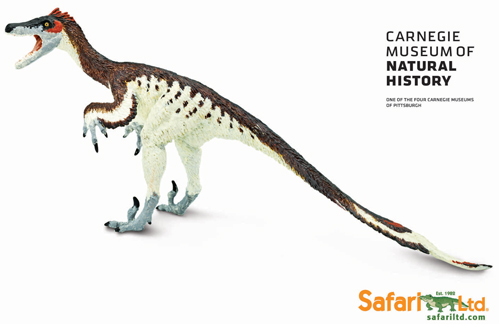
| The new Carnegie Velociraptor figure. |
Let me preface this post with a few disclaimers. One, I have no problem with people making dinosaur art however they like. But I feel it's very important to draw a distinction between dinosaur art in general and paleoart. Creating a drawing, painting, or sculpture under the guise of paleoart implies that some degree of research went into the piece. When evaluating paleoart, critics are completely entitled to demand as rigorous an approach to accuracy as the evidence allows. Of course, speculation must be included to some degree, but the baseline expectation is always that basic facts and plausible inference will be taken into consideration.
Dinosaur art is a for of pop art, a purely artistic expression. Paleoart is a representation of a scientific hypothesis about the life appearance and behavior of an extinct organism.
This recent Twitter kerfuffle was due specifically to the debut of a new dinosaur figure in the Carnegie Collection produced by Safari Ltd. I've been a big fan of the Carnegie figures (and the sometimes nicer quality Wild Safari sister series) since I was a wee lad buying my first Carnegie Pteranodon in a little hobby shop for about $2, and pining over their massive Brachiosaurus. Carnegie figures have obvious appeal for scientifically-minded young dinosaur fans. First, most of them are made with a consistent scale (usually 1:40), so when you line them all up you can see how big each animal was compared to one another. Second, they are marketed as having the highest level of scientific authority: the Carnegie Museum stamp and assurances that hey are approved by actual paleontologists gives them the weight of authority and accuracy not found in many other toy lines. Sure, many of the older figures, including my Pteranodon, are now sorely out of date, but this is due largely to the Science Marches On effect rather than a basic, original inaccuracy.
However, like many paleoartists, the sculptors at Carnegie and related accuracy-minded/marketed toy lines seem to be having, well, let's say a little trouble adapting to the feathered revolution. Trained in the '80s and '90s drawing and sculpting Paulian, reptilian dinosaurs, it's been a steep learning curve for many of these artists to switch to bird-like, feathered dinosaurs, which many artists don't even realize requires a crash course in avian anatomy, rather than reptile or mammal anatomy, to get right. This is why expert consultants are so important in these projects--artists simply need help catching up with the latest research. Unfortunately, they're usually getting bad advice from "experts" who simply do not care.
The newest entry in the Carnegie Collection is the old favorite Velociraptor. Carnegie had previously released a scaly Velociraptor, but like many of their other models, they have commendably updated it to try and reflect current science. Unfortunately, it seems they mainly achieved this by slapping feathers over the basic original model with no regard for the fact that feathers inherently change the entire presentation and outline of an animal. Unlike fur or "protofeathers", which just fluff up the outline of an animal, feathers are more like a mobile exoskeleton that re-defines the entire body.
![]() |
| My own hypothesis, based on fossil and phylogenetic evidence as well as inference from living analogues, about the life appearance of Velociraptor. |
Specifically, the wings in the new Velociraptor figure are very small, with short feathers, and are present only on the forearm, not the hand, making them only half a wing--literally, since they're issuing the primary feathers. We do not have direct evidence of primaries, but we have never found a single example of a maniraptoran that has secondaries but not primaries, and so it should be assumed they were there by default. As for secondaries, we have direct evidence in the form of quill knobs for this species. Quill knobs are not found in all feathered animals, let alone all flying birds, and seem to be associated with strong attachment either due to high-stresses during flight or other flapping behavior and/or especially large/long individual feathers.
Long story short: Not only did Velociraptor have wings, it probably had larger wings than many other dromaeosaurids. AFAIK not even Microraptor and Archaeopteryx had quill knobs to support their wings.
The new Carnegie figure, on the other hand, barely has wings at all. What went wrong?
Some insight can be gained by a recent series of incidents involving sculptor Dan LoRusso on the message board of the Dinosaur Toy Blog. LoRusso Is an amazing artist and is responsible for some of my all-time favorite dinosaur figures released in the Boston Museum of Science Collection by Battat (now being re-released with updates and new figures under the Terra brand). Collectors were understandably excited about the fact that the Battat series was coming back after nearly two decades, though the excitement was dampened a little by some obvious accuracy issues in the new figures, specifically when it came to the feathered species (or species that should have been feathered).
LoRusso was criticized online for producing a very well done but very inaccurate therizinosaur figure which completely lacked feathers. It would have fit right in with the excellent quality and Paulian style of the original series... back in 1994. But in 2014, when we have incontrovertible proof that therizinosaurs were not only feathered but that at least smaller species were very densely feathered, it is simply bizarre to see a featherless figure in a line that is being marketed as scientifically accurate. LoRusso stated that his consultants told him larger therizinosaurs would have been featherless. It's not LoRusso's fault that he somehow was able to sculpt a bald maniraptoran in the year 2013. Somebody who did not know what they were talking about and claiming to be an expert in paleoart just because they work in the related field of paleontology told him to do it, and he very reasonably believed them because they were an "expert", though obviously they had misrepresented themselves.
And there's the biggest problem and probably the answer to the question of what is going on with these strange and obvious inaccuracies. Paleoart consultants for major projects tend to be, often but not always, simply terrible. They seem not to know what they are talking about. Not only that, but second-hand reports suggest that they often simply do not care. Seriously: When asked about blatant inaccuracies creeping into paleoart-based projects like toys or books or even press releases, at least one anonymous paid paleontological consultant stated that they don't care what dinosaurs looked like in life, and so would presumably rubber-stamp any abomination that came across their desk.
@mpmartyniuk You know I've spoken to working palaeontologists who even say that they >don't care< about depicting life appearance?
— Darren Naish (@TetZoo) October 4, 2014
Here's a prime, objective example: The Carnegie Collection Caudipteryx zoui figure. This species was first found in 1998, a complete skeleton with feather impressions. There are plenty of photos of Caudipteryx fossils that show crystal clear how the feathers attach and were ignored completely for this figure. The artist might have copied some inaccurate depiction rather than doing actual research or glancing at a fossil, and the consultant approved it because they didn't know or didn't care about the relevant details. The Carnegie Caudipteryx proves that consultants are utterly useless and often have no clue what they're talking about. Any one of us can compare the model with the fossil and show that the model is objectively wrong in major details. Look for yourself:| Caudipteryx wing fossil: note the primaries, longer than the hand, anchored along the second finger, and lack of a clawed third finger. |
| Carnegie Collection Caudipteryx figure. Note the wing feathers anchored everywhere along the arm EXCEPT on the second finger where they belong, and the incorrect number of fingers. |
It's not fair to ask all working paleontologists to know or care how their research into fossils translates into life appearance. Matching osteological and behavioral correlates with the structure and anatomy of living analogues could almost be considered a distinct field separate from actual paleontology. This is something paleoartists can and do think about and research constantly, but would almost never need to enter into the research when describing fossils. There's really no reason for working paleontologists to keep up to date with developments and research that go into paleoart.
The solution? Don't ask these paleontologists to consult! Just because someone is a paleontologist does not make them an expert on the life appearance of any given species of prehistoric organism. The examples cited above were, allegedly, all approved by "expert" consultants. This simply proves the consultants that are being employed are utterly failing at their job. I hate to say it, but there are legions of paleoartists and other dinosaur fans online who jump at the chance to criticize and nitpick and otherwise consult on these things for free. It's just that by the time the product is released, it's too late to do anything about inaccuracies. If companies that use paleoart would simply post concept art beforehand on, say, Facebook, they could probably get much better advice for free. Or, preferably, they could employ actual paleoartists as experts, hopefully artists who specialize in researching the life appearance of a given subject group of organisms.
Darren Naish, Mark Witton, and John Conway recently published an article on the (shameful) state of paleoart as used in professional and commercial contexts. Companies like Safari Ltd. would do well to listen to their advice.
Wednesday, July 16, 2014
People Think Feathered Dinosaurs Don't Look Scary. They're Right.
This short article on io9 pretty well encapsulates an area of frustration for artists and scientists in the age of feathered theropods.
The implication is, right from the title, that it's common knowledge most depictions of feathered T. rex are not cool. Feathered theropods are widely derided by the public because feathers make these scary reptilian monsters less scary. In a recent Facebook discussion, I took one of those "short pelt raptor" images to task for inaccuracy (you know, the kind that pays lip service to the idea of feathered theropods, but with the minimum possible change to the classic silhouette, with a cat-like short pelt rather than a bird-like poof of feathers engulfing the body). In my reply I kind of hypothesized that there's an evolutionary psychology* reason for our aversion to feathered theropods and our cat-like concessions to the idea.
As Andrea Cau has pointed out, paleoartists (myself included), consciously or not, often employ all kinds of subtle tricks to make feathered theropods look "cool". Leaving the face scaly and reptilian is a popular trick; his body might say "Big Bird", but his face tells you he means business. Face fully feathered? Introduce an eagle-like lowered "brow" or some kind of eyebrow analogue so his facial expression can look "mean". Make sure his mouth is open or he's prominently displaying his other weapons in a ninja-like fighting stance. And be sure if you make him colorful, use high contrast, red and black if possible, and light it so his face is in shadow--that way you know he's thinking evil thoughts. This might also allow you to add eye shine making the eyes look like demonic embers! (check back to the io9 article and see how many of these points that T. rex hits).
In the comments to the io9 article, there were the predictable bouts of resistance to the idea that T. rex could have had feathers at all. "It was too large! Large mammals don't have so much fur in hot climates!" The problem with comparisons to large mammals is that feathers are very different in structure from fur, and have very different insulating properties. Fur is mainly used to keep an animal warm, but thanks to the fact that feathers grown in adjustable, planar layers, and are better at trapping and regulating air flow, many large birds use their feathers to very effectively keep themselves cool by circulation while blocking the skin from absorbing direct sun. It may actually have been disadvantageous for a large animal to lose its feathers, especially if it lived in a hot sunny climate. The fully-feathered Yutyrannus was not significantly smaller than any but the largest T. rex. Most T. rex specimens fell short of the 6.8 tons estimated for the most gargantuan known adults like Sue, that is certainly not the species average size!
But, there was one comment that played right into my ego-psych hypothesis. The commenter basically stated that we know juvenile T. rex had feathers, but there's no reason to think adults kept them. Except even that premise is wrong. There is in fact zero direct evidence to support the hypothesis that T. rex juveniles had feathers, let alone that they had them and then lost them. It's simply easier for people to assume that a baby animal, which is supposed to be cute, had feathers, which we psychologically associate with cute animals.
It is actually less of a stretch (i.e. more parsimonious) to hypothesize that based on its phylogenetic bracket, T. rex had feathers and retained them throughout its life, than the hypothesis that T. rex was born with feathers, lost them because they became disadvantageous at some unspecified weight, then through some unknown developmental pathway replaced its feathers with the kind of thick, scaly skin it is usually depicted with and would need to protect itself from the sun/injury if it lacked feathers. But this convoluted thinking is easier for people to accept because T. rex is the king of all monsters, and monsters are by definition not cute.**
The sad fact is, T. rex may not have looked all that cool. I think John Conway and others have brought this up before. It, and many if not most other dinosaurs, may very well have looked really, really stupid to us. Nature doesn't care if an animal looks intimidating to a species that evolved 66 million years later in a completely different environmental context alongside a vastly different set of predators. Our brains are programmed to find mammalian and reptilian predators scary at least in part* because we evolved alongside these and our survival depended on it. We had no such pressure for most kinds of birds***, and maybe coincidentally, we find very few kinds of birds the least bit intimidating. We have to be told/shown that a cassowary is even capable of being dangerous, and people still constantly trot this out as a surprising fact, despite the fact that it has very few physical differences from a Velociraptor, other than being much larger!
So, if your average Joe met a non-avialan theropod in real life, the reaction might be less like any of the raptor scenes in the original Jurassic Park and more like Newman vs. the cute, colorful, silly, hopping (read: bird-like) dilophosaur - bemusement leading to injury.
* I know evo psych is mostly made up of untestable just-so-storys. But it's still fun to think about.
** That's sarcasm. Tyrannosaurs were not monsters, they were plain old regular animals. A lesson people forget from the original Jurassic Park (probably because they're not actually depicted hat way in the movie, despite the fact that the characters talk about it).
***Raptors seem to be the exception. Probably because they preyed on early humans, and maybe also because of their mean-looking "eyebrows"?
![]() |
| Ooh, I'm shakin' in my boots. Photo by Simon Rumble, licensed. |
As Andrea Cau has pointed out, paleoartists (myself included), consciously or not, often employ all kinds of subtle tricks to make feathered theropods look "cool". Leaving the face scaly and reptilian is a popular trick; his body might say "Big Bird", but his face tells you he means business. Face fully feathered? Introduce an eagle-like lowered "brow" or some kind of eyebrow analogue so his facial expression can look "mean". Make sure his mouth is open or he's prominently displaying his other weapons in a ninja-like fighting stance. And be sure if you make him colorful, use high contrast, red and black if possible, and light it so his face is in shadow--that way you know he's thinking evil thoughts. This might also allow you to add eye shine making the eyes look like demonic embers! (check back to the io9 article and see how many of these points that T. rex hits).
In the comments to the io9 article, there were the predictable bouts of resistance to the idea that T. rex could have had feathers at all. "It was too large! Large mammals don't have so much fur in hot climates!" The problem with comparisons to large mammals is that feathers are very different in structure from fur, and have very different insulating properties. Fur is mainly used to keep an animal warm, but thanks to the fact that feathers grown in adjustable, planar layers, and are better at trapping and regulating air flow, many large birds use their feathers to very effectively keep themselves cool by circulation while blocking the skin from absorbing direct sun. It may actually have been disadvantageous for a large animal to lose its feathers, especially if it lived in a hot sunny climate. The fully-feathered Yutyrannus was not significantly smaller than any but the largest T. rex. Most T. rex specimens fell short of the 6.8 tons estimated for the most gargantuan known adults like Sue, that is certainly not the species average size!
But, there was one comment that played right into my ego-psych hypothesis. The commenter basically stated that we know juvenile T. rex had feathers, but there's no reason to think adults kept them. Except even that premise is wrong. There is in fact zero direct evidence to support the hypothesis that T. rex juveniles had feathers, let alone that they had them and then lost them. It's simply easier for people to assume that a baby animal, which is supposed to be cute, had feathers, which we psychologically associate with cute animals.
![]() |
| Are one of these things is not as scary as the other? Illustrations by M. Martyniuk, all rights reserved. |
The sad fact is, T. rex may not have looked all that cool. I think John Conway and others have brought this up before. It, and many if not most other dinosaurs, may very well have looked really, really stupid to us. Nature doesn't care if an animal looks intimidating to a species that evolved 66 million years later in a completely different environmental context alongside a vastly different set of predators. Our brains are programmed to find mammalian and reptilian predators scary at least in part* because we evolved alongside these and our survival depended on it. We had no such pressure for most kinds of birds***, and maybe coincidentally, we find very few kinds of birds the least bit intimidating. We have to be told/shown that a cassowary is even capable of being dangerous, and people still constantly trot this out as a surprising fact, despite the fact that it has very few physical differences from a Velociraptor, other than being much larger!
So, if your average Joe met a non-avialan theropod in real life, the reaction might be less like any of the raptor scenes in the original Jurassic Park and more like Newman vs. the cute, colorful, silly, hopping (read: bird-like) dilophosaur - bemusement leading to injury.
* I know evo psych is mostly made up of untestable just-so-storys. But it's still fun to think about.
** That's sarcasm. Tyrannosaurs were not monsters, they were plain old regular animals. A lesson people forget from the original Jurassic Park (probably because they're not actually depicted hat way in the movie, despite the fact that the characters talk about it).
***Raptors seem to be the exception. Probably because they preyed on early humans, and maybe also because of their mean-looking "eyebrows"?
Sunday, June 15, 2014
What Does T. rex Say?
![]() |
| "Hissssssssssssssssss!" T. rex holotype specimen. Photo by Scott Robert Anseimo, CC BY-SA 3.0. |
But how close to reality are these sounds? Do we have any ways of using science to figure out what dinosaurs and other stem-birds may have sounded like? Do we have evidence that they made sounds at all?
Sunday, May 18, 2014
Review: Papo Archaeopteryx
Saturday, January 25, 2014
Oh, Hi, Bohaiornithids!
It's not often that we are introduced to a large new clade of stem-birds*, but a new paper by Wang et al. finds support for just such a thing among the enantiornithes. Named Bohaiornithidae, the family unites a few previously-known similar-looking opposite birds with two brand new species.
![]() |
| Phylogeny of Bohaiornithidae, modified after Wang et al. 2014. |
Sunday, September 8, 2013
Iridescence in Simple Feathers - The Case of the Blue Troodon
![]() |
| Iridescent feathers in troodontids - possible? Image by Matt Martyniuk, all rights reserved. (Supreme dino fans may recognize the pose even from this small clip...) |
Sunday, September 1, 2013
You're Doing It Wrong : Dino Foot Scales
![]() |
| Above: Our subject matter. |
These kinds of unjustified assumptions have been rampant in the history of studying stem-birds. Archaeopteryx has traditionally been depicted, incorrectly, with a reversed hallux, and occasionally even with beak-like structures, simply because it's a "bird", and those are features all birds have. Except Archaeopteryx is not a true "bird", it's a stem-bird, more closely related to birds than to any other living animal group, but not a member of the group that includes all modern birds. It's fair to assume that an extinct member of the duck lineage, like Vegavis, had a bill, but that's not necessarily so for, say, Patagopteryx, despite the fact that it is usually referred to as a "bird".
![]() |
| Modern bird feet, by Philip Henry Gosse, 1849, public domain. Note overlapping scutes on the top surfaces, and pebbly, polygonal reticulae on the bottom surfaces. |
Most paleoartists have absorbed these kinds of warnings, and do a good job of avoiding obvious errors based on typology, the assumption that all species in a certain "type" share "key characteristics." But there are some typological memes in the bird lineage that are more pernicious, possibly because their actual evolution is something most artists don't think about very much.
Take, for example, the bird-like scutes that are almost universally illustrated covering the tarsus (upper foot/lower hind limb) of dinosaurs. Is there any evidence that these were actually present in any given group of non-theropod stem birds? Well... no. Not that I'm aware of (if you know differently, please comment!).
![]() |
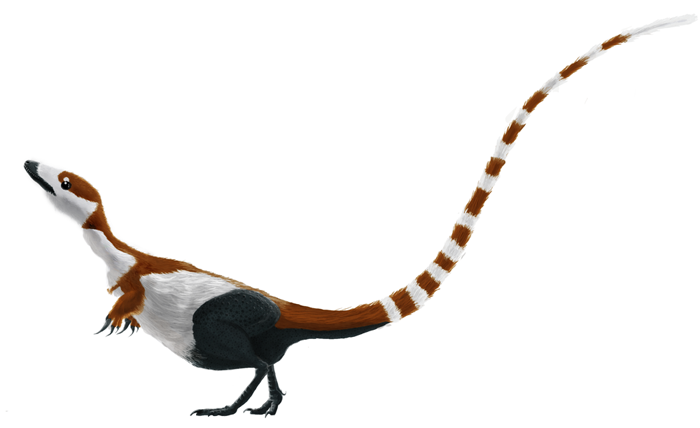
| Sinosauropteryx prima with tarsal scutes. Image by Matt Martyniuk, licensed. |
Of course, like many paleo-memes that developed during the 1980s, the main idea seems to be using this as a flourish to make otherwise scaly dinosaurs seem more bird-like. And thanks to skin impressions, we know that many dinosaurs had scales, right?
Monday, August 19, 2013
Follow-Up: Judith River Formation = Oldman Formation
In a previous post, I hung my tentative re-identification of the holotype teeth of Deinodon horridus on a rough correlation between the Judith River and Oldman formations, the latter of which is more precisely dated and, more importantly, contains Daspletosaurus torosus, which is a candidate for the owner of Deinodon teeth.
While researching a different topic, I stumbled across a more definitive published correlation of these two formations I wasn't previously aware of. In their 2001 paper on the stratigraphy of the Two Medicine Formation, Horner et al. discuss the correlation of parts of that formation with the Judith River. Horner et al. note that the Judith River can be separated into two basic units divided by a disconformity, corresponding with a marine transgression (when the terrestrial ecosystem was swamped by the rising of the Western Interior Seaway, the sediments deposited by which appear to have been lost in this instance).
Helpfully, Horner et al. note that it is from the lower unit that Hay collected numerous dinosaur teeth which were later described by Leidy as the infamous tooth taxa such as Deinodon, Aublysodon, Trachodon, and Troodon. More helpful still, the paper provides a handy chart showing the arrangement of the strata and including points at which radiometric dates have been taken. The base of the lower Deinodon-bearing unit is dated at about 78 million years old. The next available date is from just above the disconformity (i.e. after the seaway had retreated again) and shows an age of 75.4 million years ago. That's narrowing it down, but there's no date from within the formation from just below the disconformity, which would give us an upper boundary for the Deinodon strata.
But, there's hope. Horner et al. note that Rogers (1998) suggested the disconformity itself probably correlates to around the Willow Creek Anticline in the middle Two Medicine Formation (which contains the famous Egg Mountain Maiasaura nesting site). This segment of the TMF has been dated to 76.7 Ma ago, which may give us a rough upper boundary for the age of Hay's fossil tooth collection.
So, based on this paper at least, it looks like Deinodon and friends were collected from rocks aged somewhere between 78 and 76.7 million years old. Which is about the same age range as the Oldman Formation to the north. So, Deinodon horridus and Daspletosaurus torosus did indeed live at about the same time and in the same region (there were no checkpoints at the US-Canadian border back then!), making it more likely that they represent the same species, and the possibility that Deinodon actually represents Gorgosaurus less likely.
Looks like I'm going to have to create a new tag for Arcane Biostratigraphy and Geology Stuff...
Oh, and somebody in the comments last time asked me to get into Trachodon. This is definitely a subject for a longer blog post, though I'm a bit less excited about it because I'm more pessimistic that it's identity is knowable. But maybe this new info can help us get started. I already mentioned that the Trachodon teeth appear to come from the same strata as Maiasaura (and it's well known that Trachodon's contemporary Troodon formosus is reported from Egg Mountain as well, though T. formosus is also reported from pretty much everywhere and everywhen else...). Could Maiasaura be Trachodon? Perhaps! But it could also be Brachylophosaurus, or maybe even Gryposaurus. And... there's been a rumor going around for a while now that Trachodon teeth are referable to Lambeosaurinae. Which lambeosauines are known from this time and place that could fit the bill? Both Parasaurolophus and Corythosaurus have been reported from the uppermost Oldman, though these may be too young. Hypacrosaurus sp. seems to have been contemporary with Maiasaura, so that could be it...
Yeah, you can see why I'm pessimistic. Tyrannosaurids are rare, and there tend to be only one or two species of tyrannosaurids present in any given ecosystem. Hadrosaurids are... the opposite.
References
Horner, J. R., Schmitt, J. G., Jackson, F., & Hanna, R. (2001). Bones and rocks of the Upper Cretaceous Two Medicine-Judith River clastic wedge complex, Montana. In Field trip guidebook, Society of Vertebrate Paleontology 61st Annual Meeting: Mesozoic and Cenozoic Paleontology in the Western Plains and Rocky Mountains. Museum of the Rockies Occasional Paper (Vol. 3, pp. 3-14).
While researching a different topic, I stumbled across a more definitive published correlation of these two formations I wasn't previously aware of. In their 2001 paper on the stratigraphy of the Two Medicine Formation, Horner et al. discuss the correlation of parts of that formation with the Judith River. Horner et al. note that the Judith River can be separated into two basic units divided by a disconformity, corresponding with a marine transgression (when the terrestrial ecosystem was swamped by the rising of the Western Interior Seaway, the sediments deposited by which appear to have been lost in this instance).
Helpfully, Horner et al. note that it is from the lower unit that Hay collected numerous dinosaur teeth which were later described by Leidy as the infamous tooth taxa such as Deinodon, Aublysodon, Trachodon, and Troodon. More helpful still, the paper provides a handy chart showing the arrangement of the strata and including points at which radiometric dates have been taken. The base of the lower Deinodon-bearing unit is dated at about 78 million years old. The next available date is from just above the disconformity (i.e. after the seaway had retreated again) and shows an age of 75.4 million years ago. That's narrowing it down, but there's no date from within the formation from just below the disconformity, which would give us an upper boundary for the Deinodon strata.
But, there's hope. Horner et al. note that Rogers (1998) suggested the disconformity itself probably correlates to around the Willow Creek Anticline in the middle Two Medicine Formation (which contains the famous Egg Mountain Maiasaura nesting site). This segment of the TMF has been dated to 76.7 Ma ago, which may give us a rough upper boundary for the age of Hay's fossil tooth collection.
So, based on this paper at least, it looks like Deinodon and friends were collected from rocks aged somewhere between 78 and 76.7 million years old. Which is about the same age range as the Oldman Formation to the north. So, Deinodon horridus and Daspletosaurus torosus did indeed live at about the same time and in the same region (there were no checkpoints at the US-Canadian border back then!), making it more likely that they represent the same species, and the possibility that Deinodon actually represents Gorgosaurus less likely.
Looks like I'm going to have to create a new tag for Arcane Biostratigraphy and Geology Stuff...
Oh, and somebody in the comments last time asked me to get into Trachodon. This is definitely a subject for a longer blog post, though I'm a bit less excited about it because I'm more pessimistic that it's identity is knowable. But maybe this new info can help us get started. I already mentioned that the Trachodon teeth appear to come from the same strata as Maiasaura (and it's well known that Trachodon's contemporary Troodon formosus is reported from Egg Mountain as well, though T. formosus is also reported from pretty much everywhere and everywhen else...). Could Maiasaura be Trachodon? Perhaps! But it could also be Brachylophosaurus, or maybe even Gryposaurus. And... there's been a rumor going around for a while now that Trachodon teeth are referable to Lambeosaurinae. Which lambeosauines are known from this time and place that could fit the bill? Both Parasaurolophus and Corythosaurus have been reported from the uppermost Oldman, though these may be too young. Hypacrosaurus sp. seems to have been contemporary with Maiasaura, so that could be it...
Yeah, you can see why I'm pessimistic. Tyrannosaurids are rare, and there tend to be only one or two species of tyrannosaurids present in any given ecosystem. Hadrosaurids are... the opposite.
References
Horner, J. R., Schmitt, J. G., Jackson, F., & Hanna, R. (2001). Bones and rocks of the Upper Cretaceous Two Medicine-Judith River clastic wedge complex, Montana. In Field trip guidebook, Society of Vertebrate Paleontology 61st Annual Meeting: Mesozoic and Cenozoic Paleontology in the Western Plains and Rocky Mountains. Museum of the Rockies Occasional Paper (Vol. 3, pp. 3-14).
Tuesday, August 13, 2013
Did Jurassic Park Name T. rex?
![]() |
| T. rex illustration by Matt Martyniuk, licensed. |
Sunday, July 14, 2013
Deinodon's Identity Revisited
Tuesday, June 4, 2013
You're Doing It Wrong: CGI Feathered Dinosaurs
![]() |
| YIKES. Promotional still from When Dinosaur Roamed America, Discovery Channel 2001 |
Saturday, April 20, 2013
Supporting the Dinosaur/Bird Link in the Era of the MANIAC
I'm posting this more as an open question than a statement of my own opinion, so comments appreciated!
A new paper out in Paleobiology by Verracchio et al. describes the porosity of Troodon formosus eggs and uses the data as evidence to support the hypothesis that troodontids brooded their eggs, like modern birds and other known maniraptorans, rather than burying them, like crocodilians and some other modern birds. In and of itself, this conclusion is interesting in that it pretty much solidifies nest brooding (as opposed to burial) as the ancestral trait for modern birds, and for maniraptorans (or at least chuniaoans*) in general.
I hate to admit it, but my first thought when reading the headline of this news article from PhysOrg was that, yeah, we all assumed that anyway. The unspoken "rule of cool" is that science tends to be more exciting when we find evidence that contradicts previously well-supported hypotheses, rather than confirming hypotheses we all took for granted. Sure, finding the Higgs-Boson was exciting, but not nearly as exciting as not finding it, which could have led to new physics. I assumed, and I'm sure many others did as well, that troodontids brooded their eggs, based on the reasonably secure hypothesis that oviraptorids (which are known to have done so) are more basal. This behavior in troodontids was even depicted nicely in 2011's Dinosaur Revolution. So score another one for phylogenetic bracketing!
(Of course, this is not to imply that all chuniaoans must have brooded their eggs. It's entirely possible that reversals to burial nesting occurred, as with modern megapodes, and this seems especially likely for very large species like some dromaeosaurines. But the odds that any given chuniaoan would not be a brooder are low.)
Aside from all that, the assertion in the PhysOrg headline struck me as particularly meaningless. How could a study of troodontid brooding lend support to the dinosaur/bird hypothesis? This statement would have been accurate a decade ago, but not today. The reason is the moving goalposts of the dinosaur/bird opposition.
A new paper out in Paleobiology by Verracchio et al. describes the porosity of Troodon formosus eggs and uses the data as evidence to support the hypothesis that troodontids brooded their eggs, like modern birds and other known maniraptorans, rather than burying them, like crocodilians and some other modern birds. In and of itself, this conclusion is interesting in that it pretty much solidifies nest brooding (as opposed to burial) as the ancestral trait for modern birds, and for maniraptorans (or at least chuniaoans*) in general.
| Study coauthor Darla Zelenitsky with Troodon formosus nest. Photo by Jay Im, University of Calgary. |
(Of course, this is not to imply that all chuniaoans must have brooded their eggs. It's entirely possible that reversals to burial nesting occurred, as with modern megapodes, and this seems especially likely for very large species like some dromaeosaurines. But the odds that any given chuniaoan would not be a brooder are low.)
![]() |
| Arctic troodontids, anatomy based on Troodon formosus. Matt Martyniuk, all rights reserved. |
Friday, November 2, 2012
The Flying Longipterygids
I started to get a little carried away in my previous post on longirostrisavisine tails, so I decided to split the finished post in half and use this one to delve a little more into the possible implications the odd tails and clawless wings of that group would have had on their flight styles.
As mentioned previously, longirostravisines, unlike most other enantiornitheans, lacked claws on all three of their manual digits, a trait apparently acquired separately of the Carinatae (Ichthyornis + modern birds). In the last post I speculated that this might have reflected a distinct flying (or at least landing) style. But how much do we really know about longipterygid flight?
In their recent paper, Close & Rayfield attempted to correlate wishbone (furcula) shape with flight style. Many enantiornitheans in the analysis plotted together in a cluster well separated from modern birds, but close to basal avialans like Confuciusornis which are usually presumed to have been gliders. Oddly, in the Close & Rayfield figure reproduced above, Rapaxavis (no. 103), a longirostravisine, clusters with the weirdo enantiornithean-style fliers, while more basal longipterygid Longipteryx (no. 98) groups with continuous-flapping fliers and is marked as an ornithurine (something seems off here).
In another recent open-access paper on Mesozoic bird flight styles, Wang et. al (2011), using wing element and primary feather length ratios, found Longirostrisavis to be a continuous-flapping flier, and Longipteryx either a continuous-flapping or a flap-gliding flier, roughly the opposite result of the Close & Rayfield furcula-based analysis.
The fact that two independent analyses using two distinct methods produced different results probably does not bode well for the precision of either method. Clearly, we need to figure out better methods to more reliably tests flight styles in extinct birds.
As mentioned previously, longirostravisines, unlike most other enantiornitheans, lacked claws on all three of their manual digits, a trait apparently acquired separately of the Carinatae (Ichthyornis + modern birds). In the last post I speculated that this might have reflected a distinct flying (or at least landing) style. But how much do we really know about longipterygid flight?
In their recent paper, Close & Rayfield attempted to correlate wishbone (furcula) shape with flight style. Many enantiornitheans in the analysis plotted together in a cluster well separated from modern birds, but close to basal avialans like Confuciusornis which are usually presumed to have been gliders. Oddly, in the Close & Rayfield figure reproduced above, Rapaxavis (no. 103), a longirostravisine, clusters with the weirdo enantiornithean-style fliers, while more basal longipterygid Longipteryx (no. 98) groups with continuous-flapping fliers and is marked as an ornithurine (something seems off here).
In another recent open-access paper on Mesozoic bird flight styles, Wang et. al (2011), using wing element and primary feather length ratios, found Longirostrisavis to be a continuous-flapping flier, and Longipteryx either a continuous-flapping or a flap-gliding flier, roughly the opposite result of the Close & Rayfield furcula-based analysis.
The fact that two independent analyses using two distinct methods produced different results probably does not bode well for the precision of either method. Clearly, we need to figure out better methods to more reliably tests flight styles in extinct birds.
Saturday, August 11, 2012
Did Sinosauropteryx Have "Protofeathers"?
![]() |
| Life restoration of the S. prima type specimen by M. Martyniuk |
Friday, August 10, 2012
The Strange Bird Dalianraptor cuhe
| Type specimen of D. cuhe, originally posted by Andrea Cau |
D. cuhe has spent the last several years as a species in obscurity, even among most paleontology enthusiasts. I recall my first glimpse of the type specimen, wondering over the seemingly-complete remains of an "undescribed possible dromaeosauird" in a low-res photo posted online in the early '00s. I can remember saving the image to my reference folder, hoping that one day I'd be able to update the file name. It's a fascinating animal, but... is it real?
Wednesday, August 1, 2012
The Tail of Shanweiniao
![]() |
| Fossil tail feathers of S. cooperorum, from O'Connor et al., 2009. |
S. cooperorum itself is most well-known for its elaborate tail made up of six ribbon-like feathers. Those feathers overlapped at the base, and may have acted as an air brake for precise landings with the feet on small branches. It's possible that most other enantiornitheans, which lacked long feathery tails and also retained wing claws, landed by simply smacking clumsily into tree trunks or brush and grabbing on with all four limbs.
Subscribe to:
Posts (Atom)