Showing posts with label history. Show all posts

Friday, August 31, 2018

The Many Crests of Pterodactylus

Little Pterodactylus,  from the late Jurassic period of Bavaria, was one of the first pterosaurs ever discovered (a story you can read all about in my book Beasts of Antiquity). Represented by numerous juvenile and subadult specimens, it's among the better understood pterosaurs as well, especially if you include a few controversial specimens that have recently been argued to represent distinct genera such as Aerodactylus (a conclusion many pterosaur specialists remain skeptical of, but that's a topic for another post).

Although many Pterodactylus specimens preserve soft tissue, one pretty important aspect of their biology is NOT so well understood - their crests. In the past few decades, it has become apparent that crests of one kind or another are a hallmark of most pterodactyloid pterosaurs (and even a good number of non-pterodactyloids). Crests were first reported for Pterodactylus itself by Doderlein in 1929, but it was almost never depicted with a crest in art afterwards. The first-ever crested Pterodactylus was probably a toy. In 1988, Tyco released a crested Pterodactylus toy as part of their "Dino-Riders" line. Though produced under the supervision of Bob Bakker, it's unclear whether or not the crest was based on Bakker's inside knowledge of pterosaurs or was just a lucky guess added to give a fairly plain pterosaur toy more flair. Bakker himself had illustrated Pterodactylus without any crests in The Dinosaur Heresies several years earlier. Despite the fact that Peter Wellnhofer described a lappet "crest" (see below) for Pterodactylus in 1970, and even figured this specimen in his popular 1996 book The Illustrated Encyclopedia of Prehistoric Flying Reptiles, illustrations in that same book depicted Pterodactylus as crestless.

Photo of Pterodactylus specimen BSP 1929 I 18, from Wellnhofer 1996. You can see a thin occipital lappet extending diagonally up from the back of the skull.

The dubious Tyco example aside, the concept of a crested Pterodactylus didn't really reach the popular consciousness (and had apparently been forgotten by science, much like several other "modern" ideas about pterosaurs that were really discovered by 19th and early 20th century German paleontologists) until the first ultraviolet florescence studies done by Eberhard Frey and Helmut Tischlinger in the late 1990s and early 2000s. They produced what, at the time, seemed like a very bizarre reconstruction of a pterosaur, especially one like Pterodactylus which was somewhat famous for being the 'crestless one' (as opposed to its more famous, crested cousin, the giant Pteranodon). The illustration that was sent out in press materials about the early UV studies showed a shaggy mane of filaments on the neck, big, floppy webbed feet, a throat pouch, and a big, teardrop-shaped crest that extended above and behind the eyes. Clearly, the UV analysis had totally overhauled our image of Pterodactylus.

Frey and Tischlinger's reconstruction of Pterodactylus based on UV studies.

Or did it? The actual UV papers are still difficult to come by online, so early on it was difficult if not impossible for many paleoartists to examine the source material themselves. In the mean time, Frey's Pterodactylus became the gold standard for accuracy, with savvy artists beginning to incorporate the mane, webbed feet, and distinctive crest into their own work, all based not on any photos or diagrams of fossils, but simply on Frey's pencil drawing. Here's my own early take on the "new" Pterodactylus. Note that, in order to try and be a little different, I applied the UV soft tissue findings to a different specimen, the holotype of Pterodactylus brevirostris (which may actually be a juvenile Ctenochasma!).
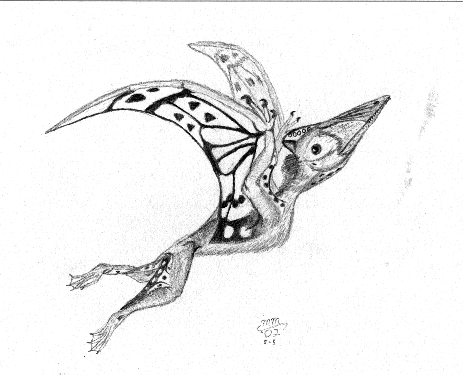

Note that this was done in June 2002, shortly after the publication of Frey's English-language work summarizing the UV findings of the past few years. I later sketched out a version based more directly on Frey's original drawing:

A couple of things turned out to be... maybe not wrong, per se, but definitely speculative and not directly evidence-based, about the Frey-style Pterodactylus.

For one, that shaggy mane. Pterodactylus did indeed have a coat of unusually long pycnofibres on its neck. And by "unusually long", I mean that they are nearly half a centimeter long (compared to a ~10 cm long neck), unlike most of the incredibly tiny fibers coating the rest of the body. The "mane", therefore, would probably have appeared as a particularly fuzzy, bristly section of a short, dense coat.

As for the crest, none of the specimens show an oval shaped crest extending above and behind the eyes. What the few specimens we have of the crest show is actually two discrete crests or crest-like structures. The main crest, as preserved, is roughly triangular, with its peak just in front of the eyes. A second structure protrudes behind the skull. This has been called the "occipital lappet", and was first noticed by Wellnhofer in 1970. Superficially, the lappet resembles a small version of the crest of Pteranodon. Or, maybe more appropriately, the rear spar of the crest of Tupandactylus. In that tapejarid, the crest is comprised of two bony supports. One, roughly triangular in shape, above the snout. The other, a long horizontal spike, extends behind the skull. In between was an enormous, rounded crest composed of keratin or some other rigid soft tissue. The two "obvious" crests are merely the support struts for these larger structures. Frey imagined that in life, the triangular crest above the eyes and the occipital lappet may have been joined together into this kind of single structure, the apparent shape of the crests as preserved being an artifact of decomposition or post-mortem breakage. This interpretation has been followed by a majority of artists since, as a Google Image search will show.

You can see that an image search for "Pterodactylus crest" brings up some fossils and diagrams, 2 reconstructions of Pteranodon (of course), 1 of an ornithocheirid (somebody got confused?), 1 old-fashioned reconstruction with no crest, 3 different reconstructions with a triangular crest and separate lappet (one of which is my own), and 9 reconstructions with a Frey-style joined crest (again including one of my own!). 
Mark Witton, in his 2013 book Pterosaurs, was influential in popularizing an even larger tapejarid-like crest, which he included both in his reconstructions and skeletal diagrams. His reasoning for taking the Frey-style crest to the next level was based mainly on the general rule that pterosaur crests tend to be larger than they appear.

There are some important differences, though, that we should consider before speculating too much about a tapejarid-style crest in Pterodactylus. First, the two are not particularly close relatives, and tapejarid-like crests have not yet been found in any other pterodactyloid groups. Given the enormous crest diversity among pterosaurs, I'm not sure it's appropriate to assume they were all basically big ovals and differences are just preservational. Some other pterosaurs unrelated to Tupandactylus did have big, rounded crests, but these were more like semicircles erupting from the skull, not extending behind it or significantly above it (like wukongopterids and even some ctenochasmatoids closer to Pterodactylus itself). One other example of "enormous crest supported by bony struts" has been proposed in the form of Nyctosaurus, but despite some spectacular looking restorations out there, it's unlikely those enormous spars supported any soft tissue.

The huge, oval-shaped crest of Tupandactylus was supported by long bony crests that graded into soft tissue, unlike the totally soft crests of Pterodactylus. Photo from the AMNH pterosaur exhibit by Lisa Brormann.
Second, the supposed spars of the Pterodactylus crest are not made of bone! The reason Tupandactylus and other tapejarids can have those huge oval crests sitting on their heads is because they have bony supports. Even the smaller species like Tapejara wellnhoferi has a significant hard, bone-based component to its (possibly) large oval crest. In Pterodactylus, not only is the main crest comprised entirely of soft tissue with an unusually minimal amount of bone as an underlying base, the occipital lappet is not made of keratin at all. Upon close examination of the internal structure of the lappet, it seems to be supported internally by twisted fibers similar to those that make up the pycnofibre coat. The lappet would not have been flat in life, like the crest of Pteranodon, but conical. The fact that it is composed internally of fibers may imply that it was flexible, a result that would explain why it is preserved in different positions in different specimens (some curving upward, some straight). The lappet seems to have been more an extension of the skin integument than a typical crest, sort of like the wattles and caruncles of a turkey.

Possible crest reconstructions for Pterodactylus (based on specimen BSP 1929 I 18). Clockwise from top: Crest and lappet as preserved; joined crest after Frey 2002; joined crest after Witton 2013; minimally extended unjoined crest.
Diagram by M. Martyniuk 2018, all rights reserved. 
It's entirely possible that future specimens will show that we have Pterodactylus crest shapes wrong, or that the main crest was in some way attached to the lappet. But given the evidence right now, that interpretation is one of the less likely possibilities. A few prominent paleoartists who helped popularize the tapejarid-style crest have since produced lappeted ones, including Mark Witton and John Conway, both of whom, intriguingly, depicted the lappet as just part of the larger pycnofiber assemblage - Conway as an extension of the "mane", Witton as part of a larger set of display fibers). You can read more about Witton's new Pterodactylus reconstruction on his blog.

All of these reconstructions still go a bit beyond the known evidence by depicting large, flamboyant crests. As they probably should - Witton was correct when he pointed out that pterosaur crests were probably larger, in general, than traditionally thought. All of our crested Pterodactylus specimens are also sub-adult, so even though the soft tissue crests we have preserved seem to be pretty small, it's likely the crest would have gotten at least a little bigger with maturity. We just don't know how much bigger.

Reconstruction of a subadult Pterodactylus by M. Martyniuk.

Sunday, May 1, 2016

The First Feathered Dinosaurs (In Art)

The first illustration of a hypothetical "pro-avis" by Pycraft, 1906
Feathered non-avialan dinosaurs seem commonplace now, and it's hard to believe that there was a time, in living memory for some of us, when they were purely speculative. It makes sense, of course: once scientists realized (then realized again) that dinosaurs were the closest fossil relatives of birds, it was only natural to suggest that feathers had appeared in dinosaurs before they showed up in birds. To have a new type of animal, like Archaeopteryx, appear more or less fully formed with flight and feathers occurring simultaneously makes little sense in terms of evolution. Obviously, even if Archaeopteryx was considered the "first bird" or could fly in some rudimentary manner, it couldn't have been the first animal with feathers or feather-like integument. Feather-like structures had to have been present in the archaeopteryx's closest relatives. But what were those? For most of the 20th century, the answer would not have been dinosaurs.

Nopcsa's 1907 feathered, Compsognathus-like
"pro-avis" model at the Grant Museum, London.
Speculative bird ancestors with feathers or feather-like scales had been hypothesized and illustrated long before the first true feathered dinosaurs appeared in paleoart. These hypothetical "pro-aves", as they were generally termed, were first imagined by William Pycraft in 1906. Pro-aves were usually considered arboreal, gliding animals with elongated, feather-like scales, and Pycraft's illustration provided the template followed by many later illustrators, like Heilmann's 1916 version, and Burian's gorgeous but even more lizard-like 1960 rendition. Not all pro-avis illustrations followed this template, though. In 1907, Baron Nopcsa invented his own pro-avis, illustrating his hypothesis of a running, "ground-up" origin of bird flight. In addition to his illustration, Nopcsa created a wax model. Nopcsa thought birds might have evolved from quadrupedal reptiles which became more and more bipedal as their running speed increased, passing through a phase similar to Compsognathus, though not necessarily dinosaurian.

Beebe's "tetrapteryx", 1915.
There were also creatures like the "tetrapteryx", a speculative stage in the evolution of avian flight proposed by William Beebe in 1915. Beebe illustrated an Archaeopteryx-like creature with smaller wings as well as hind wings on splayed legs, reminiscent of early (but incorrect) illustrations of Microraptor. Other than the posture, the general anatomy of this hypothetical creature ended up being prescient by accident. His rationale for this hypothesis was the observation that some bird embryos develop and then lose feather quills on their legs. Heilmann, however, rejected this hypothesis after failing to find evidence among other bird embryos. New evidence to support this hypothesis was discovered in species like Microraptor, Anchiornis, and Sapeornis, which had various degrees of airfoils present on their hind legs, a line of evidence independent of the one supposed by Beebe. Though dinosaur-like in appearance, both Beebe and Heilmann considered the ancestors of birds to be "thecodont" grade archosaurs, not dinosaurs, so these hypothetical feathered thecodonts predated the first feathered dinosaurs in art.
Speculative reconstruction of a Triassic "carnavian" dinosaur
leaving feather traces in its trackway, from Ellenberger 1974.

The thecodont origin of birds did not truly give way to a dinosaur origin until the 1970s, after John Ostrom described the similarities between Archaeopteryx and Deinonychus. If dinosaurs were the new closest relatives of birds, then at least the most bird-like among them should be depicted with feathers (Ostrom himself disagreed with this though, and, according to Bakker, he fought the idea that Deinonychus should be feathered). Of course, which dinosaurs were most closely related to birds, and just how much of a gap remained between them and Archaeopteryx, allowed for considerable wiggle room and speculation.

A "carnavian" track maker
parachuting, from Ellenberger 1974.
In 1974, Ellenberger identified what he considered to be trace evidence for feathered dinosaurs from Lesotho, in the form of possible feather imprints and footprints which could have been made by small animals parachuting from trees, dragging their tail feathers in mud, etc. He illustrated a small bipedal dinosaur with feathers in the accompanying paper, along with totally speculative skeletal restoration of a new type of animal, nested within theropod dinosaurs, which he called "carnavians." Molnar, in 1985, dismissed the suggestion that these were feather imprints. Still, Ellenberger had become the first person to ever illustrate a non-avialan dinosaur, however hypothetical the species, with feathers.

Landry's influential 1975 restoration of "Syntarsus".
The next year, in 1975, a more famous feathered dinosaur illustration of a much better-known species was provided by Sarah B. Landry, drawn under the direction of Bob Bakker for his seminal article in Scientific American, "The Dinosaur Renaissance." Landry and Bakker depicted the small theropod "Syntarsus" (=Coelophysis) covered in overlapping feather-like scales or scale-like feathers, similar to Heilmann's "proavis", and a long tuft of feathers on the head. The choice of species was not a coincidence. Michael Raath, who had described Syntarsus in 1969 (the same year as Deinonychus), was quick to tout how bird-like it was in popular books and articles, and he suggested several times that it may have been feathered.

"Syntarsus" by Stout, 1976.

To understand the impact of this "first" feathered dinosaur, just look at the rest of the 1970s and early 1980s. It was Syntarsus, not Deinonychus, which was consistently drawn with feathers from then on. Many of these later reconstructions even directly aped Bakker and Landry's style of feather crest (or slightly modified it), making "Syntarsus with feather crest" a bona fide paleoart meme. Many of these left out the more subtle body feathers of the original, unfortunately, possibly influencing decades of "half-arsed" theropods with feather mohawks, up to including the dinosaurs in the 2001 film Jurassic Park III more than 20 years later. (One notable exception to the Syntarsus trend was also a watershed moment for paleoart. After reading Bakker's article, a paleoartist named Gregory S. Paul drew his first feathered dinosaur: an Allosaurus).

One of my favorite derivatives of Landry's Syntarsus illustration is one made in 1976 by William Stout and reproduced in Don Glut's 1982 edition of The New Dinosaur Dictionary. Though Glut pointed out that the feathers were speculative, they're probably less inaccurate than the legless snake it's eating! Also included in Glut's revised dictionary was one of the first illustrations of the theropod Kakuru, by Mark Hallett. Though just as speculative as Ellenberger's drawing (Kakuru is known only from two limb bones), it has more of a modern feel. The reclining theropod is decked out in long, filamentous feathers, rather than the broad, scale-like feathers of Landry's Syntarsus. It's worth noting that all of these early drawings of feathered dinosaurs had bare or scaly faces. This method of emphasizing the transitional character of early feathered theropods was probably inspired by traditional portrayals of Archaeopteryx, a "bird" with the head of a "reptile."

Feathered ornithischians, by Lorene Bjorklund, from
The Warm-Blooded Dinosaurs, 1979.
Many bird-like dinosaurs actually had feathers covering some or all of the face as well as the body, though some kind of "modular evolution" did occur to a degree in a few lineages (here's looking' at you, Darwinopterus). And some Mesozoic dinosaurs, most famously Kulindadromeus, seem to have feathers restricted to certain body segments with abrupt transitions between feathery and scaly regions. So, this much-maligned meme isn't necessarily out of the question, at least in early feathered lineages.

A few very early books featuring extremely prescient feathered dinosaurs came in 1978 and 1979. First, Julian May brought us perhaps the first renaissance-era dinosaur book for kids, The Warm-Blooded Dinosaurs, which featured not only a feathered Struthiomimus by Lorene Bjorklund on the cover, but several feathered ornithischians inside. An Iguanodon looks sort of ambiguously feathered (it might just be the crosshatched style), and interestingly, has a abrupt transition to a croc-scutes tail very similar to Kulindadromeus. There's also a skeletal of Microvenator with a fuzzy, Greg Paul style silhouette outline. The next year, Archosauria: A New Look at the Old Dinosaur by John McLoughlin includes some species with feathered faces for the first time, like his amazing, feathered Coelurus. It's odd as a modern reader to see that in both of these books, it's the more basal dinosaurs shown with feathers. Primitive ornithopods and "coelurosaurs" (considered a paraphyletic grade of early, ancestral dinosaurs at the time) like Syntarsus, Coelurus, and Saltopus are given feathers while deinonychosaurs like Saurornithoides and Deinonychus are not. The influence of the thecodont theory was still going strong, with birds thought to have evolved from the earliest dinosaurs rather than deinonychosaurs, which were exclusively known from the Cretaceous at that time.

Kakuru by Mark Hallett, from Glut 1982.

Ironically, Deinonychus, which out of all these dinosaurs was most similar to Archaeopteryx, did not become consistently or even frequently depicted with feathers until the at least the late 1980s. This was also probably due, in part, to artistic inertia. The original illustration of Deinonychus that accompanied Ostrom's description was so iconic that it was being copied well into the '90s. One of the first depictions of a feathered Deinonychus was a statuette produced by sculptor and founding father of Neopaganism Otter Zell (aka Oberon Zell). If anybody who owns a copy of this statuette wants to trade it for my right arm, please let me know.

After Syntarsus, the next non-avialan to become consistently depicted with feathers was Avimimus. From its first discovery, Avimimus was interpreted (and in some cases, like the supposed lack of a tail, misinterpreted) as being as birdlike or more than Archaeopteryx. Though commonly misreported online as having quill knobs, Avimimus actually had a flat ridge on the ulna which has been interpreted as a similar kind of support for the soft tissue of a feathered wing. Though not the same kind of direct evidence as quill knobs would be, most paleoartists ran with the suggestion, and most early Avimimus illustrations did portray it with feathers. John Sibbick restored it that way for David Norman's 1985 Illustrated Encyclopedia of Dinosaurs, and his version is a down-right throwback to the "pro-aves" of the early 1900s, with long, scale-like feathers on the outstretched arms and tail.
The first(?) feathered Deinonychus,
a statuette by Otter Zell, 1984.

1986 saw the publication of Bakker's The Dinosaur Heresies, filled with his own illustrations of feathered dinosaurs, including Deinonychus. (Stout and Paul had both continued to illustrate feathered dinosaurs up to this time, though not all were published or widely distributed at the time). Bakker's book opened up the door to more mainstream portrayals of this controversial subject, and it's no coincidence that many other artists were working the occasional feathered dinos into books and articles in the years that followed. Most notable among these were Paul's Predatory Dinosaurs of the World in 1988, and children's books inspired by it like The News About Dinosaurs. From then on, every "renaissance" era dinosaur book worth its salt included at least one speculative feathered theropod. Some books were bold enough to become the first to put "Feathers On Bloody Everything" (to quote the lament of some current-day feather detractors), theropods and ornithischians alike, as in 1988's speculative evolution book The New Dinosaurs by Dougal Dixon.

Two early restorations of Avimimus. Left: by Sergai Kurzanov, looking very bird-y.
Right: By John Sibbick from Norman's Encyclopedia, looking very much like Heilmann's "pro-avis."
By the time the first actual feathered dinosaur was announced in 1996, dinosaur fans, if not the general public, had been well prepared and had even come to expect such a find to be inevitable. The fact that this first find was Sinosauropteryx unfortunately reinforced some stereotypes that had been perpetuated by early renaissance era paleoart, such as short, fur-like feathers, naked legs and bellied, and half-feathered faces. Paul essentially invented the latter meme in an attempt to make his theropods look more bird like (by suggesting a sort of beak), and while this was his own personal speculation, many later artists ran with it, including in early drawings of Sinosauropteryx. The fossil appeared to support the hypothesis, which would have been an incredibly lucky guess for Paul if not for the fact that the snout past the eyes on that specimen had not even been fully prepared out of the rock (maybe, just maybe, because the scientists themselves were so influenced by Paul that they didn't expect any feathers to be found there!).

A modern feathered dinosaur:
 Tianyulong sculpture by Jason Brougham, 2016.
In a way, modern paleoart is still struggling to shed the memes and conventions generated by this pre-evidence feathered dinosaur artwork. Many artists are starting to critically examine just how far-off much of that early art really was, and to realize that it was, of course, just pure speculation about what may be, not informed speculation based on fossil evidence. Many dinosaurs, especially non-avialan coelurosaurs, had a feather covering that was much more Archaeopteryx-like than any of those pioneering artists could imagine. It's only recently that many of the best artists have been going back for inspiration not to Landry and Paul and Bakker, but to the earlier artists who were drawing Archaeopteryx and the various "pro-aves". This new era of paleoart, part of what Tom Holtz has dubbed the "Dinosaur Enlightenment," will no doubt generate its own set of tropes which will need to be overcome by the next generation of artists. We're already seeing that with the dogmatic insistence from some quarters on a certain standard of feathering for all dinosaurs when the fossils are starting to suggest much more variety. With any luck, the internet will allow this new generation to push forward and more widely and rapidly share new ideas and possibilities about what feathered dinosaurs can be.

Saturday, May 23, 2015

The Year of the Ceratopsian Ankylosaurs

Life restoration of an advanced stegosaur- I mean an ankylosaur (Ankylosaurus magniventris) by Emily Willoughby,  CC-BY-SA.
When digging into the history of North American fossil interpretation for the eventual next edition of my Beasts of Antiquity series, one thing that I found a bit weird was the constant reference to ankylosaurids and nodosaurids as types of stegosaurs. To a modern reader, this seems off. After all, the group of armored dinosaurs, Thyreophora ("shield bearers"), is divided into two major groups: Ankylosauria and Stegosauria, each with a few well supported subgroups. It makes sense that these close relatives might once have been classified together, and stegosaurs were discovered first, lending them priority of name. But what changed? Neither ankylosaurs nor stegosaurs are particularly large groups (especially the stegosaurs), and it seems odd that 20th century taxonomists would want to raise a group as small as the modern idea of Stegosauria to the level of "suborder".  Why were ankylosaurs eventually spun off, leaving the more primitive stegosaurs behind? I decided to do a little digging to find out.

Thursday, September 5, 2013

The Tale of the "Sail"

This version of the painting, "The Fin-Back Lizards" (background: Dimetrodon incisivus, foreground: Naosaurus claviger) by Charles R. Knight, appeared in H.F. Osborn's obituary for E.D. Cope, The Century Magazine (1897). Public domain.
Prehistoric tetrapods are fascinating to young and old alike in large part due to their often unusual features. We have duck-billed hadrosaurids, mammoths with huge curving tusks, horned and frilled ceratopsids, plate-backed stegosaurids, and, famously, a variety of prehistoric animals with sails on their backs, like the dimetrodonts.

Sails are often said to be present in other prehistoric animals, like ouranosaurs, spinosaurs, and arizonasaurs, but these are not the quintessential "sails" present in early synapsids like edaphosaurs and dimetrodonts. In the former, the neural spines of the vertebrae are very tall, but also broad and flat, as in normal vertebral columns. These probably anchored muscles, and at the very least supported a ridge of thick soft tissue, not just skin. In dimetrodonts and edaphosaurs*, on the other hand, the neural spines are not just tall, but thin, round, and strut-like. These aren't the kind of vertebrae that would be wrapped in muscle, and may have supported only a thin membrane of skin (I'm not aware of any actual direct evidence for a skin membrane sail, but correct me if I'm wrong).

During the late 1800s, the anatomy and relationships of the sail-backed synapsids was not yet well understood. In a situation weirdly parallel to the famous story about Brontosaurus, the first skeletons of what are now known as Edaphosaurus were found lacking skulls. A small herbivorous skull was actually found first, and given the name Edaphosaurus, but the connection to the sail-backed body was not made until later.  The whole saga of Naosaurus, as the headless body was named, was told by Brian Switek at Laelaps. In short, the headless body of Edaphosaurus was seen by E.D. Cope as being very similar to Dimetrodon, and Cope referred a skull to it which is know known to belong to the smooth-spined form rather than the knobby-spined form. When it was discovered that is was actually the small, herbivorous heads already named Edaphosaurus belonged to the headless body, the name Naosaurus was sunk.

Skull attributed to Naosaurus claviger (but now to Dimetrodon) from Cope 1888, public domain.

The thing that interested me most about revisiting this story was the whole history of the term "sail" itself. Why were these synapsids referred to as "sail-backs", a term that has since spread to any prehistoric animal with long neural spines?

Many people are aware of the early speculation that sail-backed synapsids used their sails to, well, sail. That is, to literally use their tall dorsal fins to catch the wind and move across water. Most people nowadays also think back on this idea as rather silly. The dorsal fin "sails" were, of course, parallel to the body, like the configuration of a sloop. However, unlike the speculative use of large crests as sails in some pterosaurs, which could at least move the head and neck to change the orientation of the supposed sail, poor dimetrodonts and edaphosaurs would be consigned to getting dragged more or less laterally across the surface of the water. At best, the undulating swimming motion of the torso would cell catch some wind, but the resulting constant change and undulating motion of the sail itself seems like it would make steering very difficult. (Nonetheless, I'm certain I've seen an artistic rendition of this behavior somewhere).

Switek says in his blog post the same thing I and everyone else tend to assume about Cope's sailing hypothesis, which is that Cope suspected "the long spines had a membrane stretched between them and could be used to catch the wind, just like a sail".

But, that's not quite right. It's true that Naosaurus translates as "ship lizard", named for Cope's sail-back hypothesis. But this hypothesis seems to have been specific to Cope's ship lizard, not to the (he thought) closely related Dimetrodon. In fact, if you read some of Cope's original descriptions, you find that the only feature he thought separated Naosaurus from Dimetrodon was the presence of transverse processes on the neural spines. Those are the little thorny side-projections present on the sides of the edaphosaur sail, contrary to the smooth, spike-like bony projections that make up that of dimetrodonts.

Cope thought that it was these side projections, which, while most were broken at the base, he estimated would could be up to half the length of the main neural spine in some specimens, that actually anchored the membranes of the sail! Cope pictured edaphosaurs with a series of membranous sails perpendicular to the torso, not parallel to it, similar to the configuration of the rigging of a large sailing ship rather than a sloop. As Cope said,

"In a full-sized individual, the longest cross-arms, which are the lowest in position, have an expanse of two hundred and sixty millimeters, or ten and a quarter inches, while the spine has about the height of five hundred millimeters (19.75 inches), the body being 60 mm. long. The animal must have presented an extraordinary appearance. Perhaps the yard-arms were connected by membrane with the neural spine or mast, thus serving the animal as a sail, with which he navigated the waters of the Permian lakes." (Cope 1888, p. 294).

While many prehistoric animals are described as having sails, it's interesting to keep in mind that this term seems to first have come about based on a hypothesized structure that was very different from the comparatively "normal" dorsal fins and ridges we're used to seeing today. Cope himself seems to have given up on the idea by the time he was supervising Charles Knight in a restoration of Naosaurus,** which other than the Dimetrodon-like skull, appears relatively normal by modern standards. Still, a proper reconstruction of a truly mast-sailed edaphosaur would be a nice challenge for paleoartists...

*Interestingly, most phylogenetic analyses nowadays suggest that these two types of sail-backed synapsids do not form a natural group with each other. So either the sails evolved convergently, or they are a trait of the common ancestor of the two types of animal. Which would mean our own ancestors were sail-backs!
**Knight later revised his Naosaurus painting, removing the transverse processes altogether and giving it an actual Dimetrodon skull, modifying it into simply a restoration of a Dimetrodon.

References
* Cope, E. D. (1888). Systematic Catalogue of the Species of Vertebrata Found in the Beds of the Permian Epoch in North America with Notes and Descriptions. Transactions of the American Philosophical Society, 16(2), 285-297.
* Osborn, H. F. (1897). A Great Naturalist. Century Magazine, November.