Showing posts with label ornithischians. Show all posts

Monday, July 18, 2016

Playing with Saurian's Genericometer


There's a dinosaur game in development called Saurian. Have you heard of it? You should really check out! It's shaping up to be super cool and extremely rigorous when it comes to science and coming up with accurate portrayals of an extinct ecosystem. Check out their page!*

*Full disclosure: I may be involved in this game's development in some small capacity. There will be birds.

The Saurian developers have made a somewhat controversial choice when it comes to the name of the Hell Creek Formation hadrosaurid. Yes, boys and girls, a video game company has dipped its toe into the boiling caldera that is dinosaur nomenclature.  Many fans (and keep in mind these are people who know enough to be early backers of a game priding itself on scientific accuracy and technical minutiae) were a little shocked to see the announcement of the Saurian hadrosaurid. Not just at the unbelievably painstaking level the devs went to in order to research and create the character - everything from life history and growth trajectories to mapping out the actual pattern of scales found on an infamous fossil mummy. People were also a little put off by the fact it was named Anatosaurus annectens rather than Edmontosaurus annectens.

I'm not going to re-hash the long and convoluted history of everybody's favorite "trachodont" (Wikipedia does a pretty good job of that). For the purposes of this post, it's enough to understand that these two species of dinosaurs, Anatosaurus annectens and Edomontosaurus regalis, are fairly similar. So similar that for the past 25 years or so, most scientists have "lumped" them together under the same group of species, the genus Edmontosaurus, making the binomial of the Hell Creek Formation species Edmontosaurus annectens and relegating the name Anatosaurus to the trash heap of history.

But, a few years ago something changed. See, there was a second Hell Creek hadrosaurid, a bigger and much more different looking beast named Anatotitan copei. During the same 25 year period, mostly everybody has agreed this dinosaur was different enough from its relatives to deserve its own genus name. Recently, studies have demonstrated that those differences aren't necessarily due to being more distantly related, but just being... older. Anatotitan, it turns out, is just a mature version of Anatosaurus/Edmontosaurus annectens that had built up more unique features with age. It's not just a similar species to annectens, like Edmontosaurus reglais is, it's the same species. So onto the trash heap with Anatotitan.

But wait! Anatosaurus was thrown out because it was too similar to Edmontosaurus. Now, it turns out, it was actually different--different enough that its adult form was given its own genus for all those years. So shouldn't Anatosaurus be a genus again?

Well, that depends on what you mean by "genus". There is no universally recognized rationale for what makes something "different enough" to be a genus, and the concept varies wildly between fields of biology. Each scientist has their own opinion, their own gut feeling based on tradition and intuition, not science, of what a genus should be. If you asked an entomologist to re-classify all dinosaurs based on her own personal "genericometer" settings, we'd end up with one single genus of dinosaur, and it would include every bird that ever lived. Probably crocodiles too. We'd be left arguing, based on page priority or something, if the star of Jurassic Park should be called Passer rex, Vultur rex, or Crocodylus rex. On the flip side, if you had a ceratopsian worker reclassify the beetles, we'd end up with a hundred billion new genera of beetle.*

*I'm not 100% sure that's the correct number, but it'd be something with a lot of zeroes.

Some people have attempted to bring some science to the art of taxonomy, and quantify genera. Recently and most famously, Emanuel Tschopp and colleagues published their precise genericometer settings, and used those settings to reclassify the diplodocid sauropods. This resulted in bringing back the old, previously-junked genus name Brontosaurus (you may have heard of it). This is a great thing to try, but the method was only designed to apply to diplodocids. It might wreak havoc with names in other dinosaur groups, and would certainly result in an entomologist revolt if anybody ever tried to use it on bugs.

To their credit, the Saurian team have been up front with their genericometer settings used in the game. Rather than base their concept of genus completely on anatomical similarity, they've made the very intriguing choice of combining evolutionary relationships with a chronological component. Basically, if species B is the closest relative of species A, and if species B is known from fossils that can be dated to within one million years of species A fossils, then species A and B are to be classified in the same genus.

I thought it would be fun to try out these genericometer settings and see how it compares to the current traditional consensus, and to some other more widely criticized attempts to re-genericize dinosaurs, like the classification used by Greg Paul in his Princeton Field Guide to Dinosaurs.
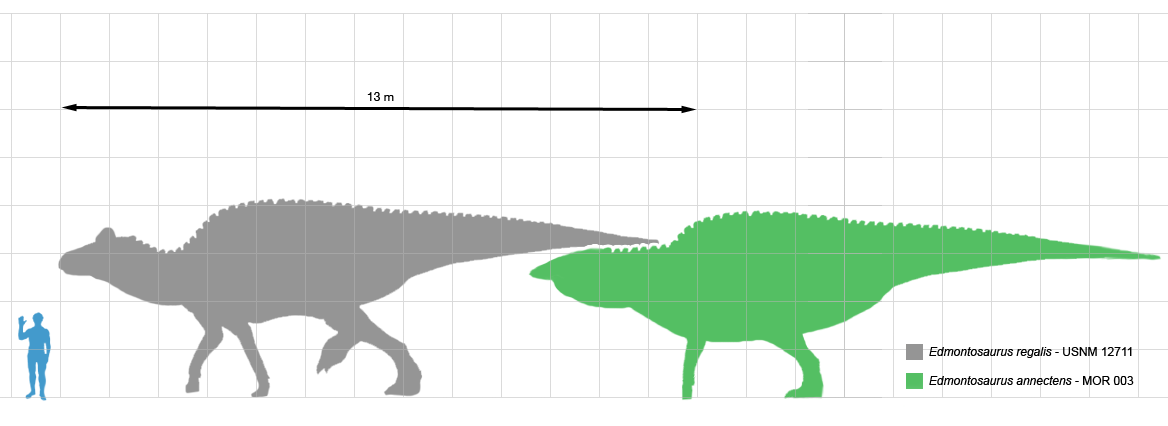
Edmontosaurus vs. Anatosaurus.

We'll start with Anatosaurus. If we take Anatotitan to be its synonym, then according to most recent phylogenies, its closest relative is Edmontosaurus regalis, which lived more than a million years earlier. This is why Saurian chose to split Anatosaurus back off into its own genus. But right here, we immediately need to note how highly dependent on the vagaries of phylogenetic analysis this method is. Ugrunaaluk is a very similar hadrosaurid that actually lived in between Edmontosaurus and Anatosaurus, and was originally thought to represent specimens of Edmontosaurus. According to the (very few) phylogenetic analysis on its relationships, Ugrunaaluk is actually outside the Anatosaurus+Edmontosaurus clade. But, given its chronological position, it's always possible more analysis will show that it is transitional between them. Ugrunaaluk is still too old to connect Anatosaurus to Edmontosaurus by a million years or less, but only slightly. Ugrunaaluk lived about 69 Ma ago, and the earliest Anatosaurus fossils are about 67 Ma old. All it would take would be one slightly younger Ugrunaaluk specimen, in that case, to pull the whole shebang back into Edmontosaurus.

Following this cladogram for the sake of argument, let's look at the next outgrip to Edmontosaurus, which is the clade Saurolophini. Now we reach the sticky question of what counts as the next closest relative of Edmontosaurus, moving down the tree. So lets start at the tip of the next branch, with Saurolophus. S. osborni lived between about 69-68 Ma ago, slightly later than the last Edmontosaurus, but still within a million years. S. angustirostris lived about 70 Ma ago, during the time Edmontosaurus was alive. Prosaurolophus lived up until around 74 Ma ago, which predates Saurolophus but sits just barely within a million years of the lower range of Edmontosaurus. Since both Saurolophus and Prosaurolophus lived within a million years of the upper and lower range of Edmontosaurus, following these genricometer settings, they should all be lumped into a single genus. Because of the rules of priority, that means Edmontosaurus itself goes on the trash heap and Saurolophus regalis becomes the correct name for that species. Same for the next closest relative to the Saurolophus + Edmontosaurus group, Gryposaurus, which is within a million years of Prosaurolophus. Ditto Kritosaurus. It's not until the Brachylophosaurini clade that we finally get a break from all this lumping, but already, half of the short-crested hadrosaurids are now Saurolophus.

Obviously, I'm taking this a little far on purpose, just to test it out as a general-use genericometer for dinosaurs. You could easily tweak these settings to produce more traditional genera, like adding a rule against paraphyly (both Anatosaurus and Kerberosaurus would fall within a clade formed by members of Saurolophus in the above example; though in my opinion this is a feature rather than a bug, since some genera had to have evolved from others anyway, it's a little silly trying to rigidly keep them monophyletic). We could also add a stipulation that the time component is relative to the type species or, even better, type specimen, to allow for inevitable evolutionary grades from one form to another. This would, in effect, place a sort of million-year "radius" around a species that is not ever-expanding. So anything up-tree or down-tree of E. regalis, like Ugrunaaluk, gets caught in its gravity well, but we don't then jump to anything within a million years of Ugrunaluuk, too. I have to think this is probably the real intent of the Saurian team's method.

A variety of ceratopsid genera, by Danny Cicchetti (CC-By-SA).
"These are all different GENERA? That's hilarious," --Entomologists.

Using this type-restricted genericometer method could still do some fun things in the one part of the dinosaur tree that everybody sort of secretly thinks is horribly over-split but doesn't say so out loud because nobody really wants to rain on those guys' big ol' naming party: the ceratopsids.

The Saurian team stated that, if they were to include Torosaurus as a distinct species in the game, it would be as a species of Triceratops, per the genericometer settings described above. Following this cladogram and a type-restricted interpretation of Saurian's method, Torosaurus does become a species of Triceratops, the holotype of which is from about 67 million years ago. Nedoceratops has to go as well. Now, the Triceratops party ends there based on this particular cladogram, but I find the placement of the Titanoceratops a little er... iffy. Titanoceratops is really, really similar to Pentaceratops from almost the same time and place, so finding it in between a bunch of species that look basically identical to Triceratops is odd. I'm not saying it's wrong, but let's just ignore it for the moment. If we do, then Ojoceratops, Eotriceratops, and Regaliceratops all become species of Triceratops, too. So the entire clade Triceratopsini = Triceratops.

Further down the tree, we have Anchiceratops and Arrhinoceratops becoming synonyms. Kosmoceratops and Vagaceratops, too. Chasmosaurus subsumes Mojoceratops, Agujaceratops, Utahceratops, and Pentaceratops. Coahuiloceratops and Bravoceratops are both safe, and form the sister clade to the big Chasmosaurus complex.

On the centrosaurine side of the tree, Achelousaurus becomes Einiosaurus, unless paraphyly is invoked. Centrosaurus gobbles up Coronosaurus, Spinops, and Styracosaurus (again, unless paraphyly is invoked, in which case Styracosaurus remains valid but includes Rubeosaurus ovatus; this was the plan for one of the unmet Saurian Kickstarter stretch goals that would have included Styracosaurus ovatus).

Overall, this system produces a classification that is similar to, but not nearly as extensively lumped, as the one used by Greg Paul. I kind of like it, especially with the type species stipulation in play. I think that if you are going to use genera, and not just convert all genus names to species praenomen as some people have suggested, it's a good idea to have some kind of standard metric. The problem is, of course, that nobody will ever agree to one standard. Even within dinosaurs. Nobody specializes in all dinosaur groups. We have ceratopsian workers, tyrannosaur workers, avialan workers, sauropod workers, etc., all with their own traditions and personal metrics. This is why it tends to be the science popularizers, like the Saurian devs or Greg Paul or even Bob Bakker, who are the ones coming up with what all the professionals view as highly idiosyncratic classifications. They're attempting to take all these disparate fields within dinosaur paleontology and apply a single metric to all of them, which is bound to change a few things away from the consensus.

At the end of the day, the consensus is what it is. I'm glad people are exploring ways to apply consistency and standards to science-related minutiae like taxonomy. But it's equally important that those efforts be transparent, so we can compare each metric to the others and see which produces the results we like the best. Because at the end of the day, all of this splitting and lumping of genera comes down to just that: a matter of opinion.

Saturday, May 23, 2015

The Year of the Ceratopsian Ankylosaurs

Life restoration of an advanced stegosaur- I mean an ankylosaur (Ankylosaurus magniventris) by Emily Willoughby,  CC-BY-SA.
When digging into the history of North American fossil interpretation for the eventual next edition of my Beasts of Antiquity series, one thing that I found a bit weird was the constant reference to ankylosaurids and nodosaurids as types of stegosaurs. To a modern reader, this seems off. After all, the group of armored dinosaurs, Thyreophora ("shield bearers"), is divided into two major groups: Ankylosauria and Stegosauria, each with a few well supported subgroups. It makes sense that these close relatives might once have been classified together, and stegosaurs were discovered first, lending them priority of name. But what changed? Neither ankylosaurs nor stegosaurs are particularly large groups (especially the stegosaurs), and it seems odd that 20th century taxonomists would want to raise a group as small as the modern idea of Stegosauria to the level of "suborder".  Why were ankylosaurs eventually spun off, leaving the more primitive stegosaurs behind? I decided to do a little digging to find out.

Saturday, February 21, 2015

The Evolving View of Stegosaurus

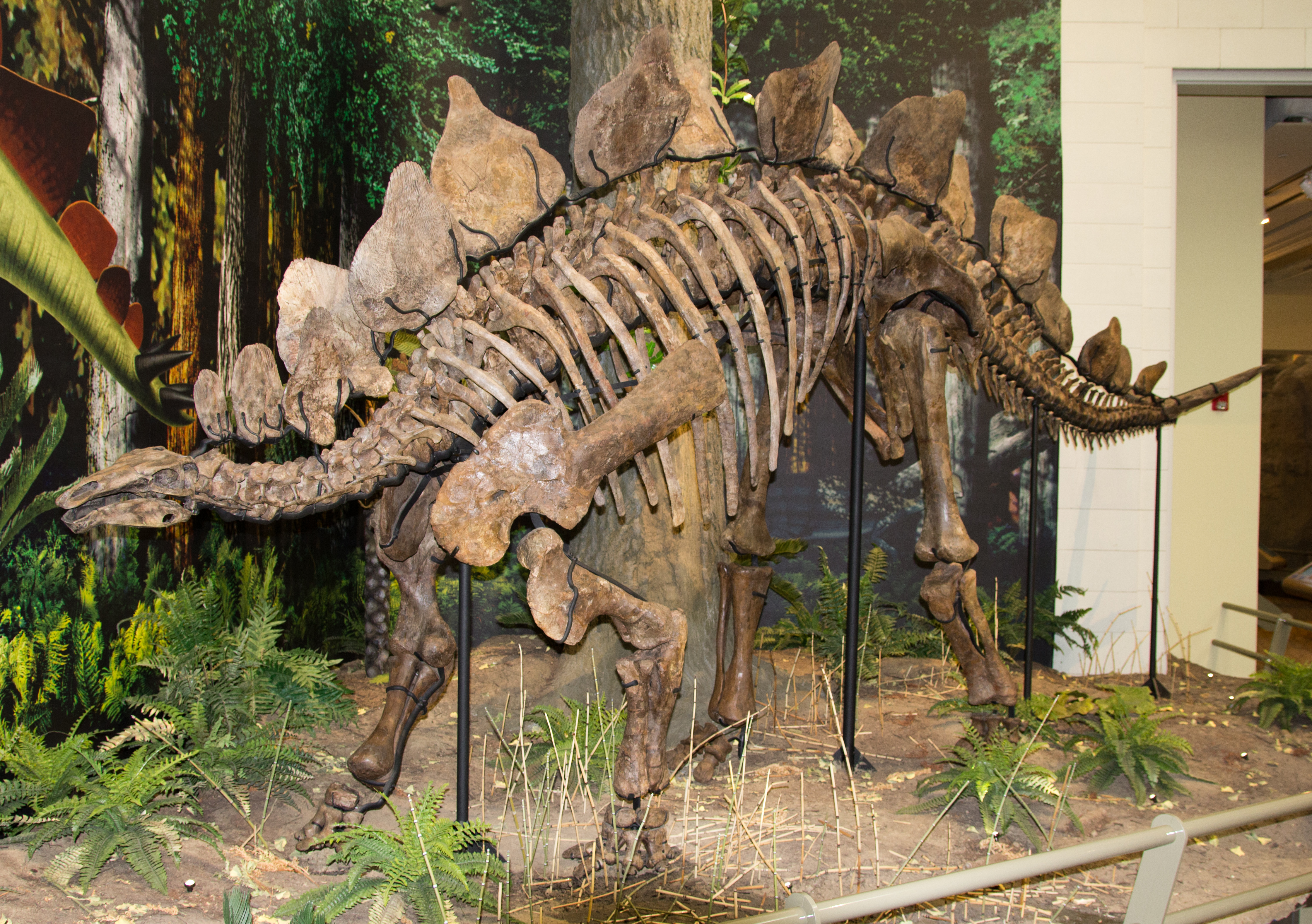
Mounted skeleton of Stegosaurus ungulatus at the Carnegie Museum. The tail, plate, and spike arrangement have been updated in this mount to reflect current thinking following the study by Carpenter (1998). Photo by Perry Quan, CC-By-SA 2.0.
Seeing as how I've been working on restorations of two different stegosaur species this month, I thought I'd write up a quick review of the most famous aspect of these iconic dinosaurs: Their big, triangular plates. For a complete overview of the history and interpretation of Stegosaurus, be sure to see Ken Carpenter's 1998 paper.

Interpretation of the life appearance of stegosaurs has changed several times since they were discovered by O.C. Marsh in 1877. The first stegosaur fossil (belonging to the species S. armatus) were found near the town of Morrison, Colorado, but the specimen was disarticulated and only a few of the plates were preserved. Initially, Marsh thought that these plates played flat along the animal's back, forming a sort of turtle-like shell, or like the tiles on a roof (hence the name Stegosaurus, which means "roofed lizard"). Marsh also initially believed that stegosaurs were aquatic, due to this turtle-like appearance, but also that they would have walked on two legs on land.

Sunday, June 15, 2014

What Does T. rex Say?

"Hissssssssssssssssss!"
T. rex holotype specimen. Photo by Scott Robert Anseimo, CC BY-SA 3.0.
It's an iconic scene in every dinosaur movie: the huge, conquering carnivorous theropod rears back and lets out a terrifying bellow. Sound effects artists spend huge amounts of time sampling vocalizations from various animals to create just the right mix to create an unfamiliar, otherworldly roar. And, of course, everybody knows that pterodactyls let out harsh, echoing, prehistoric sounding screeches.

But how close to reality are these sounds? Do we have any ways of using science to figure out what dinosaurs and other stem-birds may have sounded like? Do we have evidence that they made sounds at all?

Sunday, September 1, 2013

You're Doing It Wrong : Dino Foot Scales

Above: Our subject matter.
It's often said by those who support a strict phylogenetics-based system of naming life that it's only by restricting well-known names from neontology (the study of modern organisms) to crown groups can we avoid making unjustified assumptions about members of stem-groups.

These kinds of unjustified assumptions have been rampant in the history of studying stem-birds. Archaeopteryx has traditionally been depicted, incorrectly, with a reversed hallux, and occasionally even with beak-like structures, simply because it's a "bird", and those are features all birds have. Except Archaeopteryx is not a true "bird", it's a stem-bird, more closely related to birds than to any other living animal group, but not a member of the group that includes all modern birds. It's fair to assume that an extinct member of the duck lineage, like Vegavis, had a bill, but that's not necessarily so for, say, Patagopteryx, despite the fact that it is usually referred to as a "bird".

Modern bird feet, by Philip Henry Gosse, 1849, public domain. Note overlapping scutes on
the top surfaces, and pebbly, polygonal reticulae on the bottom surfaces.

Most paleoartists have absorbed these kinds of warnings, and do a good job of avoiding obvious errors based on typology, the assumption that all species in a certain "type" share "key characteristics." But there are some typological memes in the bird lineage that are more pernicious, possibly because their actual evolution is something most artists don't think about very much.

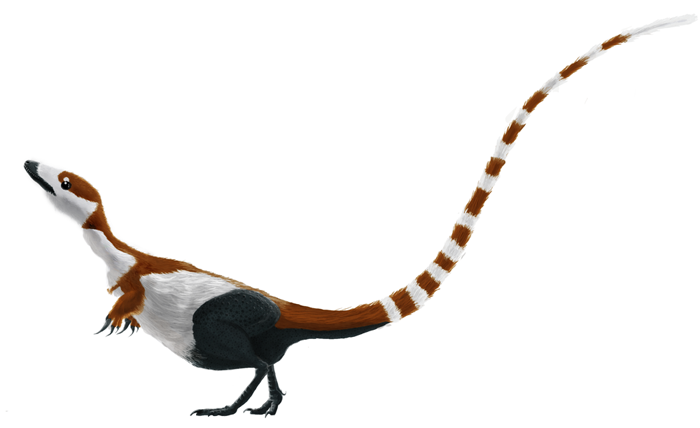
Take, for example, the bird-like scutes that are almost universally illustrated covering the tarsus (upper foot/lower hind limb) of dinosaurs. Is there any evidence that these were actually present in any given group of non-theropod stem birds? Well... no. Not that I'm aware of (if you know differently, please comment!).

Sinosauropteryx prima with tarsal scutes.
Image by Matt Martyniuk,  licensed.
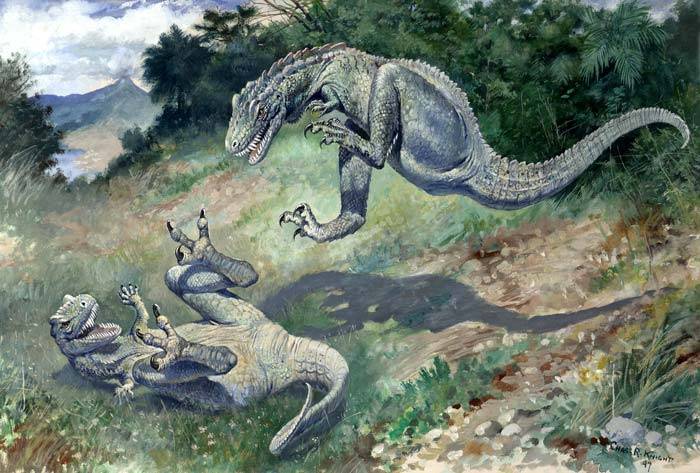
I'm not sure when this meme began, and if it's related to the Dinosaur Renaissance when the link between birds and dinosaurs was re-established. Looking at some Charles Knight paintings, such as his famous "Leaping Lealaps", it appears that the feet of his theropods were scaled based on modern lizards (more on the differences between lizard scales and other types of "scales" below). Bakker's influential early restoration of Deinonychus does not include any obvious scutes on the feet or tarsus. Mark Hallet, on the other hand, did include what look like oblong bird-like scutes on his theropods. At any rate, it's hard to deny that "bird feet" are typical of almost all modern reconstructions of dinosaurs, including my own, and are not limited to theropods. Bird-feet are often restored on ornithischians and even pterosaurs.

Of course, like many paleo-memes that developed during the 1980s, the main idea seems to be using this as a flourish to make otherwise scaly dinosaurs seem more bird-like. And thanks to skin impressions, we know that many dinosaurs had scales, right?

Saturday, May 11, 2013

The Validity of Lambeosaurus - Anybody Know A Good Lawyer?

Reconstruction of Didanodon altidens specimen ROM 794 (aka Lambeosaurus lambei,
aka Procheneosaurus praeceps) by Matt Martyniuk, all rights reserved.
I've talked a lot on this blog about my personal justifications for using "old fashioned" names for many groups or species of stem-birds. In many cases, names which were in common use during the 19th and early 20th centuries were replaced later by one or two influential scientists for reasons which don't really hold up when you look at the codes that govern naming in biology. For example, Manospondylus gigas may currently be the correct name for the theropod we know and love as Tyrannosaurus rex, but this possibility has almost never been discussed because everybody assumes it's a nomen oblitum - a name out of use for so long that it becomes automatically invalid under the International Code of Zoological Nomenclature (ICZN). Note the word "assume"--as I've written before, most people, even working scientists, don't really know what criteria must be met to classify a name as obsolete.

The name of one very well-known dinosaur is in such a sorry state that it's like the Manosponylus / Tyrannosaurus debacle squared. The genus Lambeosaurus, a well-known hadrosaurid with a distinctive squared-off crest with a backward-pointed prong, was named twice prior getting its popular moniker, and neither of those names can be considered obsolete, since they were both coined during the 20th century.

The first name given to fossil material (in this case a jaw) now universally attributed to Lambeosaurus was Didanodon. In a 2006 review of hadrosaurs, Lund and Gates stated (without discussion) that the genus and its type species, Didanodon altidens, were nomina nuda, or "naked names" lacking the proper description necessary to establish them. But is this really the case?

Wednesday, April 10, 2013

What's A Monoclonius?


Hypothetical restoration of an adult Monoclonius crassus,
by Matt Martyniuk. All rights reserved.

Monoclonius crassus is an iconic ceratopsian, a fixture of many 1970s era dinosaur books, which owes its status almost completely to another species. 

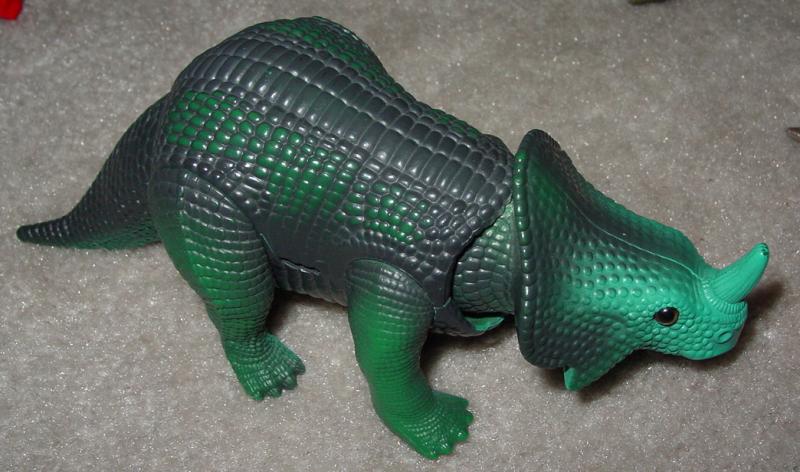
I grew up with depictions of Monoclonius in media like Phil Tippet's short film Prehistoric Beast and toys like the DinoRiders figure. Like most representations of Monoclonius in popular culture, these were based on specimens now classified as Centrosaurus apertus (though, actually, that DinoRider looks like it has a genuinely Monoclonius-type frill, long, straight, and unadorned). 

Originally known only from teeth and a fragmentary frill and nasal horn, the Monoclonius was one of the first ceratopsians known to science, found by E.D. Cope in 1876 and named for its configuration of tooth roots ("single sprout" as opposed to the "double sprout" of Diclonius, now known to pertain to a hadrosaur). 

Like many of Cope's species, Monoclonius was not recognized for what it really was (a "horned dinosaur") until more complete remains from other ceratopsians likeTriceratops were found by Cope's rival O.C. Marsh. Monoclonius itself remaned enigmatic for many years, though the idea of a Triceratops-like ceratopsian with a single large nasal horn was used by Charles R. Knight in his famous painting of Cope's other dubious ceratopsian, Agathaumas. Knight also incorporated spiny dermal armor associated with some supposed Monoclonius remains, though at least some of this material was later shown to belong to ankylosaurs and pachycephalosaurs.

Monoclonius became iconic when complete skeletons of ceratopsians were found in the Judith River/Dinosaur Park Formation of Montana/Alberta. In the early 1900s, C.H. Sternberg (who had co-discovered the orgiinal Monoclonius fossils with Cope) established that complete specimens classified by Lawrence Lambe as Centrosaurus apertus (and some of which were considered to be Monoclonius and which had already been used to form a picture of that animal) were a distinct species. After this, the genus Monoclonius was dismantled, with former specimens re-assigned to either new or recently established centrosaurine genera.

Matters were complicated by the discovery of the drastic changes centrosaurines went through as they grew, and today the distinctive Monoclonius specimens are generally considered juvenile centrosaurines. Zach Miller has done an awesome rendering of a centrosaurine growth series showing where a traditional "Monoclonius" specimen fits into the sequence. 
Skull of the subadult Monoclonius lowei. Note the three prominent projections at the rear of the
 parietal frill. Incipient styracosaur-like spikes?

However, known specimens of Monoclonius aren't a perfect match for juveniles of the contemporary Einiosaurus, as Miller notes. The long, generally flattened frill with larger incipient spikes at the first three positions of the the parietal (Ryan 2006) are reminiscant of Styracosaurus and Einiosaurus, all of about the same geological age. The large size of a specimen sometimes referred to the distinct species Monoclonius lowei compares with some pachyrhinosaurs like the contemporary Achelousaurus, and while these do begin life with a small nasal horn that later develops into a boss, and though it isn't backward-cureved, such drastic changes during ontogony are known in other ceratopsians. It may be that Monoclonius is a juvenile form of (and therefore a senior synonym of) one of these centrosaurines, or it may be a valid species similar to both, possibly a transitional form between centrosaurin-type centrosaurs and pachyrhinosaurs. Ironically, though long mixed up with that genus, Monoclonius doesn't seem to be as great a match for Centrosaurus itself.

In my restoration of a hypothetical, mature Monoclonius (above), I made it generally styracosaur-like, though with more einiosaur-like parietal spikes, and these could alternately be seen as styracosaur parietal spikes which are not yet fully grown. In this way I've tried to hedge my bets: this Monoclonius could either be a mature, intermediate stage between styracosaurs and einiosaurs, or simply an immature but very large styracosaur. 

The nasal horn is restored as styracosaur-like as well, a conservative growth trajectory for the shorter, recurved nose horn seen in subadult specimens of M. crassus and M. lowei. However, it's entirely possible that as the nasal horn grew, it swept forward into the hook-like horn of Einiosaurus or even flattened and thickened into the nasal boss seen in Achelousaurus. Both of those pachyrhinosaurs have long parietal spikes like Monoclonius seems to have had, though both only had a single pair jutting from the back of the frill, while Monoclonius seems to have been developing at least three. Though, again, it's possible the transformation was more extreme than I'm assuming for my illustration, and that these incipient parietal horns were resorbed during growth like the epiparietals of chasmosaurines (e.g. Triceratops).

Rather than the centrosaur-like Monoclonius of my childhood, it looks like this fairly plain-looking ceratopsian grew up into something a bit more spectacular. But we'll need further study and, hopefully, more specimens to find out exactly what, and exactly how extreme, that transformation may have been.

* Ryan, M.J. (2006). "The status of the problematic taxon Monoclonius (Ornithischia: Ceratopsidae) and the recognition of adult-sized dinosaur taxa." Geological Society of America Abstracts with Programs, 38(4): 62.

Wednesday, July 25, 2012

Wrong for the Right Reasons

Outdated restoration of a Protoceratops andrewsi nesting
ground. Painting by Charles R. Knight, 1922.

Flipping through an old dinosaur book from the 1970s or early 1980s can be pretty fun. Nostalgia aside, it's great to see how far the science of paleontology has progressed in just a few decades, and also have a few laughs at the (from our modern perspective) outrageously outdated ideas and reconstructions we find. (David Orr's blog Love in the Time of Chasmosaurs has a great, long-running series covering "vintage dinosaur art" that lovingly pokes fun at some of the mistakes made by past palaeontographers.) Old dinosaur TV shows can be just as good. Last week, Mrs. M recorded a bunch of dinosaur shows for me which were airing on the Science Channel. I hadn't seen any of them before, and didn't realize until I hit play that I was in for a blast from the past. The shows were obviously old-school, narrated by Jeff Goldblum (I assumed these had come out around the time of The Lost World: Jurassic Park until one episode started discussing finds from later in the 1990s like Beipiaosaurus). One episode featured a segment on Roy Chapman Andrew's famous discovery of dinosaur eggs in the Gobi Desert, and the infamous misinterpretation of the eggs as belonging to Protoceratops rather than Oviraptor. This is just the kind of paleontological gaffe we paleo fans get schadenfreude out of today. After discussing the refuted hypothesis that an Oviraptor found on a nest of these eggs was first thought to be eating them rather than guarding them as later finds suggested, Mrs. M asked the obvious question: Why, given that this thing was found on top of the eggs, did they assume the eggs belonged to a different dinosaur?

Tuesday, August 3, 2010

Triceratops Exists, Learn to Read


Above: "Evil scientists want to kill me!"

By now many of you may have seen the headline on science news sites proclaiming that Triceratops has gone the way of Brontosaurus thanks to Scanella and Horner's new paper which suggests it may have been a sub-adult form of Torosaurus. If you understand the very rudimentary basics of science, you may be thinking, "WTF?"

Unfortunately, it should be clear by now that the vast majority of "science reporters" out there are among the most incompetent people being paid to ostensibly "do" the "job" of "reporting news" "accurately." I've already covered the backstory here. Needless to say, just because Triceratops is a juvenile Torosaurs doesn't mean it no longer exists, and furthermore Torosaurus is the newer name, so the name Triceratops is safe and sound (well, except from the shadowy threat of Agathaumas, but that's a different story). Also, David Orr at the awesome blog Love in the Time of Chasmosaurs has already addressed this failure of journalism and journalistic integrity. So I'll just add a few thoughts because really, this is just getting ridiculous.

You've heard it said before that most mainstream science reporters do not understand any single part of the subjects they're covering, and they can therefore be classed not only as useless, but as actively detrimental to human progress. Let's just accept that and call out a few of these hacks by name, shall we? Here are two articles that came up among the top hits when I typed "''Triceratops''" into Google, and are therefore doing the most damage to intelligence in the English speaking world.

Casey Chan, an apparently illiterate Gizmodo blogger, writes: "Scientists sure enjoy crushing my childhood memory of The Land Before Time (they nixed Brontosaurus a while back). Hopefully they won't delete Triceratops too." Immediately after this is a link to a site explaining why they won't, which Casey either read but did not understand or didn't bother to read at all.

Dan Satherley, 3 News NZ reporter of alarmist half-truths, writes: "It seems however that despite its juvenile status, its popularity with the public means that it'll be Torosaurus that ceases to exist. Horner says Torosaurus specimens will now be considered Triceratops." Yeah. You read right. This directly contradicts the headline. Unlike Casey, above, who is merely a simpleton, Dan read the original report, understood most of it (it's not the fact that Triceratops is popular that it remains valid, it's that it's the older name), and wrote the opposite as a headline in an effort to attract more hits. Classy. This is like beginning a review of the movie Backdraft with the headline "Fire in local theater kills dozens."

I should also mention that DinoGoss is not responsible for any head-desk collision injuries caused by reading the comments in these articles. You've been warned.

Monday, July 5, 2010

Tall Tail


This may be old news for those who attended last years SVP meeting, but news of this is (to my knowledge) breaking for the first time online. Matthew Herne has finished a complete osteology of the Australian ornithischian Leaellynasaura, abstract here: http://www.vertpaleo.org/meetings/SVPProgramAbstracts09WEB.pdf.pdf

A few surprising things here. First, Leaellynasaura is traditionally called a hypsilophodontid, or at least basal ornithopod. This study finds that it's even more basal among ornithischians, even sharing some characters with thyreophorans, so it's best placed as a basal genasaurian. Next, the tail lacks the distinctive lattice of ossified, stiffening tendons found in members of many ornithischian clades. Instead, the postzygapophyses of the tail are greatly expanded relative to other members of this order, which may have helped stiffen the back half of the tail.

Most surprisingly, the tail itself is apparently ridonkulously (technical term) long. Leaellynasaurua has over 70 tail vertebrae, more than any other ornithischians save some hadrosaurs, but more astounding is the total length of the tail, which made up 75% the total body length, being three times longer than the torso, head and neck combined. Why such a long tail? One idea floated by Dann Pigdon on the DML today is that if Leaellynasaura had a covering of filamentous feather or fur-like integument (as seen in Psittacosaurus and Tianyulong), it may have been able to use its tail for warmth during cold antarctic nights, wrapping the tail around the body like an arctic fox. It may have also been useful for territorial signaling or mating displays, especially if (as in most animals with filamentous or feathery coats) it could puff the tail up to an apparently larger size by raising its hackles.

I couldn't help taking a break from my Yixian field guide series to try restoring this hypothesis, and the results are above. Can't wait to see this paper officially in print!

Thursday, April 29, 2010

Imploding Hadrosaurs and Dubious Nomina Dubia

By now, everybody has heard about Jack Horner's attempt to KILL our beloved Torosaurus.

Above: Look out Toro, Horner's coming and he's packing an AK! Photo by Daniel Hendricks, licensed.

Well, I say "our," but I've never really given much of a thought to Torosaurus, beyond my 10-year-old self trying to get the mechanized DinoRiders toy. But some people seem to feel inexplicably attached to this name, often and incorrectly translated as "bull lizard" (it's got big horns, and was ornery like a raging bull!). In reality it means "perforated lizard", in reference to the holes in its frill. And it's not like the animal will cease to exist, it's just the mature, let's say "silver back" stage of Triceratops. Or should we say, Torosaurus is the mature morph, and Triceratops is the immature morph, of Agathaumas. As I mentioned before, Agathaumas specimens lack diagnostic characters in the context of an environment with multiple taxa from which it must be distinguished. But if there's only one ceratopsian in town, the identity of those generic-looking postcrania is narrowed down to one option, and it's no longer a nomen dubium.

Above: Dear E.D., Please stop naming isolated vertebrae and teeth. kthx. Photo by F. Gutekunst pre-1897, public domain.

Ah, the nomen dubium, or "doubtful name." This is an unofficial* designation given by scientists to names whose type specimens can't be classified because they're too generic. Like many dinosaurs discovered by E.D. Cope, Agathaumas was named based on partial postcranial remains. As more fossils turned up, it turned out that its "unique" postcranial features were actually characteristic of a larger clade, and all ceratopsids have nearly identical torsos and limbs. So Agathaumas lost it's standing as a valid name, because (lacking a skull) it couldn't be determined which species of ceratopsid the bones came from. True, the genus name could have simply been used for all ceratopsid species with this type of postcrania, but modern taxonomists don't roll that way, preferring genera to be mostly monophyletic. For years, Agathaumas remained known as a nomen dubium. It probably belonged to either Triceratops or Torosaurus, the only contemporary contenders known from better remains, but since no skull was found with the type specimen, we could never know for sure which one was the junior synonym.

* The ICZN does not officially recognize any such thing as a nomen dubium, and contrary to popular belief, has no rules to the effect that family names can't be based on dubious taxa, etc. Hence Titanosauridae (=Saltasauridae), Hadrosauridae (=Lambeosauridae), Troodontidae (=Stenonychosauridae), Deinodontidae (=Tyrannosauridae), Podokesauridae (=Coelophysidae) Ceratopsidae (=Chasmosauridae) and yes, Ornithodesmidae (=Dromaeosauridae) are all perfectly valid.

That is, of course, unless the number of potential synonyms is reduced to 1. With Triceratops and Torosaurus recognized as one genus, there is no reason to think that the type specimen of Agathaumas and the type specimen of Triceratops don't come from the same species. If and when another genus of ceratopsid is ever discovered from the well-sampled late Maastrichtian beds of North America, this could always be reversed, but for now the default hypothesis must be that only one was present, rather than an extremely common genus with a wide range of individual variation (Triceratops) and one shadowy mystery genus known only from a post-crania identical to Triceratops but hey, maybe it had like 20 horns or something, who knows?

Sarcasm aside, the concept of nomina dubia has become a bit crazy over the years. Jaime Headden has recently been on a mini-crusade to this point on the DML, questioning some pretty well ingrained and yet pretty flimsy concepts of what is and isn't "non-diagnostic". Let's come to our senses and realize that stratigraphic, ecological and temporal considerations also need to be taken into account. Yes, Agathaumas is non-diagnostic relative to, say, Chasmosaurus. But those two were not contemporaries, and barring the use of a time machine, the other ceratopsians that could potentially be synonyms of Agathaumas could not have existed in the same time and place as it did. Except for one, Triceratops, which by rights should go the way or either Brontosaurus (abandonment) or Coelophysis (official conservation).

Above: The dinosaur Rioarribasaurus had its name changed to Coelophysis by mistake. It turns out the original Coelophysis was not only a different species, it wasn't even a dinosaur. The original is now known as Euceolophysis, or "true Coelophysis." Photo by Ballista, licensed.

Which brings me to the promised hadrosaur implosion. Thanks largely to the work of Nicolas Campione, the taxonomy of Late Cretaceous hadrosaurs is finally being untangled after nearly two centuries of confusion. Contrary to conventional wisdom, the short-snouted type species Edmontosaurus regalis appears to be present only in the Campanian Horseshoe Canyon Formation, not the end-Mesozoic Lance, Hell Creek, etc. All the long-snouted "edmontosaurs" in the late Maastrichtian formations can be assigned to either Edmontosaurus annectens (previously Anatosaurus) or the truly duck-billed form Anatotian. Whether or not E. annectens should therefore be kept as Edmontosaurus or re-classified back to Anatosaurus is a matter of personal preference.

Above: The hadrosaur of many names, lately Anatotitan, the once and future Thespesius? Photo by Claire Houck, licensed.

But there's another monkey wrench here. Campione, in his un-published abstracts and talks so far, has been agnostic on the validity of Anatotitan as a separate species. In the past it's been suggested that the "duck-bill" is merely a preservational artifact, a crushed skull. But, there are several specimens that show this feature, and one that appears to be transitional between narrow and duck-snouted forms. On the DML, Greg Paul has asserted that there is only one species of late Maastrictian edmontosaur, and that the flat-billed versions are the mature growth stage. They even fit the pattern of growth seen in the earlier E. regalis populations, reaching the same maximum size, but then also sprouting the duckbill.

So, it looks like Anatotian is about to go the way of Torosaurus. Except, now the newly low-diversity late Maastrictian dinosaur fauna threatens to resurrect another long-dead name. Thespesius is known only from vertebrae. Those vertebrae could theoretically have come from any hadrosaur... if all hadrosaurs were immortal highlanders. In reality, though, there appears to have been only one hadrosaur species in this ecosystem. And in that case, it can have only one name. And that name is Thespesius occidentalis, "western wondrous one." That name is not Trachodon annectens, because I think the type specimen of Trachodon mirabilis is a ceratopsian. But I'm looking into that one.

Above: Some of these teeth may or may not belong to Trachodon mirabilis. From Leidy, 1860, public domain.

To continue crushing the dreams of myself in 1988 and fans of Jurassic Park everywhere, I'll next try to research whether or not Manospondylus is really a nomen oblitum like everybody is assuming (and everyone does simply assume this, because can you imagine if it weren't?). Outlook probably not so good.

Friday, October 30, 2009

Toro! Toro! Toro!

Above: Ceratopsian skull specimen AMNH 5116. Triceratops, Torosaurus... or both? Read on...

By now, all dino fans have probably heard the buzz on the indicator: Jack Horner and team are working on a paper which attempts to prove that Torosaurus and Triceratops are the same thing, and that in general, growth series in dinosaurs are often misinterpreted as numerous similar species (something that has long been acknowledged in pterosaurs and recently in early birds like Archaeopteryx and, probably, Confuciusornis).

Here's the quick and dirty background: Triceratops was named by O.C. Marsh in 1889 based on a pair of horns and skull roof collected in 1887 from Colorado. Numerous complete specimens followed, making Triceratops the archetypal horned dinosaur with its two long forward-pointing brow horns and single short, forward-pointing nose horn, in front of a relatively short (by ceratopsian standards), solid frill. The frill is notable: most ceratopsians, including close relatives of Triceratops, have long frills with large openings, or fenestrae, in the bone.

Torosaurus was described a few years later in 1891, also by Marsh, based on two skulls. Unlike Triceratops, the Torosaurus skulls had long frills with the standard fenestrae. Its frill was also smooth around the edges: many Triceratops specimens show that they had small, bony scutes adorning the frill's edge, called epoccipitals.

According to Horner's talks at SVP, which he also summarized in an interview on the podcast The Skeptic's Guide to the Universe (available here), those differences are not due to species variation, or even sexual dimorphism as previously hinted. Rather, Torosaurus is nothing more than the most mature growth stage of Triceratops. The paper isn't out yet so all the data isn't available, but presumably Horner will demonstrate based on microscopic bone growth studies that all the specimens currently assigned to Triceratops are not fully mature, and that like modern birds, some secondary sexual characteristics (such as the expanded, chasm-filled frill) pop up quite suddenly at the 'last minute' in the animal's growth, after it has already reached nearly adult size.
Above: Diagram of a 'classic' Torosaurus skull. By William Diller Matthew, 1915. Public domain.

We can already see heaps of major changes taking place as Triceratops grows. Juveniles have backward curving horns, which completely change to point forward during growth. Remember those epoccipital fringes, the lack of which is so diagnostic of Torosaurus? We already see them becoming reduced from tall, pointed osteoderms in younger forms to smooth and rounded, and finally merging with the frill itself and smoothing out so as to be almost invisible. Indeed, in these oldest individuals, the bone in the center of the frill can also be seen to thin like a man's receding hairline. Given that we already know all of this about Trike's growth, it's not a very huge leap to recognize a long, smooth, holy frill as the next logical step, and those just happen to have been named Torosaurus for 110 years.

The goss has been flying over this online, and a few interesting tidbits have come up. Having grown up in the Northeast US, the most interesting to me concerns the mistaken identity of some specimens of Triceratops. For me, the quintessential Triceratops is the one in the American Museum of Natural History (specimen AMNH 5116). However, as many have pointed out on DinoForum and elsewhere, it's also among the most... well, un-Triceratops like.

Above: Triceratops skull 'classic' vs. specimen AMNH 5116. By Ed T. and Michael Gray (right), licensed.

Compare the images above. On the right is my beloved AMNH Trike. On the left is a 'classic' Triceratops skull. The frill on the AMNH specimen is longer, and lacks epoccipitals. The frill is also tall and back-swept, not flared out to the sides, as in most Triceratops skulls. Not only that, but as you can see in the image at the top of this post (which is a more contrasty view of the same AMNH skull), almost all of the frill has been restored in plaster to conform with what a Trike should look like. There are significant gaps in the middle of the frill entirely filled with plaster... exactly where the fenestrae of Torosaurus go. If Torosaurus and Triceratops are indeed separate species, the AMNH Trike is no Trike at all... it's a Torosaurus in disguise!

Thankfully, it's more than likely that there is no such thing as Torosaurus, any more than there was a Brontosaurus. It's all Triceratops baby, and we can conclude that this famous last of the ceratopsians was indeed last, the only one of its kind in the Lance and Hell Creek Formations that date to the very end of the Mesozoic era.

But... wait... isn't there another named ceratopsian from the same time and place? Named BEFORE Triceratops?? If there was only one Lance/Hell Creek ceratopsian, then Torosaurus get sunk into Triceratops as a synonyms. Does Triceratops then have to be abandoned in favor of... Agathaumas!?
Above: Painting of Agathaumas by Charles R. Knight, 1897. Public domain.
Dun dun duuuuuun!

Wednesday, March 18, 2009

Mystery Wednesday Solved... Feathered Ornithischians?


Just when you thought the picture of feather evolution was getting clearer... enter Tianyulong, the feathered heterodontosaurid.

...WHAT??

You heard me. Read about the new find at Ed Young's blog.

[Image: Tianyulong confuciusi, credit Li-Da Xing]

So what does it all mean? I doubt there'll be any consensus, but the authors do a pretty good job of showing that, like the feathers of Sinosauropteryx and Beipiaosaurus, these structures are hollow and not collagen. So were all dinosaurs (or ornithodirans as a whole, dinosaurs + pterosaurs) feathered, and many lost feathers and re-grew scales? The distribution is now making it look like all these structures (ceratopsian quills, ptero-fuzz, feather,s protofeathers and now ornithischian fibres) are homologous--that is, they all derive from a common, ancestral structure. However, I think it's more likely that these started out at bristle-like quills, and evolved into softer, more fuzzy pelts in a few lineages independently, the small, active ones that would be pre-disposed to adapting these inherited quills.

But what do I know? I'll keep you posted on what ideas start getting inevitably tossed around.