Showing posts with label ornithopods. Show all posts

Monday, July 18, 2016

Playing with Saurian's Genericometer


There's a dinosaur game in development called Saurian. Have you heard of it? You should really check out! It's shaping up to be super cool and extremely rigorous when it comes to science and coming up with accurate portrayals of an extinct ecosystem. Check out their page!*

*Full disclosure: I may be involved in this game's development in some small capacity. There will be birds.

The Saurian developers have made a somewhat controversial choice when it comes to the name of the Hell Creek Formation hadrosaurid. Yes, boys and girls, a video game company has dipped its toe into the boiling caldera that is dinosaur nomenclature.  Many fans (and keep in mind these are people who know enough to be early backers of a game priding itself on scientific accuracy and technical minutiae) were a little shocked to see the announcement of the Saurian hadrosaurid. Not just at the unbelievably painstaking level the devs went to in order to research and create the character - everything from life history and growth trajectories to mapping out the actual pattern of scales found on an infamous fossil mummy. People were also a little put off by the fact it was named Anatosaurus annectens rather than Edmontosaurus annectens.

I'm not going to re-hash the long and convoluted history of everybody's favorite "trachodont" (Wikipedia does a pretty good job of that). For the purposes of this post, it's enough to understand that these two species of dinosaurs, Anatosaurus annectens and Edomontosaurus regalis, are fairly similar. So similar that for the past 25 years or so, most scientists have "lumped" them together under the same group of species, the genus Edmontosaurus, making the binomial of the Hell Creek Formation species Edmontosaurus annectens and relegating the name Anatosaurus to the trash heap of history.

But, a few years ago something changed. See, there was a second Hell Creek hadrosaurid, a bigger and much more different looking beast named Anatotitan copei. During the same 25 year period, mostly everybody has agreed this dinosaur was different enough from its relatives to deserve its own genus name. Recently, studies have demonstrated that those differences aren't necessarily due to being more distantly related, but just being... older. Anatotitan, it turns out, is just a mature version of Anatosaurus/Edmontosaurus annectens that had built up more unique features with age. It's not just a similar species to annectens, like Edmontosaurus reglais is, it's the same species. So onto the trash heap with Anatotitan.

But wait! Anatosaurus was thrown out because it was too similar to Edmontosaurus. Now, it turns out, it was actually different--different enough that its adult form was given its own genus for all those years. So shouldn't Anatosaurus be a genus again?

Well, that depends on what you mean by "genus". There is no universally recognized rationale for what makes something "different enough" to be a genus, and the concept varies wildly between fields of biology. Each scientist has their own opinion, their own gut feeling based on tradition and intuition, not science, of what a genus should be. If you asked an entomologist to re-classify all dinosaurs based on her own personal "genericometer" settings, we'd end up with one single genus of dinosaur, and it would include every bird that ever lived. Probably crocodiles too. We'd be left arguing, based on page priority or something, if the star of Jurassic Park should be called Passer rex, Vultur rex, or Crocodylus rex. On the flip side, if you had a ceratopsian worker reclassify the beetles, we'd end up with a hundred billion new genera of beetle.*

*I'm not 100% sure that's the correct number, but it'd be something with a lot of zeroes.

Some people have attempted to bring some science to the art of taxonomy, and quantify genera. Recently and most famously, Emanuel Tschopp and colleagues published their precise genericometer settings, and used those settings to reclassify the diplodocid sauropods. This resulted in bringing back the old, previously-junked genus name Brontosaurus (you may have heard of it). This is a great thing to try, but the method was only designed to apply to diplodocids. It might wreak havoc with names in other dinosaur groups, and would certainly result in an entomologist revolt if anybody ever tried to use it on bugs.

To their credit, the Saurian team have been up front with their genericometer settings used in the game. Rather than base their concept of genus completely on anatomical similarity, they've made the very intriguing choice of combining evolutionary relationships with a chronological component. Basically, if species B is the closest relative of species A, and if species B is known from fossils that can be dated to within one million years of species A fossils, then species A and B are to be classified in the same genus.

I thought it would be fun to try out these genericometer settings and see how it compares to the current traditional consensus, and to some other more widely criticized attempts to re-genericize dinosaurs, like the classification used by Greg Paul in his Princeton Field Guide to Dinosaurs.
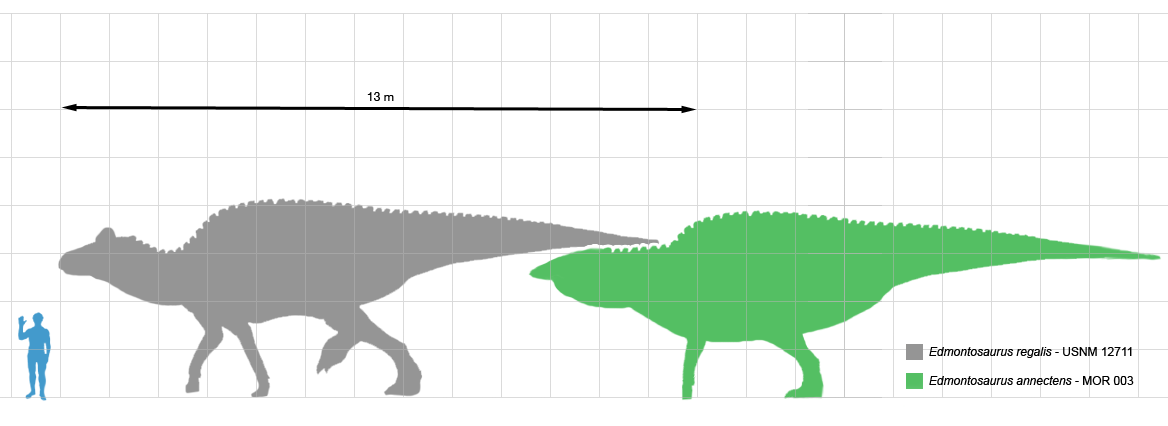
Edmontosaurus vs. Anatosaurus.

We'll start with Anatosaurus. If we take Anatotitan to be its synonym, then according to most recent phylogenies, its closest relative is Edmontosaurus regalis, which lived more than a million years earlier. This is why Saurian chose to split Anatosaurus back off into its own genus. But right here, we immediately need to note how highly dependent on the vagaries of phylogenetic analysis this method is. Ugrunaaluk is a very similar hadrosaurid that actually lived in between Edmontosaurus and Anatosaurus, and was originally thought to represent specimens of Edmontosaurus. According to the (very few) phylogenetic analysis on its relationships, Ugrunaaluk is actually outside the Anatosaurus+Edmontosaurus clade. But, given its chronological position, it's always possible more analysis will show that it is transitional between them. Ugrunaaluk is still too old to connect Anatosaurus to Edmontosaurus by a million years or less, but only slightly. Ugrunaaluk lived about 69 Ma ago, and the earliest Anatosaurus fossils are about 67 Ma old. All it would take would be one slightly younger Ugrunaaluk specimen, in that case, to pull the whole shebang back into Edmontosaurus.

Following this cladogram for the sake of argument, let's look at the next outgrip to Edmontosaurus, which is the clade Saurolophini. Now we reach the sticky question of what counts as the next closest relative of Edmontosaurus, moving down the tree. So lets start at the tip of the next branch, with Saurolophus. S. osborni lived between about 69-68 Ma ago, slightly later than the last Edmontosaurus, but still within a million years. S. angustirostris lived about 70 Ma ago, during the time Edmontosaurus was alive. Prosaurolophus lived up until around 74 Ma ago, which predates Saurolophus but sits just barely within a million years of the lower range of Edmontosaurus. Since both Saurolophus and Prosaurolophus lived within a million years of the upper and lower range of Edmontosaurus, following these genricometer settings, they should all be lumped into a single genus. Because of the rules of priority, that means Edmontosaurus itself goes on the trash heap and Saurolophus regalis becomes the correct name for that species. Same for the next closest relative to the Saurolophus + Edmontosaurus group, Gryposaurus, which is within a million years of Prosaurolophus. Ditto Kritosaurus. It's not until the Brachylophosaurini clade that we finally get a break from all this lumping, but already, half of the short-crested hadrosaurids are now Saurolophus.

Obviously, I'm taking this a little far on purpose, just to test it out as a general-use genericometer for dinosaurs. You could easily tweak these settings to produce more traditional genera, like adding a rule against paraphyly (both Anatosaurus and Kerberosaurus would fall within a clade formed by members of Saurolophus in the above example; though in my opinion this is a feature rather than a bug, since some genera had to have evolved from others anyway, it's a little silly trying to rigidly keep them monophyletic). We could also add a stipulation that the time component is relative to the type species or, even better, type specimen, to allow for inevitable evolutionary grades from one form to another. This would, in effect, place a sort of million-year "radius" around a species that is not ever-expanding. So anything up-tree or down-tree of E. regalis, like Ugrunaaluk, gets caught in its gravity well, but we don't then jump to anything within a million years of Ugrunaluuk, too. I have to think this is probably the real intent of the Saurian team's method.

A variety of ceratopsid genera, by Danny Cicchetti (CC-By-SA).
"These are all different GENERA? That's hilarious," --Entomologists.

Using this type-restricted genericometer method could still do some fun things in the one part of the dinosaur tree that everybody sort of secretly thinks is horribly over-split but doesn't say so out loud because nobody really wants to rain on those guys' big ol' naming party: the ceratopsids.

The Saurian team stated that, if they were to include Torosaurus as a distinct species in the game, it would be as a species of Triceratops, per the genericometer settings described above. Following this cladogram and a type-restricted interpretation of Saurian's method, Torosaurus does become a species of Triceratops, the holotype of which is from about 67 million years ago. Nedoceratops has to go as well. Now, the Triceratops party ends there based on this particular cladogram, but I find the placement of the Titanoceratops a little er... iffy. Titanoceratops is really, really similar to Pentaceratops from almost the same time and place, so finding it in between a bunch of species that look basically identical to Triceratops is odd. I'm not saying it's wrong, but let's just ignore it for the moment. If we do, then Ojoceratops, Eotriceratops, and Regaliceratops all become species of Triceratops, too. So the entire clade Triceratopsini = Triceratops.

Further down the tree, we have Anchiceratops and Arrhinoceratops becoming synonyms. Kosmoceratops and Vagaceratops, too. Chasmosaurus subsumes Mojoceratops, Agujaceratops, Utahceratops, and Pentaceratops. Coahuiloceratops and Bravoceratops are both safe, and form the sister clade to the big Chasmosaurus complex.

On the centrosaurine side of the tree, Achelousaurus becomes Einiosaurus, unless paraphyly is invoked. Centrosaurus gobbles up Coronosaurus, Spinops, and Styracosaurus (again, unless paraphyly is invoked, in which case Styracosaurus remains valid but includes Rubeosaurus ovatus; this was the plan for one of the unmet Saurian Kickstarter stretch goals that would have included Styracosaurus ovatus).

Overall, this system produces a classification that is similar to, but not nearly as extensively lumped, as the one used by Greg Paul. I kind of like it, especially with the type species stipulation in play. I think that if you are going to use genera, and not just convert all genus names to species praenomen as some people have suggested, it's a good idea to have some kind of standard metric. The problem is, of course, that nobody will ever agree to one standard. Even within dinosaurs. Nobody specializes in all dinosaur groups. We have ceratopsian workers, tyrannosaur workers, avialan workers, sauropod workers, etc., all with their own traditions and personal metrics. This is why it tends to be the science popularizers, like the Saurian devs or Greg Paul or even Bob Bakker, who are the ones coming up with what all the professionals view as highly idiosyncratic classifications. They're attempting to take all these disparate fields within dinosaur paleontology and apply a single metric to all of them, which is bound to change a few things away from the consensus.

At the end of the day, the consensus is what it is. I'm glad people are exploring ways to apply consistency and standards to science-related minutiae like taxonomy. But it's equally important that those efforts be transparent, so we can compare each metric to the others and see which produces the results we like the best. Because at the end of the day, all of this splitting and lumping of genera comes down to just that: a matter of opinion.

Sunday, June 15, 2014

What Does T. rex Say?

"Hissssssssssssssssss!"
T. rex holotype specimen. Photo by Scott Robert Anseimo, CC BY-SA 3.0.
It's an iconic scene in every dinosaur movie: the huge, conquering carnivorous theropod rears back and lets out a terrifying bellow. Sound effects artists spend huge amounts of time sampling vocalizations from various animals to create just the right mix to create an unfamiliar, otherworldly roar. And, of course, everybody knows that pterodactyls let out harsh, echoing, prehistoric sounding screeches.

But how close to reality are these sounds? Do we have any ways of using science to figure out what dinosaurs and other stem-birds may have sounded like? Do we have evidence that they made sounds at all?

Monday, August 19, 2013

Follow-Up: Judith River Formation = Oldman Formation

In a previous post, I hung my tentative re-identification of the holotype teeth of Deinodon horridus on a rough correlation between the Judith River and Oldman formations, the latter of which is more precisely dated and, more importantly, contains Daspletosaurus torosus, which is a candidate for the owner of Deinodon teeth.

While researching a different topic, I stumbled across a more definitive published correlation of these two formations I wasn't previously aware of. In their 2001 paper on the stratigraphy of the Two Medicine Formation, Horner et al. discuss the correlation of parts of that formation with the Judith River. Horner et al. note that the Judith River can be separated into two basic units divided by a disconformity, corresponding with a marine transgression (when the terrestrial ecosystem was swamped by the rising of the Western Interior Seaway, the sediments deposited by which appear to have been lost in this instance).

Helpfully, Horner et al. note that it is from the lower unit that Hay collected numerous dinosaur teeth which were later described by Leidy as the infamous tooth taxa such as Deinodon, AublysodonTrachodon, and Troodon. More helpful still, the paper provides a handy chart showing the arrangement of the strata and including points at which radiometric dates have been taken. The base of the lower Deinodon-bearing unit is dated at about 78 million years old. The next available date is from just above the disconformity (i.e. after the seaway had retreated again) and shows an age of 75.4 million years ago. That's narrowing it down, but there's no date from within the formation from just below the disconformity, which would give us an upper boundary for the Deinodon strata.

But, there's hope. Horner et al. note that Rogers (1998) suggested the disconformity itself probably correlates to around the Willow Creek Anticline in the middle Two Medicine Formation (which contains the famous Egg Mountain Maiasaura nesting site). This segment of the TMF has been dated to 76.7 Ma ago, which may give us a rough upper boundary for the age of Hay's fossil tooth collection.

So, based on this paper at least, it looks like Deinodon and friends were collected from rocks aged somewhere between 78 and 76.7 million years old. Which is about the same age range as the Oldman Formation to the north. So, Deinodon horridus and Daspletosaurus torosus did indeed live at about the same time and in the same region (there were no checkpoints at the US-Canadian border back then!), making it more likely that they represent the same species, and the possibility that Deinodon actually represents Gorgosaurus less likely.

Looks like I'm going to have to create a new tag for Arcane Biostratigraphy and Geology Stuff...

Oh, and somebody in the comments last time asked me to get into Trachodon. This is definitely a subject for a longer blog post, though I'm a bit less excited about it because I'm more pessimistic that it's identity is knowable. But maybe this new info can help us get started. I already mentioned that the Trachodon teeth appear to come from the same strata as Maiasaura (and it's well known that Trachodon's contemporary Troodon formosus is reported from Egg Mountain as well, though T. formosus is also reported from pretty much everywhere and everywhen else...). Could Maiasaura be Trachodon? Perhaps! But it could also be Brachylophosaurus, or maybe even Gryposaurus. And... there's been a rumor going around for a while now that Trachodon teeth are referable to Lambeosaurinae. Which lambeosauines are known from this time and place that could fit the bill? Both Parasaurolophus and Corythosaurus have been reported from the uppermost Oldman, though these may be too young. Hypacrosaurus sp. seems to have been contemporary with Maiasaura, so that could be it...

Yeah, you can see why I'm pessimistic. Tyrannosaurids are rare, and there tend to be only one or two species of tyrannosaurids present in any given ecosystem. Hadrosaurids are... the opposite.

References

Horner, J. R., Schmitt, J. G., Jackson, F., & Hanna, R. (2001). Bones and rocks of the Upper Cretaceous Two Medicine-Judith River clastic wedge complex, Montana. In Field trip guidebook, Society of Vertebrate Paleontology 61st Annual Meeting: Mesozoic and Cenozoic Paleontology in the Western Plains and Rocky Mountains. Museum of the Rockies Occasional Paper (Vol. 3, pp. 3-14).

Wednesday, October 20, 2010

Another Burrowing Ornithopod


Above: Type specimen of Koreanoaurus (minus referred pelvis and hindlimbs) from Huh et al. 2010.

Though Bob Bakker had been suggesting that small ornithpods dug burrows for years, on the basis of the kind of sediments the basal ornithopods of Montana were usually found in, we didn't get solid confirmation that these were really burrowing creatures until the discovery of Oryctodromeus. Here was an ornithopod with the same, vaguely burrower-like features as its relatives Orodromeus and Zephyrosaurus, but which was found inside an obvious burrow.

The burrow was the key, because aside from some fairly ambiguous skeletal details, these dinosaurs all had fairly standard ornithpod proportions: elongated necks, long (usually) stiffened tails (but see below), long hind limbs and short front limbs. The overall body plan was that of a bipedal runner, not a dinosaurian wombat.

While still far from mole or wombat like, the new dinosaur Koreanosaurus boseongensis (named by Min Huh, Lee Dae-Gil, Kim Jung-Kyun, Lim Jong-Deock and Pascal Godefroi) is even closer than its relatives. It has very robust forelimbs, and while the humerus is still long, the forearm is short and stout, with a massive scapula and coaracoid, and a big keeled breastbone, all of which indicate attachment sites for powerful muscles useful for digging. Interestingly, the hind limbs are also very specialized. They're relatively short compared to the forelimbs, with a low ratio between the femur and tibia lengths, and with short metatarsals. The length indicates that even if this wasn't a fossorial creature, it was probably a quadruped. The hip is especially interesting. The head of the femur, the bit which fits into the hip socket, is at a 135 degree angle to the rest of the bone. This would have given Koreanosaurus a very un-dinosaurian semi-splaying leg posture, similar to burrowing mammals. The authors speculate that it would have used its legs to brace itself inside an incipient burrow while it used its powerful forelimbs to shovel soil.

So, while the team of scientists was unable to locate any nearby fossil burrows big enough to have been made by this (roughly) meter long ornithopod, the skeletal details are more than enough to suggest a digging lifestyle. But it was no dinosaurian mole, as it still had many features in common with terrestrial dinosaurs, like a long neck and (presumably) long, partly stiffened tail. However, we shouldn't be so quick to assign stiffness to the tail just because this is found in other ornithopods. As I reported before, the Australian Leaellynasaura had an unusual, very long, very flexible tail.

Koreanosaurus was found in seaside cliffs of Boseong, on the south coast of Korea. It is the first Korean dinosaur known from good remains. It should be noted that another Korean dinosaur (a theropod) had previously been unofficially named "Koreanosaurus," but as this was a nomen nudum, it's no more a valid scientific name than "Sue," and is rightly ignored.

Thursday, April 29, 2010

Imploding Hadrosaurs and Dubious Nomina Dubia

By now, everybody has heard about Jack Horner's attempt to KILL our beloved Torosaurus.

Above: Look out Toro, Horner's coming and he's packing an AK! Photo by Daniel Hendricks, licensed.

Well, I say "our," but I've never really given much of a thought to Torosaurus, beyond my 10-year-old self trying to get the mechanized DinoRiders toy. But some people seem to feel inexplicably attached to this name, often and incorrectly translated as "bull lizard" (it's got big horns, and was ornery like a raging bull!). In reality it means "perforated lizard", in reference to the holes in its frill. And it's not like the animal will cease to exist, it's just the mature, let's say "silver back" stage of Triceratops. Or should we say, Torosaurus is the mature morph, and Triceratops is the immature morph, of Agathaumas. As I mentioned before, Agathaumas specimens lack diagnostic characters in the context of an environment with multiple taxa from which it must be distinguished. But if there's only one ceratopsian in town, the identity of those generic-looking postcrania is narrowed down to one option, and it's no longer a nomen dubium.

Above: Dear E.D., Please stop naming isolated vertebrae and teeth. kthx. Photo by F. Gutekunst pre-1897, public domain.

Ah, the nomen dubium, or "doubtful name." This is an unofficial* designation given by scientists to names whose type specimens can't be classified because they're too generic. Like many dinosaurs discovered by E.D. Cope, Agathaumas was named based on partial postcranial remains. As more fossils turned up, it turned out that its "unique" postcranial features were actually characteristic of a larger clade, and all ceratopsids have nearly identical torsos and limbs. So Agathaumas lost it's standing as a valid name, because (lacking a skull) it couldn't be determined which species of ceratopsid the bones came from. True, the genus name could have simply been used for all ceratopsid species with this type of postcrania, but modern taxonomists don't roll that way, preferring genera to be mostly monophyletic. For years, Agathaumas remained known as a nomen dubium. It probably belonged to either Triceratops or Torosaurus, the only contemporary contenders known from better remains, but since no skull was found with the type specimen, we could never know for sure which one was the junior synonym.

* The ICZN does not officially recognize any such thing as a nomen dubium, and contrary to popular belief, has no rules to the effect that family names can't be based on dubious taxa, etc. Hence Titanosauridae (=Saltasauridae), Hadrosauridae (=Lambeosauridae), Troodontidae (=Stenonychosauridae), Deinodontidae (=Tyrannosauridae), Podokesauridae (=Coelophysidae) Ceratopsidae (=Chasmosauridae) and yes, Ornithodesmidae (=Dromaeosauridae) are all perfectly valid.

That is, of course, unless the number of potential synonyms is reduced to 1. With Triceratops and Torosaurus recognized as one genus, there is no reason to think that the type specimen of Agathaumas and the type specimen of Triceratops don't come from the same species. If and when another genus of ceratopsid is ever discovered from the well-sampled late Maastrichtian beds of North America, this could always be reversed, but for now the default hypothesis must be that only one was present, rather than an extremely common genus with a wide range of individual variation (Triceratops) and one shadowy mystery genus known only from a post-crania identical to Triceratops but hey, maybe it had like 20 horns or something, who knows?

Sarcasm aside, the concept of nomina dubia has become a bit crazy over the years. Jaime Headden has recently been on a mini-crusade to this point on the DML, questioning some pretty well ingrained and yet pretty flimsy concepts of what is and isn't "non-diagnostic". Let's come to our senses and realize that stratigraphic, ecological and temporal considerations also need to be taken into account. Yes, Agathaumas is non-diagnostic relative to, say, Chasmosaurus. But those two were not contemporaries, and barring the use of a time machine, the other ceratopsians that could potentially be synonyms of Agathaumas could not have existed in the same time and place as it did. Except for one, Triceratops, which by rights should go the way or either Brontosaurus (abandonment) or Coelophysis (official conservation).

Above: The dinosaur Rioarribasaurus had its name changed to Coelophysis by mistake. It turns out the original Coelophysis was not only a different species, it wasn't even a dinosaur. The original is now known as Euceolophysis, or "true Coelophysis." Photo by Ballista, licensed.

Which brings me to the promised hadrosaur implosion. Thanks largely to the work of Nicolas Campione, the taxonomy of Late Cretaceous hadrosaurs is finally being untangled after nearly two centuries of confusion. Contrary to conventional wisdom, the short-snouted type species Edmontosaurus regalis appears to be present only in the Campanian Horseshoe Canyon Formation, not the end-Mesozoic Lance, Hell Creek, etc. All the long-snouted "edmontosaurs" in the late Maastrichtian formations can be assigned to either Edmontosaurus annectens (previously Anatosaurus) or the truly duck-billed form Anatotian. Whether or not E. annectens should therefore be kept as Edmontosaurus or re-classified back to Anatosaurus is a matter of personal preference.

Above: The hadrosaur of many names, lately Anatotitan, the once and future Thespesius? Photo by Claire Houck, licensed.

But there's another monkey wrench here. Campione, in his un-published abstracts and talks so far, has been agnostic on the validity of Anatotitan as a separate species. In the past it's been suggested that the "duck-bill" is merely a preservational artifact, a crushed skull. But, there are several specimens that show this feature, and one that appears to be transitional between narrow and duck-snouted forms. On the DML, Greg Paul has asserted that there is only one species of late Maastrictian edmontosaur, and that the flat-billed versions are the mature growth stage. They even fit the pattern of growth seen in the earlier E. regalis populations, reaching the same maximum size, but then also sprouting the duckbill.

So, it looks like Anatotian is about to go the way of Torosaurus. Except, now the newly low-diversity late Maastrictian dinosaur fauna threatens to resurrect another long-dead name. Thespesius is known only from vertebrae. Those vertebrae could theoretically have come from any hadrosaur... if all hadrosaurs were immortal highlanders. In reality, though, there appears to have been only one hadrosaur species in this ecosystem. And in that case, it can have only one name. And that name is Thespesius occidentalis, "western wondrous one." That name is not Trachodon annectens, because I think the type specimen of Trachodon mirabilis is a ceratopsian. But I'm looking into that one.

Above: Some of these teeth may or may not belong to Trachodon mirabilis. From Leidy, 1860, public domain.

To continue crushing the dreams of myself in 1988 and fans of Jurassic Park everywhere, I'll next try to research whether or not Manospondylus is really a nomen oblitum like everybody is assuming (and everyone does simply assume this, because can you imagine if it weren't?). Outlook probably not so good.

Wednesday, July 1, 2009

More On Chewy Hadrosaurs

First, thanks to those who commented and emailed regarding my post on the controversial hadrosaur chewing mechanics paper (see "Nom nom nom"). Vince Williams, lead author of the paper in question, was among those who contacted me about it, and he pointed out an error that stems from (yet again) science reporting that isn't all there.

Above: Underside of the skull of Leonardo, the Brachylophosaurus mummy. By Ed T., from Flikr. Licensed.

My last post reiterated a statement from this MSNBC article, that gut contents of the famous hadrosaur mummy "Leonardo" seem to contradict Williams et al.'s findings, because the plant matter was

a) chopped or sheared, not chewed, and
b) mainly coniferous, indicating that hadrosaurs were browsers rather than grazers.

Well, I checked up on the source that MSNBC used for this information (Leonardo is, despite documentaries on the History Channel, not fully studied and published on yet). That lead me to another MSNBC article on Leo, which appears to state the opposite! From the older, cited article:
  • "An analysis of the gut contents from an exceptionally well-preserved juvenile dinosaur fossil suggests that the hadrosaur's last meal included plenty of well-chewed leaves digested into tiny bits."
  • "An analysis of pollen found in the specimen's gut region revealed a variety of plants, including ferns, conifers and flowering plants. Although the pollen could have been ingested when the dinosaur drank water, the tiny leaf bits, under 5 millimeters (a quarter-inch) in length, indicate that Leonardo was a big browser of plants, Chin said."
So, the gut contents in question actually would seem to support, at least in part, Williams' findings. Even stranger given the apparent lack of cranial kinesis reported last December. Obviously further study is needed on this...

Tuesday, June 30, 2009

Nom nom nom

Above: Edmontosaurus skull, note teeth in back of jaw. Photo: Ballista / Wikipedia, licensed

Did hadrosaurs chew? A recently named lambeosaur called Angulomastacator ("angle chewer") would have us think so. So would a new paper by Williams et al. on an intensive study of hadrosaur tooth wear. As this article reports, the direction of hundreds of scratches were mapped in 3D to suss out what type of chewing method was used by hadrosaurs. The authors found that they employed an extinct form of chewing unlike any living animals, in which the natural kinesis (joints between the skull bones found in modern reptiles) forced the bones of the upper jaw outward, causing the tooth batteries to slide against each other in a sideways motion.

Sounds very interesting and a great step to resolving the ecologies of this well-known dinosaur group... or is it? A major paper that came out in the December issue of JVP argued convincingly that dinosaur skulls such as this didn't actually have any kinesis at all! As David Marjanovic summed up on the DML, the argument there was that people who have spent their careers studying modern reptiles and their kinetic skulls have assumed that dinosaurs followed the same pattern, and have grasped at straws to find evidence of kinesis where it doesn't actually exist (that is, that dinosaurs lost cranial kinesis at some point in their evolution from other reptiles, or never had it, meaning it's a novel feature of lizards and snakes). If that's the case, than the underlying assumption of this new hadrosaur paper is wrong. Another blow against their conclusions, as noted in the article above, is that reports of fossil stomach contents from hadrosaur mummies show food that had been sheared, not chewed. Gut contents also suggest a diet predominantly of conifers (pine trees etc.), while the tooth wear study suggests food was cropped close to the ground and may have been rich in silica, suggesting a diet primarily of ferns and horsetails.

Above: Edmontosaurus tooth battery, which was studied for wear patterns. Photo: Vince Williams / Univ. of Leicester

So then, how to explain the unique wear patterns on hadrosaur teeth? How can we rectify the conflicting evidence regarding diet? Surely another salvo in this controversy will appear in print in a few months.

Wednesday, February 18, 2009

Iguanodon divided by (at least) 3


As anyone who follows ornithischian classification (all five of you) knows, the famous British ornithopod Iguanodon has been getting the chop in the last few years. One of the first dinosaurs to be found and named, Iguano has picked up dozens of species over the past century or so and, not surprisingly, as studies of iguanodont realtionships got more precise it became necessary to divvy most up into their own genera outside Iguanodon proper. Last year, researcher, artist, and screaming-biplane enthusiast Gregory S. Paul published a paper reviewing the genus and spun off two new genera: Mantellisaurus and Dollodon.

Now, word on the tubes is that David Norman has given a lecture called "Iguanodontians from the Wealden of Britain and Europe" in which he gave his own review of the genus and spun off a few extras. These aren't published yet and far be it from me to facilitate any claim-jumping or Iguano-gate scandals by naming them here. That being said, goss hungry dino fans can find the names in a DML post from today and on a few Spanish-language blogs including aragosaurus.com. As you'll see, one of the new names kind of sounds like it'd be more at home on the periodic table than a list of dinosaur taxa. Ornithischian workers are werid guys.

Norman also discussed Paul's new genera: he thinks Mantellisaurus is valid but reckons Dollodon should be kept as a species of Iguanodon. We'll problably have to wait for all this to hit the press before reaching any kind of consensus, but stay tuned to the Goss to see if anybody weighs in prematurely.

Picture of Dollodon is public domain from Wiki Commons.