Showing posts with label controversies. Show all posts

Friday, August 31, 2018

The Many Crests of Pterodactylus

Little Pterodactylus,  from the late Jurassic period of Bavaria, was one of the first pterosaurs ever discovered (a story you can read all about in my book Beasts of Antiquity). Represented by numerous juvenile and subadult specimens, it's among the better understood pterosaurs as well, especially if you include a few controversial specimens that have recently been argued to represent distinct genera such as Aerodactylus (a conclusion many pterosaur specialists remain skeptical of, but that's a topic for another post).

Although many Pterodactylus specimens preserve soft tissue, one pretty important aspect of their biology is NOT so well understood - their crests. In the past few decades, it has become apparent that crests of one kind or another are a hallmark of most pterodactyloid pterosaurs (and even a good number of non-pterodactyloids). Crests were first reported for Pterodactylus itself by Doderlein in 1929, but it was almost never depicted with a crest in art afterwards. The first-ever crested Pterodactylus was probably a toy. In 1988, Tyco released a crested Pterodactylus toy as part of their "Dino-Riders" line. Though produced under the supervision of Bob Bakker, it's unclear whether or not the crest was based on Bakker's inside knowledge of pterosaurs or was just a lucky guess added to give a fairly plain pterosaur toy more flair. Bakker himself had illustrated Pterodactylus without any crests in The Dinosaur Heresies several years earlier. Despite the fact that Peter Wellnhofer described a lappet "crest" (see below) for Pterodactylus in 1970, and even figured this specimen in his popular 1996 book The Illustrated Encyclopedia of Prehistoric Flying Reptiles, illustrations in that same book depicted Pterodactylus as crestless.

Photo of Pterodactylus specimen BSP 1929 I 18, from Wellnhofer 1996. You can see a thin occipital lappet extending diagonally up from the back of the skull.

The dubious Tyco example aside, the concept of a crested Pterodactylus didn't really reach the popular consciousness (and had apparently been forgotten by science, much like several other "modern" ideas about pterosaurs that were really discovered by 19th and early 20th century German paleontologists) until the first ultraviolet florescence studies done by Eberhard Frey and Helmut Tischlinger in the late 1990s and early 2000s. They produced what, at the time, seemed like a very bizarre reconstruction of a pterosaur, especially one like Pterodactylus which was somewhat famous for being the 'crestless one' (as opposed to its more famous, crested cousin, the giant Pteranodon). The illustration that was sent out in press materials about the early UV studies showed a shaggy mane of filaments on the neck, big, floppy webbed feet, a throat pouch, and a big, teardrop-shaped crest that extended above and behind the eyes. Clearly, the UV analysis had totally overhauled our image of Pterodactylus.

Frey and Tischlinger's reconstruction of Pterodactylus based on UV studies.

Or did it? The actual UV papers are still difficult to come by online, so early on it was difficult if not impossible for many paleoartists to examine the source material themselves. In the mean time, Frey's Pterodactylus became the gold standard for accuracy, with savvy artists beginning to incorporate the mane, webbed feet, and distinctive crest into their own work, all based not on any photos or diagrams of fossils, but simply on Frey's pencil drawing. Here's my own early take on the "new" Pterodactylus. Note that, in order to try and be a little different, I applied the UV soft tissue findings to a different specimen, the holotype of Pterodactylus brevirostris (which may actually be a juvenile Ctenochasma!).
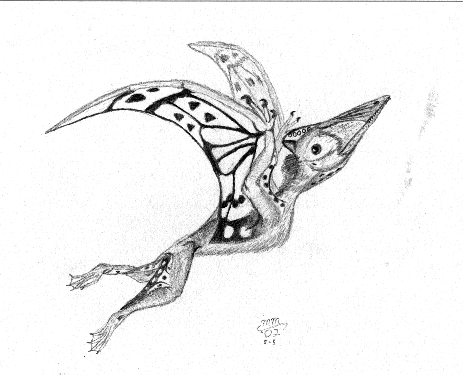

Note that this was done in June 2002, shortly after the publication of Frey's English-language work summarizing the UV findings of the past few years. I later sketched out a version based more directly on Frey's original drawing:

A couple of things turned out to be... maybe not wrong, per se, but definitely speculative and not directly evidence-based, about the Frey-style Pterodactylus.

For one, that shaggy mane. Pterodactylus did indeed have a coat of unusually long pycnofibres on its neck. And by "unusually long", I mean that they are nearly half a centimeter long (compared to a ~10 cm long neck), unlike most of the incredibly tiny fibers coating the rest of the body. The "mane", therefore, would probably have appeared as a particularly fuzzy, bristly section of a short, dense coat.

As for the crest, none of the specimens show an oval shaped crest extending above and behind the eyes. What the few specimens we have of the crest show is actually two discrete crests or crest-like structures. The main crest, as preserved, is roughly triangular, with its peak just in front of the eyes. A second structure protrudes behind the skull. This has been called the "occipital lappet", and was first noticed by Wellnhofer in 1970. Superficially, the lappet resembles a small version of the crest of Pteranodon. Or, maybe more appropriately, the rear spar of the crest of Tupandactylus. In that tapejarid, the crest is comprised of two bony supports. One, roughly triangular in shape, above the snout. The other, a long horizontal spike, extends behind the skull. In between was an enormous, rounded crest composed of keratin or some other rigid soft tissue. The two "obvious" crests are merely the support struts for these larger structures. Frey imagined that in life, the triangular crest above the eyes and the occipital lappet may have been joined together into this kind of single structure, the apparent shape of the crests as preserved being an artifact of decomposition or post-mortem breakage. This interpretation has been followed by a majority of artists since, as a Google Image search will show.

You can see that an image search for "Pterodactylus crest" brings up some fossils and diagrams, 2 reconstructions of Pteranodon (of course), 1 of an ornithocheirid (somebody got confused?), 1 old-fashioned reconstruction with no crest, 3 different reconstructions with a triangular crest and separate lappet (one of which is my own), and 9 reconstructions with a Frey-style joined crest (again including one of my own!). 
Mark Witton, in his 2013 book Pterosaurs, was influential in popularizing an even larger tapejarid-like crest, which he included both in his reconstructions and skeletal diagrams. His reasoning for taking the Frey-style crest to the next level was based mainly on the general rule that pterosaur crests tend to be larger than they appear.

There are some important differences, though, that we should consider before speculating too much about a tapejarid-style crest in Pterodactylus. First, the two are not particularly close relatives, and tapejarid-like crests have not yet been found in any other pterodactyloid groups. Given the enormous crest diversity among pterosaurs, I'm not sure it's appropriate to assume they were all basically big ovals and differences are just preservational. Some other pterosaurs unrelated to Tupandactylus did have big, rounded crests, but these were more like semicircles erupting from the skull, not extending behind it or significantly above it (like wukongopterids and even some ctenochasmatoids closer to Pterodactylus itself). One other example of "enormous crest supported by bony struts" has been proposed in the form of Nyctosaurus, but despite some spectacular looking restorations out there, it's unlikely those enormous spars supported any soft tissue.

The huge, oval-shaped crest of Tupandactylus was supported by long bony crests that graded into soft tissue, unlike the totally soft crests of Pterodactylus. Photo from the AMNH pterosaur exhibit by Lisa Brormann.
Second, the supposed spars of the Pterodactylus crest are not made of bone! The reason Tupandactylus and other tapejarids can have those huge oval crests sitting on their heads is because they have bony supports. Even the smaller species like Tapejara wellnhoferi has a significant hard, bone-based component to its (possibly) large oval crest. In Pterodactylus, not only is the main crest comprised entirely of soft tissue with an unusually minimal amount of bone as an underlying base, the occipital lappet is not made of keratin at all. Upon close examination of the internal structure of the lappet, it seems to be supported internally by twisted fibers similar to those that make up the pycnofibre coat. The lappet would not have been flat in life, like the crest of Pteranodon, but conical. The fact that it is composed internally of fibers may imply that it was flexible, a result that would explain why it is preserved in different positions in different specimens (some curving upward, some straight). The lappet seems to have been more an extension of the skin integument than a typical crest, sort of like the wattles and caruncles of a turkey.

Possible crest reconstructions for Pterodactylus (based on specimen BSP 1929 I 18). Clockwise from top: Crest and lappet as preserved; joined crest after Frey 2002; joined crest after Witton 2013; minimally extended unjoined crest.
Diagram by M. Martyniuk 2018, all rights reserved. 
It's entirely possible that future specimens will show that we have Pterodactylus crest shapes wrong, or that the main crest was in some way attached to the lappet. But given the evidence right now, that interpretation is one of the less likely possibilities. A few prominent paleoartists who helped popularize the tapejarid-style crest have since produced lappeted ones, including Mark Witton and John Conway, both of whom, intriguingly, depicted the lappet as just part of the larger pycnofiber assemblage - Conway as an extension of the "mane", Witton as part of a larger set of display fibers). You can read more about Witton's new Pterodactylus reconstruction on his blog.

All of these reconstructions still go a bit beyond the known evidence by depicting large, flamboyant crests. As they probably should - Witton was correct when he pointed out that pterosaur crests were probably larger, in general, than traditionally thought. All of our crested Pterodactylus specimens are also sub-adult, so even though the soft tissue crests we have preserved seem to be pretty small, it's likely the crest would have gotten at least a little bigger with maturity. We just don't know how much bigger.

Reconstruction of a subadult Pterodactylus by M. Martyniuk.

Wednesday, April 12, 2017

You're Doing It Wrong: Pteranodon Bills

Your bill's looking a little puny, there, buddy.
(Painting by Heinrich Harder, 1912, public domain).
Everybody knows Pteranodon. Quick, stop to imagine it! It's easy, because it's the most often-illustrated and well known pterosaur to the general public (though today's marketing departments often call it a pterodactyl, following it's original, century-out-of-date classification).

But hold on. That image you have in your head right now, of a big pterosaur with a long crest and a mid-length pointy beak? That's likely wrong, and may be just as much a hybrid as those Flintstones-style creatures with pteranodont crests and Rhamphorhynchus tails.

How do we know? Let's talk about Dawndraco.

Saturday, October 11, 2014

You're Doing It Wrong: Protobird Toys Edition

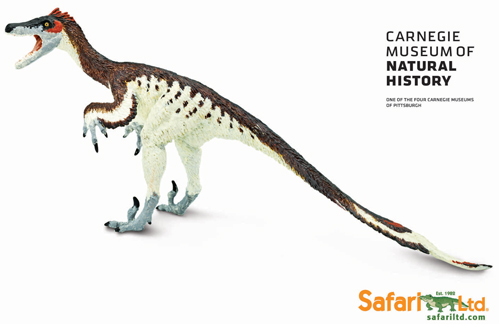
The new Carnegie Velociraptor figure.
I'm pretty slack when it comes to keeping up with my Twitter account, but if one thing can get me to break my one post per month general rule, it's "somebody is wrong on the Internet!" Or, in this case, "somebody made an inaccurate dinosaur model under the auspices of museum-approved accuracy!"

Let me preface this post with a few disclaimers. One, I have no problem with people making dinosaur art however they like. But I feel it's very important to draw a distinction between dinosaur art in general and paleoart. Creating a drawing, painting, or sculpture under the guise of paleoart implies that some degree of research went into the piece. When evaluating paleoart, critics are completely entitled to demand as rigorous an approach to accuracy as the evidence allows. Of course, speculation must be included to some degree, but the baseline expectation is always that basic facts and plausible inference will be taken into consideration.

Dinosaur art is a for of pop art, a purely artistic expression. Paleoart is a representation of a scientific hypothesis about the life appearance and behavior of an extinct organism.

This recent Twitter kerfuffle was due specifically to the debut of a new dinosaur figure in the Carnegie Collection produced by Safari Ltd. I've been a big fan of the Carnegie figures (and the sometimes nicer quality Wild Safari sister series) since I was a wee lad buying my first Carnegie Pteranodon in a little hobby shop for about $2, and pining over their massive Brachiosaurus. Carnegie figures have obvious appeal for scientifically-minded young dinosaur fans. First, most of them are made with a consistent scale (usually 1:40), so when you line them all up you can see how big each animal was compared to one another. Second, they are marketed as having the highest level of scientific authority: the Carnegie Museum stamp and assurances that hey are approved by actual paleontologists gives them the weight of authority and accuracy not found in many other toy lines. Sure, many of the older figures, including my Pteranodon, are now sorely out of date, but this is due largely to the Science Marches On effect rather than a basic, original inaccuracy.

However, like many paleoartists, the sculptors at Carnegie and related accuracy-minded/marketed toy lines seem to be having, well, let's say a little trouble adapting to the feathered revolution. Trained in the '80s and '90s drawing and sculpting Paulian, reptilian dinosaurs, it's been a steep learning curve for many of these artists to switch to bird-like, feathered dinosaurs, which many artists don't even realize requires a crash course in avian anatomy, rather than reptile or mammal anatomy, to get right. This is why expert consultants are so important in these projects--artists simply need help catching up with the latest research. Unfortunately, they're usually getting bad advice from "experts" who simply do not care.

The newest entry in the Carnegie Collection is the old favorite Velociraptor. Carnegie had previously released a scaly Velociraptor, but like many of their other models, they have commendably updated it to try and reflect current science. Unfortunately, it seems they mainly achieved this by slapping feathers over the basic original model with no regard for the fact that feathers inherently change the entire presentation and outline of an animal. Unlike fur or "protofeathers", which just fluff up the outline of an animal, feathers are more like a mobile exoskeleton that re-defines the entire body.

My own hypothesis, based on fossil and phylogenetic evidence as well as
inference from living analogues, about the life appearance of Velociraptor.
That being said, the Carnegie Velociraptor is not that bad overall and is very nicely sculpted, with an interesting and plausible color scheme. The feathers look fur-like, true, but this is not unprecedented among different lineages of large ground birds, and so is not unlikely in flightless protobirds (though they'd probably still be longer). The main problem here is the wing. Yes, wing. Like chickens and ostriches, protobirds possessed fully-fledged wings despite being flightless or nearly so, and retaining large claws on the fingers (yes, chickens, ostriches, and many other birds have hand claws--they are not some prehistoric protobird relic!).

Specifically, the wings in the new Velociraptor figure are very small, with short feathers, and are present only on the forearm, not the hand, making them only half a wing--literally, since they're issuing the primary feathers. We do not have direct evidence of primaries, but we have never found a single example of a maniraptoran that has secondaries but not primaries, and so it should be assumed they were there by default. As for secondaries, we have direct evidence in the form of quill knobs for this species. Quill knobs are not found in all feathered animals, let alone all flying birds, and seem to be associated with strong attachment either due to high-stresses during flight or other flapping behavior and/or especially large/long individual feathers.

Long story short: Not only did Velociraptor have wings, it probably had larger wings than many other dromaeosaurids. AFAIK not even Microraptor and Archaeopteryx had quill knobs to support their wings.

The new Carnegie figure, on the other hand, barely has wings at all. What went wrong?

Some insight can be gained by a recent series of incidents involving sculptor Dan LoRusso on the message board of the Dinosaur Toy Blog. LoRusso Is an amazing artist and is responsible for some of my all-time favorite dinosaur figures released in the Boston Museum of Science Collection by Battat (now being re-released with updates and new figures under the Terra brand). Collectors were understandably excited about the fact that the Battat series was coming back after nearly two decades, though the excitement was dampened a little by some obvious accuracy issues in the new figures, specifically when it came to the feathered species (or species that should have been feathered).

LoRusso was criticized online for producing a very well done but very inaccurate therizinosaur figure which completely lacked feathers. It would have fit right in with the excellent quality and Paulian style of the original series... back in 1994. But in 2014, when we have incontrovertible proof that therizinosaurs were not only feathered but that at least smaller species were very densely feathered, it is simply bizarre to see a featherless figure in a line that is being marketed as scientifically accurate. LoRusso stated that his consultants told him larger therizinosaurs would have been featherless. It's not LoRusso's fault that he somehow was able to sculpt a bald maniraptoran in the year 2013. Somebody who did not know what they were talking about and claiming to be an expert in paleoart just because they work in the related field of paleontology told him to do it, and he very reasonably believed them because they were an "expert", though obviously they had misrepresented themselves.

And there's the biggest problem and probably the answer to the question of what is going on with these strange and obvious inaccuracies. Paleoart consultants for major projects tend to be, often but not always, simply terrible. They seem not to know what they are talking about. Not only that, but second-hand reports suggest that they often simply do not care. Seriously: When asked about blatant inaccuracies creeping into paleoart-based projects like toys or books or even press releases, at least one anonymous paid paleontological consultant stated that they don't care what dinosaurs looked like in life, and so would presumably rubber-stamp any abomination that came across their desk.
Here's a prime, objective example: The Carnegie Collection Caudipteryx zoui figure. This species was first found in 1998, a complete skeleton with feather impressions. There are plenty of photos of Caudipteryx fossils that show crystal clear how the feathers attach and were ignored completely for this figure. The artist might have copied some inaccurate depiction rather than doing actual research or glancing at a fossil, and the consultant approved it because they didn't know or didn't care about the relevant details. The Carnegie Caudipteryx proves that consultants are utterly useless and often have no clue what they're talking about. Any one of us can compare the model with the fossil and show that the model is objectively wrong in major details. Look for yourself:

Caudipteryx wing fossil: note the primaries, longer than the hand, anchored along the second finger,
and lack of a clawed third finger.


Carnegie Collection Caudipteryx figure. Note the wing feathers anchored everywhere along the arm
EXCEPT on the second finger where they belong, and the incorrect number of fingers.
The wings/arms of this figure are wrong in just about every single way possible, and these are not minor details. Yet it's marketed as accurate and "paleontologist approved" in a series bearing the name of a major scientific institution!

It's not fair to ask all working paleontologists to know or care how their research into fossils translates into life appearance. Matching osteological and behavioral correlates with the structure and anatomy of living analogues could almost be considered a distinct field separate from actual paleontology. This is something paleoartists can and do think about and research constantly, but would almost never need to enter into the research when describing fossils. There's really no reason for working paleontologists to keep up to date with developments and research that go into paleoart.

The solution? Don't ask these paleontologists to consult! Just because someone is a paleontologist does not make them an expert on the life appearance of any given species of prehistoric organism. The examples cited above were, allegedly, all approved by "expert" consultants. This simply proves the consultants that are being employed are utterly failing at their job. I hate to say it, but there are legions of paleoartists and other dinosaur fans online who jump at the chance to criticize and nitpick and otherwise consult on these things for free. It's just that by the time the product is released, it's too late to do anything about inaccuracies. If companies that use paleoart would simply post concept art beforehand on, say, Facebook, they could probably get much better advice for free. Or, preferably, they could employ actual paleoartists as experts, hopefully artists who specialize in researching the life appearance of a given subject group of organisms.

Darren Naish, Mark Witton, and John Conway recently published an article on the (shameful) state of  paleoart as used in professional and commercial contexts. Companies like Safari Ltd. would do well to listen to their advice.

Sunday, June 15, 2014

What Does T. rex Say?

"Hissssssssssssssssss!"
T. rex holotype specimen. Photo by Scott Robert Anseimo, CC BY-SA 3.0.
It's an iconic scene in every dinosaur movie: the huge, conquering carnivorous theropod rears back and lets out a terrifying bellow. Sound effects artists spend huge amounts of time sampling vocalizations from various animals to create just the right mix to create an unfamiliar, otherworldly roar. And, of course, everybody knows that pterodactyls let out harsh, echoing, prehistoric sounding screeches.

But how close to reality are these sounds? Do we have any ways of using science to figure out what dinosaurs and other stem-birds may have sounded like? Do we have evidence that they made sounds at all?

Sunday, September 1, 2013

You're Doing It Wrong : Dino Foot Scales

Above: Our subject matter.
It's often said by those who support a strict phylogenetics-based system of naming life that it's only by restricting well-known names from neontology (the study of modern organisms) to crown groups can we avoid making unjustified assumptions about members of stem-groups.

These kinds of unjustified assumptions have been rampant in the history of studying stem-birds. Archaeopteryx has traditionally been depicted, incorrectly, with a reversed hallux, and occasionally even with beak-like structures, simply because it's a "bird", and those are features all birds have. Except Archaeopteryx is not a true "bird", it's a stem-bird, more closely related to birds than to any other living animal group, but not a member of the group that includes all modern birds. It's fair to assume that an extinct member of the duck lineage, like Vegavis, had a bill, but that's not necessarily so for, say, Patagopteryx, despite the fact that it is usually referred to as a "bird".

Modern bird feet, by Philip Henry Gosse, 1849, public domain. Note overlapping scutes on
the top surfaces, and pebbly, polygonal reticulae on the bottom surfaces.

Most paleoartists have absorbed these kinds of warnings, and do a good job of avoiding obvious errors based on typology, the assumption that all species in a certain "type" share "key characteristics." But there are some typological memes in the bird lineage that are more pernicious, possibly because their actual evolution is something most artists don't think about very much.

Take, for example, the bird-like scutes that are almost universally illustrated covering the tarsus (upper foot/lower hind limb) of dinosaurs. Is there any evidence that these were actually present in any given group of non-theropod stem birds? Well... no. Not that I'm aware of (if you know differently, please comment!).

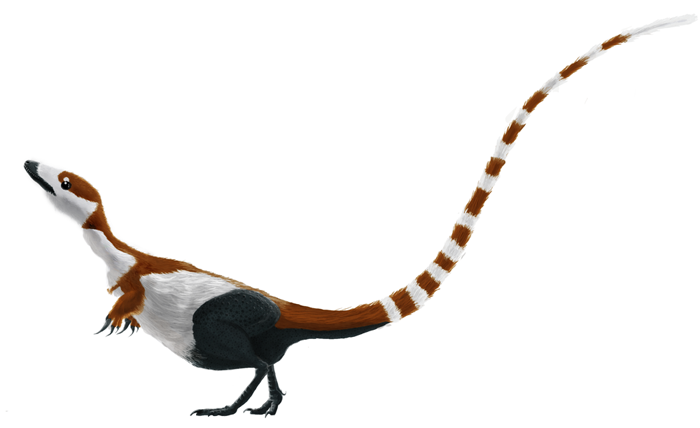
Sinosauropteryx prima with tarsal scutes.
Image by Matt Martyniuk,  licensed.
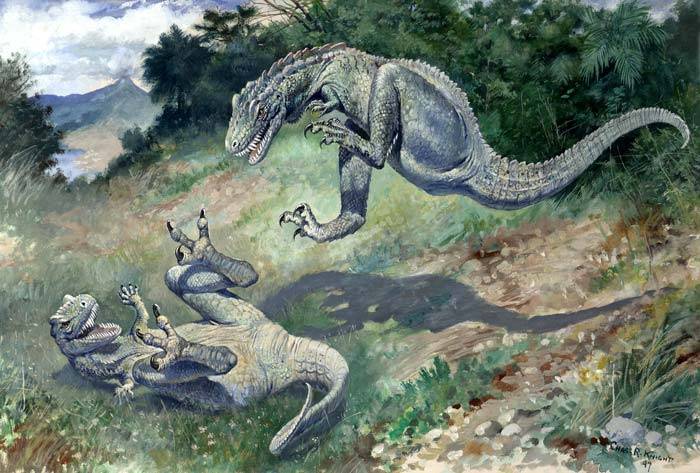
I'm not sure when this meme began, and if it's related to the Dinosaur Renaissance when the link between birds and dinosaurs was re-established. Looking at some Charles Knight paintings, such as his famous "Leaping Lealaps", it appears that the feet of his theropods were scaled based on modern lizards (more on the differences between lizard scales and other types of "scales" below). Bakker's influential early restoration of Deinonychus does not include any obvious scutes on the feet or tarsus. Mark Hallet, on the other hand, did include what look like oblong bird-like scutes on his theropods. At any rate, it's hard to deny that "bird feet" are typical of almost all modern reconstructions of dinosaurs, including my own, and are not limited to theropods. Bird-feet are often restored on ornithischians and even pterosaurs.

Of course, like many paleo-memes that developed during the 1980s, the main idea seems to be using this as a flourish to make otherwise scaly dinosaurs seem more bird-like. And thanks to skin impressions, we know that many dinosaurs had scales, right?

Saturday, April 20, 2013

Supporting the Dinosaur/Bird Link in the Era of the MANIAC

I'm posting this more as an open question than a statement of my own opinion, so comments appreciated!

A new paper out in Paleobiology by Verracchio et al. describes the porosity of Troodon formosus eggs and uses the data as evidence to support the hypothesis that troodontids brooded their eggs, like modern birds and other known maniraptorans, rather than burying them, like crocodilians and some other modern birds. In and of itself, this conclusion is interesting in that it pretty much solidifies nest brooding (as opposed to burial) as the ancestral trait for modern birds, and for maniraptorans (or at least chuniaoans*) in general.

Study coauthor Darla Zelenitsky with Troodon formosus nest. Photo by Jay Im, University of Calgary.
I hate to admit it, but my first thought when reading the headline of this news article from PhysOrg was that, yeah, we all assumed that anyway. The unspoken "rule of cool" is that science tends to be more exciting when we find evidence that contradicts previously well-supported hypotheses, rather than confirming hypotheses we all took for granted. Sure, finding the Higgs-Boson was exciting, but not nearly as exciting as not finding it, which could have led to new physics. I assumed, and I'm sure many others did as well, that troodontids brooded their eggs, based on the reasonably secure hypothesis that oviraptorids (which are known to have done so) are more basal. This behavior in troodontids was even depicted nicely in 2011's Dinosaur Revolution. So score another one for phylogenetic bracketing!

(Of course, this is not to imply that all chuniaoans must have brooded their eggs. It's entirely possible that reversals to burial nesting occurred, as with modern megapodes, and this seems especially likely for very large species like some dromaeosaurines. But the odds that any given chuniaoan would not be a brooder are low.)
Arctic troodontids, anatomy based on Troodon formosus.
Matt Martyniuk, all rights reserved.
Aside from all that, the assertion in the PhysOrg headline struck me as particularly meaningless. How could a study of troodontid brooding lend support to the dinosaur/bird hypothesis? This statement would have been accurate a decade ago, but not today. The reason is the moving goalposts of the dinosaur/bird opposition.

Friday, March 29, 2013

Who Cares About "Dinosaurs"?

Question: Who cares about dinosaurs?

Short Answer: Marketing departments and monster movie fans.

Above: Not what most people think of when you say "dinosaur."
(Ashdown Maniraptoran by Matt Martyniuk, all rights reserved).

Long Answer:
This is a philosophical issue that's been on my mind for a while now, inspired by some recent and heated debates over the content of the Dinosaur article at Wikipedia. It also seems to be simmering in the background of a lot of discussions about the recent suggestion that Jurassic Park 4 will not feature modern, scientifically accurate dinosaurians.

Sunday, January 22, 2012

The Debate: Newt Gingrich vs. Jack Horner

This is something I had completely missed until my wife found it linked to on a political blog a few weeks ago. Filmed in 1998, it's a pretty awesome hour-long video of a debate held between paleontologist Jack Horner and then-Speaker of the House Newt Gingrich. The topic: "Were Tyrannosaurus rex active hunters or pure scavengers?" What else?

The debate is actually a follow-up to a previous forum Gingrich did with Horner, both as fundraisers for the Museum of the Rockies. Gingrich, it seems, is an avid armchair paleontologist.


It looks like C-SPAN doesn't let you embed videos, so here's a link to the full debate: http://www.c-spanvideo.org/program/111009-1

What's fascinating about this debate is how it illustrates almost point-by-point a lot of issues I've seen cropping up online lately about the nature of scientific hypotheses, and in particular Horner's approach to them. As some of you may know, Horner recently backpedaled on the whole tyrannosaurs-as-pure-scavengers hypothesis, saying that, from the start, it was merely an attempt to illustrate how the scientific process is supposed to work as opposed to how it often goes in paleo. (Horner explicitly renounced the pure scavenger theory in, among other places, an October 2009 interview on the outstanding Skeptics Guide to the Universe podcast).

Watching this debate unfold, two things surprised me more than I thought they would. First, wow, Gingrich really did his research for this! He comes fully prepared with several examples and analogues to modern ecosystems, many of the same arguments I've seen used in forum debates on this topic, including the fact that there are few if any pure scavengers among modern animals, that hyenas will often take live prey, that vultures can get away with it due to their ability to fly over enormous areas in search of carcasses, etc. Newt knows his stuff, and handily pummels Jack in the debate (though Horner appears to be acting as sort of a gracious host, lobbing him a lot of softballs and overall "letting" Gingrich win.)

The second thing, though, is in Horner's closing arguments. Gingrich easily beats Horner by throwing out analogy after analogy, employing simple logic to demonstrate why his hypothesis "T. rex were not pure scavengers" is superior. But Horner points out, in a way, that it doesn't matter. Debates are antithetical to science. Empirical science is in no way about who has the better argument. It's about who has a more rigorous, testable and ultimately falsifiable hypothesis and can support it with more data, not better analogies.

I have been a T. rex as predators booster since I was 6. But after watching this debate, it is clear to me that Horner has always had a better, more scientific hypothesis and overall approach to the science of paleontology. He is correct that the default assumption has always been that T. rex were active hunters. But at the end of the day, assumptions are not science, and it's a little bit appalling that this assumption has been made an implicit basis of so many statement published in peer-reviewed scientific papers without question. You can never, ever disprove the hypothesis that T. rex were active hunters without a time machine, because it's logically impossible to prove a negative. That's why in science, if we have a positive statement as our hypothesis, it's often necessary to take the null hypothesis (the opposite statement to the one we are testing) and attempt to disprove that in an attempt to support the actual hypothesis. Like string theory, T. rex-as-hunters is an idea that makes logical sense on paper but is unfalsifiable, and therefore not science--just educated speculation.

However, Horner's hypothesis can and has been disproved. We now have evidence of healed-over T. rex bite wounds that show that at least occasionally, they bit living prey species. Does this prove T. rex were active hunters? Not necessarily, but it's a major piece of data against Horner's scavenging hypothesis, and that is actually the strength of Horner's position--that it can be tested and shown to be wrong. In science, it's not always better to be right than it is to be rigorous.

So while he may have won the debate, Gingrich was right for the wrong reasons, while his opponent Horner was wrong for the right reasons.

Wednesday, December 21, 2011

Bruhathkayosaurus is Dead. Again.

 Above: Working sketches for a speculative B. matleyi reconstruction by Steve O'Connor. Click here for Steve's final drawing.

I don't know how common this knowledge is, but this is the first I've heard of it so humor me while I mourn the possibility of ever re-assessing the intriguingly large sauropod specimen known as Bruthathkayosaurus matleyi.

B. matleyi was known from fragmentary remains of the pelvis and limb bones found in the Tiruchirappalli district of Tamil Nadu, India. It was first described by Yadagiri and Ayyasami in 1989 as species of giant allosauroid. This classification was widely doubted online, but little follow-up work was ever done. The initial description is widely regarded as exceedingly poor in quality and not much can be discerned about the specimen due to poorly detailed drawings and insufficient text. Tom Holtz has even stated that "the hypothesis that this is no more than petrified wood has not been falsified yet to my satisfaction." However, Mickey Mortimer later noted that the tree trunk hypothesis "is questionable given the non-cylindrical bones preserved such as the ilium. Additionally, Chatterjee has personally examined the fossils, and while he has a bad record of misidentifying taxa, I give him enough credit to not confuse a tree for a limb bone."

Sankar Chatterjee did indeed apparently examine the material and told George Olshevsky and Tracy Ford that he believed it to be a titanosaur, as reported in 1999 here.

Holtz responded to these appeals by noting that "not all units are the Dinosaur Park or the Djadokhta. In some preservation is really, really, really crappy. You might get all sorts of authigenic growth on the fossils, or alteration of the original material. In outcrops like that, it isn't out of the question to be fooled into thinking bone is wood and vice versa, especially from simple surficial appearances. This is why a section of the fossil would help resolve if it is bone or wood." So, there's that. We'll now never be able to take that section.


While B. matleyi was a near-mythical celebrity among "semi-apocryphal gigapods", its legend loomed larger than (published) reality. While most online sources (such as the DML posts quoted above) had long since agreed that the specimen was probably a gigantic sauropod and not a gigantic carnosaur, no actual published reference to the species as a sauropod existed until five years ago (Krause et al. 2006).

And what a sauropod it was, maybe! Obviously with such a paltry footprint on the scientific literature, reliable size estimates for such a poorly described specimen are hard to come by. Luckily, some researchers have done the best they could with the available data and determined that, if B. matleyi was indeed a titanosaur with similar proportions to say, Argentinosaurus, it would have been very large indeed. Matt Wedel over at SV-POW has estimated the size of this animal in life at 139 tons. Mickey Mortimer has estimated its length at up to 34 meters. That would position it as one of the largest species of land animals ever, second only to Amphicoelias fragillimus, possibly.

And now, it appears that B. matleyi has suffered the same fate as its atlantosauroid rival for the record. In the comments at another SV-POW post about semi-apocryphal gigapods, Wedel reports that the type and only specimen of B. matleyi was at some point washed away in a flood.
UPDATE: Thanks to Fabrizio in the comments pointing out a source closer to the horse's mouth. Artist "palaeozoologist" at DeviantArt posted an apparent personal correspondance from Kumar Ayyasami last January, in which he reported that the specimen was lost in heavy rains several years ago. (There's some more discussion of the specimen and the author's publication record here, including the suggestion that Dr. Ayyasami may now be deceased--that is, if you can get past the inexplicable Ali G speak). So it sounds like not only was the specimen poorly described, but nobody had bothered to actually collect it from the field site in the ~15 years since its discovery, and it was (predictably and inevitably) lost to erosion.

Any hope of verifying the stupefying claims about this species' size now seem to be lost. And unlike A. fragilimus, which was described and well-illustrated by a mostly reputable source with no obvious errors, the poor state of the B. matleyi description will forever doom this creature to the realm of dubious claims. After all, given the poor state of the description, it seems possible that a simple scale bar error or other mix-up could have tainted the data, and therefore all of our size estimates.

So here's to Bruthathkayosaurus matleyi, a beast (or possibly, a tree?) that died 70 million years ago, raised its spectral head (or crown?) again for one tantalizing moment and then, like Hitchcock's Ornithichnites, sunk back beneath the earth before we could really learn anything about it.

Monday, December 5, 2011

Waddle, _Achillobator_, Waddle!

Above: Revised illustration of Achillobator giganticus with corrected leg proportions. Scale bar = 500 mm. By Matt Martyniuk, all rights reserved.

"I've hunted most things that can hunt you, but the way these things move..."
"Fast for a biped?"
"Cheetah speed. Fifty, sixty miles an hour if they ever got out into the open, and they're astonishing jumpers."

This quote from the original Jurassic Park film did much to cement the image of dromaeosaurids, the raptor* dinosaurs, in the public consciousness as fleet-footed hyper predators. Despite being nearly 20 years old, this portrayal has by and large remained unchanged in popular culture, with raptors often stock monsters with near-supernatural murderous abilities in everything from tongue-in-cheek xkcd comics to (I hope) tongue-in-cheek made for SyFy movies.

*Yes, I'm going to commit a cardinal sin and refer to dromies as "raptors". "Raptor" in ornithology refers to most predatory birds, even those that hunt on the ground (the Raptor Research Foundation considers Secretarybirds to be raptors). Since dromaeosaurids were both predatory and birds under any sane definition of the word, there should be no problem referring to them as an extinct group of raptors.

But were raptors really particularly fast? Bipedal running speed in digitigrade animals (that is, those that walk on their toes like birds rather than their ankles like humans) is usually roughly determined by the ratio of the lower leg bones (the tibia/tibiotarsus) to the upper foot bones (the metatarsus). The longer the upper foot is in length compared to the lower leg, the faster an animal could run. Therefore, we would expect the fastest theropod dinosaurs to be those with the longest metatarsi relative to tibiae.

A prime example of a theropod specialized for running very very quickly are the parvicursorines. This specialized group of alvarezsaurids (strange theropodan insectivores with stout, powerful arms each bearing one very large claw) has among the longest lower leg to upper leg ratio of any Mesozoic dinosaur group.  Looking at the statistics compiled by Mickey Mortimer at The Theropod Database (a phenomenal resource I turn to so often I really should just make it my browser's home page), the type specimen of Parvicursor remotus (see leg diagram here) has a femur 52.6 mm long, a tibiotarsus about 75.6 mm long, and a metatarsus 58 mm long. The functional lower leg is 113 mm long, well over twice the length of the upper leg. More importantly, the lower leg and upper foot bones were fairly close to being equal in length. This animal was clearly a speed demon.

How does this compare to raptors? If, as Jurassic Park claimed, raptors were exceptionally fast, we would expect them to have similarly long lower legs. The terrifyingly human-sized raptors in JP were a Hollywood invention, but we do know of raptor species slightly smaller and slightly larger than they were.

On the smaller side were the famous Deinonychus antirrhopus. According to TTD, the femora of one relatively complete specimen measured 248 mm, with a tibia 324 mm long, and a metatarsus 151 mm long. Again, the total lower leg length is nearly double the upper leg. But the upper foot bones were only half as long as the lower leg bones.

The "fast raptor" meme was started by John Ostrom himself, when he first described Deinonychus in 1969. This was merely speculation on his part, as the hind limb was not completely known in the first specimens. Ostrom actually changed his opinion in later papers, finding that the femur was shorter than he'd initially thought, and that the foot bones were surprisingly short compared to other dinosaurs. Not only was Deinonychus not particularly fast, it probably could not have been nearly as fast as most other small theropods, including modern flightless birds, let alone cheetahs.

Another very popular type of raptors are advanced giant dromaeosaurines (Utahraptor and Achillobator). I recently found myself revising an older drawing of an Achillobator giganticus, which were, as mentioned above, only slightly larger than the Jurassic Park raptors. Many young dinosaur fans are very attached to these species in part because they're much larger than most other raptors, and because they had a slightly anthropomorphized novel written about them by Bob Bakker shortly after JP was released (Raptor Red). As a result, these big birds have a cachet in the collective consciousness similar to the generally more famous Deinonychus and Velociraptor--that of super-fast, agile and intelligent predators.

However, when finishing up my revised drawing, I had to double check the proportions several times to make sure I wasn't screwing it up. To my amazement, the legs, particularly the lower legs and upper foot bones, looked almost laughably short. Again according to TTD, the femur of A. giganticus measures 505 mm long, the tibia 490 mm long, and the metatarsus a paltry 234 mm long--less than half the length of the tibia. Not only is the metatarsus much, much shorter than the tibia, the entire lower leg in only marginally longer than the femur! The first thing that struck me wen looking at my own reconstruction was that this looked like the dromaeosaurid equivalent of Majungasaurus, those abilisaurids with the ludicrously short legs (which, coincidentally like Achillobator, have been suggested to be made up of chimeric specimens). It is also reminiscint of another stout-legged dromaeosaurid species, Balaur bondoc. While Balaur have been suggested to be possibly herbivorous due to these strange proportions, partial jaws and some teeth of Achillobator confirm that they were carnivores. But with legs like those, it's hard to imagine these creatures behaved the way the public imagines raptors to have done, chasing down fast moving prey. Frankly, it's hard to imagine Achillobator doing much beyond waddling across Nemegtian lake shores hunting turtles in epic slow-motion chases.

For the record, no described specimen of Utahraptor preserves both a femur, a tibia, and a metatarsus, so it's impossible to say whether or not they had the same squat proportions (unless somebody has some more detailed information on the numerous undescribed specimens in the BYU collections). For now, it would be safe to assume that they, too, would have been a laughing stock if they were caught trying to run.

Ok, but why would predatory animals have such stubby legs? There is a lot of evidence that dromaeosaurids were specialized for hunting big game, often animals larger than themselves. Deinonychus are infamous for their association with large ornithopods Tenontosaurus tilletti, and while evidence suggests they mainly targeted juveniles (Forster 1984), these were still much larger in terms of weight than even adult Deinonychus. Velociraptor are known to have grappled with the larger Protoceratops, and even a rumored specimen of a Microraptor apparently preserves evidence that they tackled prey larger than themselves. The short legs, especially the short foot bones, seem to be linked with the function of the large sickle-claw, making lack of speed a trade-off for improved ability to grapple and kill large game. Dinosaurs like Tenontosaurus and Protoceratops probably weren't particularly fast-moving themselves, making this sacrifice in speed worthwhile for the chance to down a massive animal that could provide a whole lot of food.

In the end, while the raptor chase scenes in Jurassic Park remain some of the most exciting parts of the movie, they require a significant amount of disbelief to be suspended; after all, it would be more realistic but slightly less suspenseful if Laura Dern had been able to evade the raptors in the power bunker by simply breaking into a light jog.

Sunday, November 20, 2011

An Alternate History for "Archaeoraptor"

For those who didn't figure it out, yesterday's mystery bird teaser was a bit of a trick question. In fact, the bird, which I restored on a lark when working on other species, never existed at all. It was, in fact, a restoration of the famous fossil chimera, "Archaeoraptor liaoningensis". Two commentors did get it half right, guessing Yanornis, though the long tail would make that identification impossible (as euornithines, Yanornis had short tails with retractable fans of feathers). You'll notice I modified the image a bit since yesterday: Mickey Mortimer pointed out that Yanornis were not fully toothed, and while the premaxilla had teeth, there is a small edentulous anterior portion which may have supported small beaks.

Despite being the most famous fossil forgery to come out of China, the "Archaeoraptor" debacle really is a success story for the peer review process. You can read a summary of the history of the specimen here. The upshot is that several researchers were suspicious of the chimeric specimen to begin with, and though they rather dubiously chose to submit it for publication anyway, their paper was subsequently rejected by two major journals, Nature and Science, before unfortunately being reported on without review in National Geographic magazine.

In fact, it's not surprising that so many researchers were suspicious of the specimen's validity to begin with. At it combines the skull, body and wings of a Yanornis martini (a songlingornithid euornithine) and the tail of a Microraptor zhaoianus (a microraptorian dromaeosaurid), the "Archaeoraptor" specimen would have been a very odd anomaly had it been real, given our knowledge of bird evolution (even in 1999, when it was first revealed to the public). Note that many news reports have stated that the hind limbs of the composite specimen also come from a Microraptor or even a third, unidentified type of bird, Zhao et al. (2002) noted that they also come from a Yanornis martini. Anyway, I broke out Professor Farnsworth's What-If Machine to try to suss out how our current understanding of bird evolution would be different if the composite nature of the original "Archaeoraptor" specimen had never been discovered.

Intuitively, it seems like a bird with the long tail of a dromaeosaurid combined with the advanced wing configuration and well-developed breastbone of an euornithine doesn't make much sense and would have eventually caused a rather extraordinary rearrangement of the bird family tree. To test this idea, I employed the services of phylogeneticist extraordinaire Mickey Mortimer, who had coincidentally just finished coding Yanornis martini and entering it into a combined Theropod Working Group matrix. Mickey very helpfully humored my request and combined the relevant anatomy Yanornis and Microraptor into a single taxon, and plugged the result into a theropod phylogeny which included only other taxa known in 1999.

I'll let Mickey explain the analysis in more detail:

"Okay, so what I've done is taken my Theropod Working Group analysis and restricted it to taxa described by 1999 (when "Archaeoraptor" was supposed to be described) and coded by the TWG [Theropod Working group - Ed.] by 2005.  I've also limited it to those characters taken from the first TWG analysis (Norell et al., 2001), since I already posted those results on my blog (http://theropoddatabase.blogspot.com/2011/06/theropod-working-group-matrix-recoded.html) and Scott understandably doesn't want more of the Lori results being distributed before publication [Click here for the scoop on Lori, Scott Hartman's unpublished Morrison troodontid -Ed.].  So data-wise, this is equivalent to results I've already posted and with the exception of new specimens of old taxa (like the new Caudipteryx specimens in Zhou et al., 2000), which would be far too tedious to correct for, is representative of our knowledge in 1999.  "Archaeoraptor" is represented by the Yanornis codings mixed with Microraptor tail codings.  Many of those Yanornis codings are from specimens besides the Archaeovolans holotype, but I'm not going to take the time to go through and see exactly which characters can be coded from only that specimen.  In total, 11 codings were changed between Yanornis and "Archaeoraptor".  The entire matrix is 51 taxa and 210 characters."

The result of Mickey's analysis was that "Archaeoraptor" ended up as the sister taxon to Confuciusornis, but with some caveats. First, no other pygostylians (the group uniting Confuciusornis and modern birds)were included, because Confuciusornis is the only pre-1999 taxon coded by the TWG. A complete test of "Archaeoraptor"'s 1999 relationships would require the addition of taxa like Patagopteryx, Songlingornis (which is a potential close relative of Yanornis), Cathayornis, Iberomesornis, etc. Because the only plesiomorphic character of "Archaeoraptor" relative to Yanornis and other euornithines proper are the "longer tail, elongate distal caudal prezygapophyses and rectangular proximal caudal centra", "Archaeoraptor" looks, for 1999 standards, like what we might have expected the sister taxon of Pygostylia to be like. Nevertheless, because the bulk of the specimen is so derived, Mickey reckons the presence of the long tail might not pull it away from euornithines even if other basal pygostylians were included (the long tail would then have to be considered a bizarre reversal).

Mickey also tested a few alternate hypotheses to see how much support they would get. Perhaps the obvious conclusion for a scientists faced with an oddity like "Archaeoraptor" would be that it is probably a sister group to Pygostylia as mentioned above, or somehow intermediate between dromaeosaurids and pygostylians. Mickey tested this by forcing "Archaeoraptor", Confuciusornis, and dromaeosaurs to clade together, which resulted in only three extra steps: this would have been considered a pretty sound hypothesis given the small pygostylian sample. Interestingly, this arrangement would also have resulted in unenlagiines as basal eumaniraptorans and put Archaeopteryx in Troodontidae. Removing "Archaeoraptor" from the mix decreased the likelihood of a Dromaeosauridae+Pygostylia clade by five steps, which Mickey notes is still "plausible" but certainly less likely, and shows that "Archaeoraptor" would have created the kind of link between dromies and more advanced birds touted by the original NatGeo article.

This leads me to speculate that "Archaeoraptor" may have provided "evidence" for the  modular evolution of pygostylians directly from some traditional dromaeosaurs. Modular evolution refers to cases where major traits of a descendant group appear in a taxon which simultaneously retains major "primitive" or plesiomorphic traits of the ancestors taxa. One famous fossil example of this phenomenon is Darwinopterus modularis, which is a long-tailed pterosaur with a generally primitive, "rhamphorhynchoid" body plan, but which has a characteristically pterodactyloid-type skull. Had "Archaeoraptor" been accepted as real, we may now have believed that characteristic euornithine traits evolved first in the skull, forelimbs and torso of taxa which possessed otherwise dromaeosaurid tails (this is almost the exact opposite of how we view bird evolution today, with tail shortening coming very soon after the split between dromaeosaurs and pygostylians). As Mickey found, without more discoveries of basal pygostylian and ornithothoracine birds, our cladograms may have rendered dromaeosauridae paraphyletic with respect to modern birds.

Ok, but how would all this stand up over the years after 1999, with more and better specimens of basal birds from a variety of lineages? From Mickey:

"Here's where I'd expect the inclusion of more pygostylians to have an effect though, since right now with only Confuciusornis, "Archaeoraptor" is effectively the most basal pygostylian.  But if we had an omnivoropterygid, an enantiornithine, and other ornithuromorphs in there, Yanornis' birdy characters would nest it with those and make its dromaeosaurid-like tail a reversal."

So, the discovery of more and better basal bird specimens may have been enough for "Archaeoraptor" to be regarded more and more as a curious side-branch of the avian family tree, less and less relevent to bird evolution as a whole: a euornithine with some rather inexplicable reversals. This would be similar to the way the relevance of the Piltdown Man to human evolution was exponentially reduced by numerous valid specimens before it was finally found to be a hoax.

It wouldn't be DinoGoss without a discussion of taxonomical minutiae, and this is a question that has popped up on the net several times before: if "Archaeoraptor liaoningensis" included the holotype specimen of Microraptor zhaoianus, why isn't the former an objective senior synonym (that is, a name that is synonymous by virtue of being based on the exact same specimen, not a different specimen later assigned to an already named species) of the later?

The crux of the argument is that the original National Geographic article that released the "Archaeoraptor" name did not satisfy the criterion for publication set forth by the International Code of Zoological Nomenclature (ICZN).The article, "Feathers for T. rex", was written by Christopher Sloan for the November 1999 issue of the magazine. While Sloan did technically coin the name "Archaeoraptor liaoningensis" by publishing it in a widely-distributed magazine (and the ICZN does not mandate that names can only be created in peer-reviewed journals), he did not make it clear that he was intending to formally erect a new taxon (usually done by specifying ("new genus and species", "gen. et sp. nov.", or some variation). Furthermore, he explicitly referred to the fact that a formal description of the species was forthcoming. Most observers have interpreted this as falling short of the ICZN requirements for naming taxa, and I don't know of any good reason to disagree.

A more complicated factor is that, among the subsequent publications on the chimeric fossil, some authors did try to formally name the taxon and designate a lectotype (when a type specimen is found to actually represent two or more individuals, a lectotype must be chosen from among them to officially bear the name that originally applied to the lot). Noted BANDit Storrs Olson published an article in a 2000 issue of the Backbone newsletter of the US National Museum of Natural History in which he attempted to remove the tainted name from his own area of study, fossil birds. This is before many BANDits (the "birds are not dinosaurs" crowd) collectively reversed their positions and decided that dromaeosaurs ARE fossil birds after all, thus becoming MANIACs ("maniraptorans are not in actuality coelurosaurs"). Olson therefore designated the tail specimen as the lectotype. This would seemingly make "Archaeoraptor" the official senior synonym of Microraptor.

Not so fast. Olson did not actually describe the specimen or convey intent to coin the name. Like Sloan, he referred the creation of the name to other authors (in this case, Sloan himself, in the mistaken belief that Sloan's article DID coin the name). So Olson effectively specified that the nomen nudum "Archaoraptor" should refer to the tail, but failed to officially create the name, let alone specify its lectotype.

And that is why "Archaeoraptor liaoningensis" remains a nomen nudum; at least, just until some cheeky bastard decides to formally attach the name to something for reals. Technically, nomina nuda are still up for grabs nomenclature-wise...

Tuesday, May 17, 2011

Tyrannosaur Tooth Count

Making the rounds right now in the media is a story about a newly described, well-preserved baby Tarbosaurus bataar that helps shed some light on the way tyrannosaurs grow, as well as touches on lingering controversies. Plenty of other blogs have already covered this, so here's a link to the backstory from Brian Switek at Dinosaur Tracking.

Interestingly, the baby Tarb has 15 teeth in the lower jaw, the same number as adult T. bataar. There has been controversy over whether or not tyrannosaurs reduced their number of teeth as they grew, particularly when it comes to the controversial taxon Nanotyrannus lancensis. Nano is known from two specimens (one is nicknamed "Jane") that, depending who you talk to, might really be simply juvenile specimens of the contemporary Tyrannosaurus rex. The differences cited to separate the two boil down to differences in the braincase (certain braincase changes were demonstrated in the new juvenile Tarbosaurus as well), and the number of teeth. Adult T. rex are usually said to have only about 12 teeth in the dentary, while specimens of N. lancensis have a whopping 17. The new juvenile Tarb suggests that in at least some tyrannosaurs, the tooth count is not drastically reduced during growth from juvenile to adult. However, as the authors caution, this same pattern may not necessarily hold true for other tyrannosaurs, even very close relatives.

And, the same pattern does not hold true for the very closely related T. rex. Also making the blog rounds these last few days has been this video of Jack Horner's talk at TEDx in Vancouver (thanks to David Orr at Love in the Time of Chasmosaurs for posting the video link!).


Here Horner gives the basics of his theory that dinosaurs are oversplit, not in the subjective taxonomic sense, but in the more objective biological sense that specimens that could be shown to belong to one species actually represent juveniles of other species. You've all heard the details before, but towards the end he shows a slide (reproduced above) that is pretty damning to the crowd who support the validity of N. lancensis. In fact, adult specimens of T. rex show a very wide ranging tooth count, and it even appears to correspond with relative size (and presumably growth stage. If anything, the number of teeth seen in N. lancensis specimens are only one or two teeth outside the range of variation for T. rex proper, a minor variant that can almost certainly be attributed to ontogeny, and not some cryptic species of giant tyrannosaur lurking in the Lancian faunas that has so far only been identified by two juvenile specimens, while the very common T. rex is known from no juveniles at all.

Anybody know the tooth count for the "Tinker" specimen, currently held in a private collection?

Monday, May 16, 2011

Confuciusornis: Bird-o-Dactyl


There's been a lot of debate about Confuciusornis lately. Could it fly? If so, how? And how well? It probably wasn't doing anything like a modern bird does. Studies of its feather strength suggest it couldn't do more than glide (or could it?). But studies of its forelimb and shoulder girdle show it couldn't lift its arm much above the horizontal plane, making flapping pretty much impossible. Unless that huge, fenestrated deltopectoral crest gave it a rather unique flight stroke that only minimally involved the humerus.

Or, maybe this was a small theropod with enormous, high-aspect ratio wings larger than those of any other early bird, with asymmetrical feathers, puny feet and short legs ill suited for running and a small, barely reversed hallux ill suited for climbing, which couldn't flap and could barely glide with its thin feather shafts, yet is consistently found preserved as enormous flocks at the bottom of deep lake deposits. In which case the giant wings would be for display, obviously, to hopefully impress a predator so much that they decline to eat the poor bird which has no means of escape or defense other than to flee into the depths of the water like a 1960s brontosaur, only to remember that it also can't swim. No wonder they're extinct! Anyway... I hope much, much more study (and some wind tunnel tests) will eventually help untangle this mystery. For now, I was struck by something a little more frivolous. Working on a lateral view of Confuciusornis sanctus, checking and re-checking papers to make sure proportions are right, it started to look unmistakably like the profile of a... rhamphorhynchid pterosaur? Between this, and basal paravians with expanded, diamond-shaped vanes on the tips of their tails, in terms of general body plan there are some curious similarities (convergences?) between the first gliding/flying birds and primitive, long-tailed, high-aspect ratio-winged pterosaurs. My PhyloPic style silhouette version above.

Monday, February 14, 2011

Heat, Feathers, and Half-Arsed Velociraptor

Above: Comparison of common Velociraptor reconstructions by artist Tomozaurus, used with permission.

A month or so ago, this diagram (also shown above) produced by an artist known as Tomozaurus stirred up a good deal of debate over at DinoForum. Tom was trying to illustrate common misconceptions about the most likely life appearance of dromaeosaurids. By now, everyone (including the birds-are-not-dinosaurs crowd) agree that dromaeosaurids were fully feathered and pretty bird-like. Whether or not to consider them actual birds is a matter of semantics at this point. But, among dino-fans weaned on their depictions in pop-culture, there seem to be a lot of heated reactions to depicting them as too bird-like. Many will admit that they had feathers, but stop short at reconstructing them in a really bird-like manner, preferring a short, cat-like pelt that allows the graceful and well-known contours of the skeleton to show through in life. But compare any bird skeleton to a live specimen, even those with "simple" feathers like chicks or kiwi, and you'll immediately see that this is the wrong way to go. Even most feathered theropod fossils show a feather covering that does not hug the body contours, but like modern birds, consists of a lot of poofy, long feathers (especially at the breast and neck) that would make them look very "bulky."

The debate about the above image concerned how well these principles should apply to larger dino-birds like Velociraptor. Velociraptor is perhaps the worst offender in this area due to its enormous popularity: it has a very well-ingrained image in the popular consciousness that, in all likelihood, doesn't match how it would have appeared in life. But just how likely is any reconstruction?

The fact is, we don't know very much at all about the feathering in Velociraptor. At least one specimen preserves quill knobs on the ulnae where large secondary feathers must have attached, so we know for a fact that it had wings. But what about the body feathers? Tom's picture supposes that we would do best to reconstruct the remaining feathers based on related (but much smaller) species in which the full compliment of feathers has been preserved; things like Microraptor, Anchironis, Archaeopteryx, and the unnamed species nicknamed "Dave". Based on these, Tom gave his "correct" Velociraptor a full set of long primary feathers (present in Micro and Archie but much shorter in Dave and Anchi), a feather crown (present in Micro and Anchi but not Dave and Archie), flight feathers on the hind legs (present in Micro, Anchi and Dave but not Archie, though the last does have "bell bottoms" of long, non-planar pennaceous feathers down to the ankles), and feathers covering the face and most of the snout (present in all but possibly Archie). Last, he restored the body contour feathers as pennaceous rather than downy. This is the most problematic, present (apparently) in Anchiornis but not in the others (Archaeopteryx has pennaceous feathers over the hips but this appears to be a single or paired feather tracts (pterylae), and the rest of the body is covered in plumulaceous feathers or simple protofeathers).

In contrast, Tom presents two "incorrect" versions: the Greyhound/Lizard (which is so obviously wrong there's not much else to say about it) and the "Half-Arse." The later is interesting because while it deviates considerably from the inferences drawn based on its relatives, there's nothing obviously inaccurate about it, or at least implausible. The drawing seems to be identical to the Velociraptor computer models used in the TV show Dinosaur Planet: feathered, but barely so, with a short, mammal-like pelt hugging the contours of the body, a large crown for display, and many featherless areas of the body.

Defenders (or at least devils advocates) for this reconstruction pointed out that it doesn't deviate too wildly from larger, flightless modern birds. Ostriches (Struthio camelus) are famously stripped-down of feathers, more so than many people think (see image above, showing the naked underside of the wings and featherless torso). However, ostirches are also quite a bit larger than Velociraptor, and smaller ground birds from the same environment like the Secretary Bird (Sagittarius sepentarius) lack extensive naked patches. On the other hand, Rhea (Rhea spp.), which are similar to Velociraptor in weight, do have naked patches on their underwings, though not as extensive as ostirches (see image below).

So, while I still think the rather short body feathers would be a little far-fetched (longer ones would be better for thermoregulation--if overheating is the issue, the feathers would probably simply be lost entirely, which is not the case in modern birds that lose feathers only on extremities), the Half-Arse version doesn't seem all that bad.

But there's more that needs to be taken into account. A great post at Tetrapod Zoology today touches on some aspects of featherless patches on birds and its effects on thermoregulation. A bit counter-intuitively, a heavy feather coat can actually help keep birds cool--they're general insulators, not simply heat-trappers, like a thermos. In the post, Darren Naish discusses male wild turkeys, which famously have bare heads with brightly colored, outlandish soft tissue structures for display. This actually puts the male birds at a disadvantage, because all that bare skin causes the males to be more prone to overheating, requiring them to spend more time cooling in the shade than females. Like the tail of a peafowl, the naked heads of turkeys are a sexual display structure that puts the birds at a disadvantage when it comes to survival. Granted, this is only the example of one bird. I don't know how this might apply to, say, ostriches. Ostriches, like Velociraptor, inhabit a hot, arid environment. Indications suggest that Velociraptor lived in an even more desert-like setting, dominated by barren dune fields, making it a solidly desert bird. Would the extensive bare patches of the Half-Arse be beneficial in this setting, or would they tend to drastically overheat the animal under an unrelenting desert sun with few sources of shade?

Above: Photo of a Greater Rhea (Rhea americana) by Ramon Moller Jansen. This species is about the same size as an adult Velociraptor mongoliensis, but live in more lush environments with some tall shade plants.

According to Willmer, Stone & Johnson (2000), many ratites use similar strategies to regulate their body temperature and prevent overheating. Ratites such as the Rhea store their heat while active, and only actively attempt to shed it while at rest. This is achieved through strategies such as panting, drooping the wings (allowing air to conduct heat from the sparsely feathered underwings while at the same time shading them), and raising or lowering the sparse feathers of the back (known as ptilo-erection). It's interesting to note that in Archaeopteryx, the back is the only region of the body that has pennaceous feathers, better for trapping or shedding heat. With all of these adaptations, ostriches rarely have to seek shade, even when it's available (Levy et al., 1990). So while feather-loss in modern birds is an important strategy for those living in hot, arid climates, note that the pattern of loss is not random or extensive, but rather strategic, allowing for maximum thermal regulation.

If I were to speculate, I'd make an educated guess that bare patches in Velociraptor must have been limited to the legs, flanks and underwings for these reasons. Those areas could be shaded simply by the animals own body and cooled easily as needed. The head and neck would have been most prone to overheating. The animal could only shade these by adapting a Mei long style sheltered posture with the head tucked under the wing and body feathers (but only if a hefty body covering was present, not a form-fitting pelt). One question I can't seem to find an answer to is how ostriches cope with direct sun to their nearly bare heads and necks--the problem faced by male turkeys. My wild guess would be that the heads of turkeys are highly decorated with thickened skin, presumably a better insulator than the plain skin of an ostrich, which would allow more loss of heat to the air. Or maybe they bury their heads in the sand to keep cool... (I kid, I kid!). If anybody knows of any studies or physiological issues that would cause this to be a problem for one and not the other, please leave a comment!

References:
* Levy, A., Perelman, B., Grevenbroek, M.V., Creveld, C.V., Agbaria, R. and Yagil, R. (1990). "Effect of water restriction on renal function in ostriches (Struthio camelus)." Avian Pathology, 19: 385-393.
* Willmer, P., Stone, G. and Johnston, I.A. (2000). Environmental Physiology of Animals. Wiley-Blackwell, Science. 644 pp.