 |
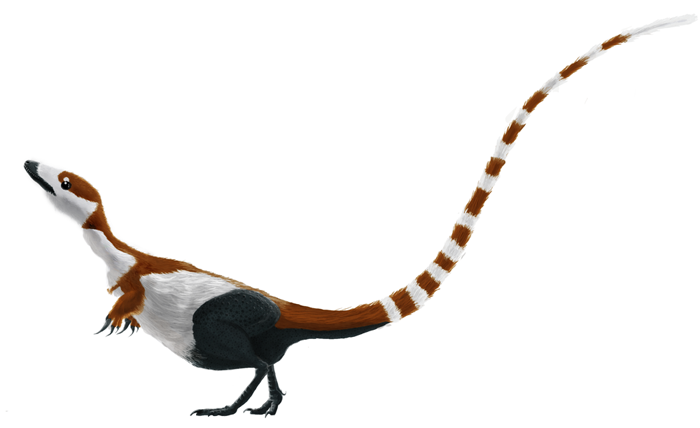
| Life restoration of the S. prima type specimen by M. Martyniuk |

Saturday, August 11, 2012
Did Sinosauropteryx Have "Protofeathers"?

Friday, August 10, 2012
The Strange Bird Dalianraptor cuhe
 |
| Type specimen of D. cuhe, originally posted by Andrea Cau |
D. cuhe has spent the last several years as a species in obscurity, even among most paleontology enthusiasts. I recall my first glimpse of the type specimen, wondering over the seemingly-complete remains of an "undescribed possible dromaeosauird" in a low-res photo posted online in the early '00s. I can remember saving the image to my reference folder, hoping that one day I'd be able to update the file name. It's a fascinating animal, but... is it real?
Wednesday, August 1, 2012
The Tail of Shanweiniao
 |
| Fossil tail feathers of S. cooperorum, from O'Connor et al., 2009. |
S. cooperorum itself is most well-known for its elaborate tail made up of six ribbon-like feathers. Those feathers overlapped at the base, and may have acted as an air brake for precise landings with the feet on small branches. It's possible that most other enantiornitheans, which lacked long feathery tails and also retained wing claws, landed by simply smacking clumsily into tree trunks or brush and grabbing on with all four limbs.
Wednesday, July 25, 2012
Wrong for the Right Reasons
 | |
| Outdated restoration of a Protoceratops andrewsi nesting ground. Painting by Charles R. Knight, 1922. |
Tuesday, June 5, 2012
The Smallest (Mesozoic) Theropods
The online community of paleontology fans seems to have an unnatural preoccupation with size. Visit any dino-related message board, and you will find near-daily debates over which carnivorous theropod was bigger (or more specifically, longer). Carcharodontosaurus? Giganotosaurus? Tyrannosaurus? Hint: if the length estimates are within a meter of each other, the weight estimates vary widely, and the beasts in question are known only from one or two fragmentary skeletons, the correct answer is "eh, they're all about the same size, give or take." Also, Therizinosaurus and Deinocheirus, being wimpy herbivores, definitely do not count.
Less often, you may come across a discussion about which dinosaur was the smallest. These usually are not the heated debates you find with the mega-carnivores, but rather casual examination of minutiae and bringing up oft-forgotten species. Yes, everybody knows Compsognathus. But did you know the "chicken-sized" type specimen is a subadult or juvenile, and the referred French specimen is much larger? And anyway, Parvicursor was daintier by far. At 34cm (13in) long, Anchiornis was hailed as the smallest dinosaur when it was initially described, but subsequent specimens were larger (up to half a meter in length; still smaller than Compsognathus and slightly shorter than the ~40cm Parvicursor). Epidexipteryx, at a stubby, tail-free 25cm (10in) in length, was the shortest of them all, but its lack of a long tail means that it was a bit larger than the competition in mass. And anyway, isn't Epidexipteryx a bird?
 |
| Size comparison of select small non-pygostylian theropods. From left: Palaeopteryx thompsoni, "Ornithomimus" minutus, Parvicursor remotus, Epidexipteryx hui. By Matt Martyniuk, licensed. |
Sunday, April 1, 2012
What Is Enantiornis?

Sunday, January 22, 2012
The Debate: Newt Gingrich vs. Jack Horner
This is something I had completely missed until my wife found it linked to on a political blog a few weeks ago. Filmed in 1998, it's a pretty awesome hour-long video of a debate held between paleontologist Jack Horner and then-Speaker of the House Newt Gingrich. The topic: "Were Tyrannosaurus rex active hunters or pure scavengers?" What else?
The debate is actually a follow-up to a previous forum Gingrich did with Horner, both as fundraisers for the Museum of the Rockies. Gingrich, it seems, is an avid armchair paleontologist.

It looks like C-SPAN doesn't let you embed videos, so here's a link to the full debate: http://www.c-spanvideo.org/program/111009-1
What's fascinating about this debate is how it illustrates almost point-by-point a lot of issues I've seen cropping up online lately about the nature of scientific hypotheses, and in particular Horner's approach to them. As some of you may know, Horner recently backpedaled on the whole tyrannosaurs-as-pure-scavengers hypothesis, saying that, from the start, it was merely an attempt to illustrate how the scientific process is supposed to work as opposed to how it often goes in paleo. (Horner explicitly renounced the pure scavenger theory in, among other places, an October 2009 interview on the outstanding Skeptics Guide to the Universe podcast).
Watching this debate unfold, two things surprised me more than I thought they would. First, wow, Gingrich really did his research for this! He comes fully prepared with several examples and analogues to modern ecosystems, many of the same arguments I've seen used in forum debates on this topic, including the fact that there are few if any pure scavengers among modern animals, that hyenas will often take live prey, that vultures can get away with it due to their ability to fly over enormous areas in search of carcasses, etc. Newt knows his stuff, and handily pummels Jack in the debate (though Horner appears to be acting as sort of a gracious host, lobbing him a lot of softballs and overall "letting" Gingrich win.)
The second thing, though, is in Horner's closing arguments. Gingrich easily beats Horner by throwing out analogy after analogy, employing simple logic to demonstrate why his hypothesis "T. rex were not pure scavengers" is superior. But Horner points out, in a way, that it doesn't matter. Debates are antithetical to science. Empirical science is in no way about who has the better argument. It's about who has a more rigorous, testable and ultimately falsifiable hypothesis and can support it with more data, not better analogies.
I have been a T. rex as predators booster since I was 6. But after watching this debate, it is clear to me that Horner has always had a better, more scientific hypothesis and overall approach to the science of paleontology. He is correct that the default assumption has always been that T. rex were active hunters. But at the end of the day, assumptions are not science, and it's a little bit appalling that this assumption has been made an implicit basis of so many statement published in peer-reviewed scientific papers without question. You can never, ever disprove the hypothesis that T. rex were active hunters without a time machine, because it's logically impossible to prove a negative. That's why in science, if we have a positive statement as our hypothesis, it's often necessary to take the null hypothesis (the opposite statement to the one we are testing) and attempt to disprove that in an attempt to support the actual hypothesis. Like string theory, T. rex-as-hunters is an idea that makes logical sense on paper but is unfalsifiable, and therefore not science--just educated speculation.
However, Horner's hypothesis can and has been disproved. We now have evidence of healed-over T. rex bite wounds that show that at least occasionally, they bit living prey species. Does this prove T. rex were active hunters? Not necessarily, but it's a major piece of data against Horner's scavenging hypothesis, and that is actually the strength of Horner's position--that it can be tested and shown to be wrong. In science, it's not always better to be right than it is to be rigorous.
So while he may have won the debate, Gingrich was right for the wrong reasons, while his opponent Horner was wrong for the right reasons.
The debate is actually a follow-up to a previous forum Gingrich did with Horner, both as fundraisers for the Museum of the Rockies. Gingrich, it seems, is an avid armchair paleontologist.

It looks like C-SPAN doesn't let you embed videos, so here's a link to the full debate: http://www.c-spanvideo.org/program/111009-1
What's fascinating about this debate is how it illustrates almost point-by-point a lot of issues I've seen cropping up online lately about the nature of scientific hypotheses, and in particular Horner's approach to them. As some of you may know, Horner recently backpedaled on the whole tyrannosaurs-as-pure-scavengers hypothesis, saying that, from the start, it was merely an attempt to illustrate how the scientific process is supposed to work as opposed to how it often goes in paleo. (Horner explicitly renounced the pure scavenger theory in, among other places, an October 2009 interview on the outstanding Skeptics Guide to the Universe podcast).
Watching this debate unfold, two things surprised me more than I thought they would. First, wow, Gingrich really did his research for this! He comes fully prepared with several examples and analogues to modern ecosystems, many of the same arguments I've seen used in forum debates on this topic, including the fact that there are few if any pure scavengers among modern animals, that hyenas will often take live prey, that vultures can get away with it due to their ability to fly over enormous areas in search of carcasses, etc. Newt knows his stuff, and handily pummels Jack in the debate (though Horner appears to be acting as sort of a gracious host, lobbing him a lot of softballs and overall "letting" Gingrich win.)
The second thing, though, is in Horner's closing arguments. Gingrich easily beats Horner by throwing out analogy after analogy, employing simple logic to demonstrate why his hypothesis "T. rex were not pure scavengers" is superior. But Horner points out, in a way, that it doesn't matter. Debates are antithetical to science. Empirical science is in no way about who has the better argument. It's about who has a more rigorous, testable and ultimately falsifiable hypothesis and can support it with more data, not better analogies.
I have been a T. rex as predators booster since I was 6. But after watching this debate, it is clear to me that Horner has always had a better, more scientific hypothesis and overall approach to the science of paleontology. He is correct that the default assumption has always been that T. rex were active hunters. But at the end of the day, assumptions are not science, and it's a little bit appalling that this assumption has been made an implicit basis of so many statement published in peer-reviewed scientific papers without question. You can never, ever disprove the hypothesis that T. rex were active hunters without a time machine, because it's logically impossible to prove a negative. That's why in science, if we have a positive statement as our hypothesis, it's often necessary to take the null hypothesis (the opposite statement to the one we are testing) and attempt to disprove that in an attempt to support the actual hypothesis. Like string theory, T. rex-as-hunters is an idea that makes logical sense on paper but is unfalsifiable, and therefore not science--just educated speculation.
However, Horner's hypothesis can and has been disproved. We now have evidence of healed-over T. rex bite wounds that show that at least occasionally, they bit living prey species. Does this prove T. rex were active hunters? Not necessarily, but it's a major piece of data against Horner's scavenging hypothesis, and that is actually the strength of Horner's position--that it can be tested and shown to be wrong. In science, it's not always better to be right than it is to be rigorous.
So while he may have won the debate, Gingrich was right for the wrong reasons, while his opponent Horner was wrong for the right reasons.
Subscribe to:
Posts (Atom)