 |
| Phylogeny of Bohaiornithidae, modified after Wang et al. 2014. |

Saturday, January 25, 2014
Oh, Hi, Bohaiornithids!
It's not often that we are introduced to a large new clade of stem-birds*, but a new paper by Wang et al. finds support for just such a thing among the enantiornithes. Named Bohaiornithidae, the family unites a few previously-known similar-looking opposite birds with two brand new species.

Sunday, September 8, 2013
Iridescence in Simple Feathers - The Case of the Blue Troodon
 |
| Iridescent feathers in troodontids - possible? Image by Matt Martyniuk, all rights reserved. (Supreme dino fans may recognize the pose even from this small clip...) |
Thursday, September 5, 2013
The Tale of the "Sail"
 |
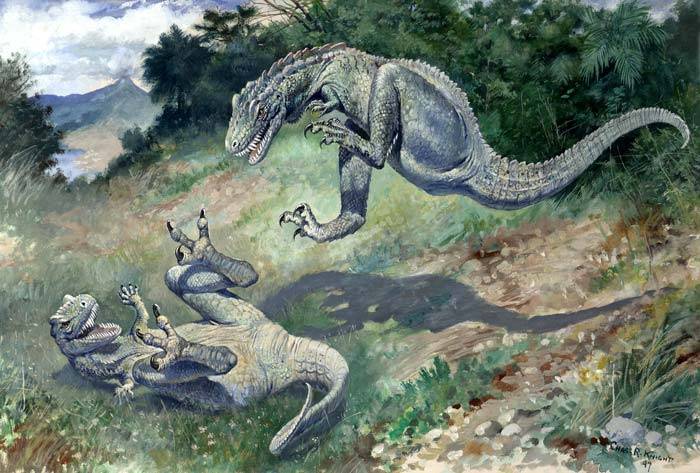
| This version of the painting, "The Fin-Back Lizards" (background: Dimetrodon incisivus, foreground: Naosaurus claviger) by Charles R. Knight, appeared in H.F. Osborn's obituary for E.D. Cope, The Century Magazine (1897). Public domain. |
Sails are often said to be present in other prehistoric animals, like ouranosaurs, spinosaurs, and arizonasaurs, but these are not the quintessential "sails" present in early synapsids like edaphosaurs and dimetrodonts. In the former, the neural spines of the vertebrae are very tall, but also broad and flat, as in normal vertebral columns. These probably anchored muscles, and at the very least supported a ridge of thick soft tissue, not just skin. In dimetrodonts and edaphosaurs*, on the other hand, the neural spines are not just tall, but thin, round, and strut-like. These aren't the kind of vertebrae that would be wrapped in muscle, and may have supported only a thin membrane of skin (I'm not aware of any actual direct evidence for a skin membrane sail, but correct me if I'm wrong).
During the late 1800s, the anatomy and relationships of the sail-backed synapsids was not yet well understood. In a situation weirdly parallel to the famous story about Brontosaurus, the first skeletons of what are now known as Edaphosaurus were found lacking skulls. A small herbivorous skull was actually found first, and given the name Edaphosaurus, but the connection to the sail-backed body was not made until later. The whole saga of Naosaurus, as the headless body was named, was told by Brian Switek at Laelaps. In short, the headless body of Edaphosaurus was seen by E.D. Cope as being very similar to Dimetrodon, and Cope referred a skull to it which is know known to belong to the smooth-spined form rather than the knobby-spined form. When it was discovered that is was actually the small, herbivorous heads already named Edaphosaurus belonged to the headless body, the name Naosaurus was sunk.
 |
| Skull attributed to Naosaurus claviger (but now to Dimetrodon) from Cope 1888, public domain. |
The thing that interested me most about revisiting this story was the whole history of the term "sail" itself. Why were these synapsids referred to as "sail-backs", a term that has since spread to any prehistoric animal with long neural spines?
Many people are aware of the early speculation that sail-backed synapsids used their sails to, well, sail. That is, to literally use their tall dorsal fins to catch the wind and move across water. Most people nowadays also think back on this idea as rather silly. The dorsal fin "sails" were, of course, parallel to the body, like the configuration of a sloop. However, unlike the speculative use of large crests as sails in some pterosaurs, which could at least move the head and neck to change the orientation of the supposed sail, poor dimetrodonts and edaphosaurs would be consigned to getting dragged more or less laterally across the surface of the water. At best, the undulating swimming motion of the torso would cell catch some wind, but the resulting constant change and undulating motion of the sail itself seems like it would make steering very difficult. (Nonetheless, I'm certain I've seen an artistic rendition of this behavior somewhere).
Switek says in his blog post the same thing I and everyone else tend to assume about Cope's sailing hypothesis, which is that Cope suspected "the long spines had a membrane stretched between them and could be used to catch the wind, just like a sail".
But, that's not quite right. It's true that Naosaurus translates as "ship lizard", named for Cope's sail-back hypothesis. But this hypothesis seems to have been specific to Cope's ship lizard, not to the (he thought) closely related Dimetrodon. In fact, if you read some of Cope's original descriptions, you find that the only feature he thought separated Naosaurus from Dimetrodon was the presence of transverse processes on the neural spines. Those are the little thorny side-projections present on the sides of the edaphosaur sail, contrary to the smooth, spike-like bony projections that make up that of dimetrodonts.
Cope thought that it was these side projections, which, while most were broken at the base, he estimated would could be up to half the length of the main neural spine in some specimens, that actually anchored the membranes of the sail! Cope pictured edaphosaurs with a series of membranous sails perpendicular to the torso, not parallel to it, similar to the configuration of the rigging of a large sailing ship rather than a sloop. As Cope said,
"In a full-sized individual, the longest cross-arms, which are the lowest in position, have an expanse of two hundred and sixty millimeters, or ten and a quarter inches, while the spine has about the height of five hundred millimeters (19.75 inches), the body being 60 mm. long. The animal must have presented an extraordinary appearance. Perhaps the yard-arms were connected by membrane with the neural spine or mast, thus serving the animal as a sail, with which he navigated the waters of the Permian lakes." (Cope 1888, p. 294).
While many prehistoric animals are described as having sails, it's interesting to keep in mind that this term seems to first have come about based on a hypothesized structure that was very different from the comparatively "normal" dorsal fins and ridges we're used to seeing today. Cope himself seems to have given up on the idea by the time he was supervising Charles Knight in a restoration of Naosaurus,** which other than the Dimetrodon-like skull, appears relatively normal by modern standards. Still, a proper reconstruction of a truly mast-sailed edaphosaur would be a nice challenge for paleoartists...
*Interestingly, most phylogenetic analyses nowadays suggest that these two types of sail-backed synapsids do not form a natural group with each other. So either the sails evolved convergently, or they are a trait of the common ancestor of the two types of animal. Which would mean our own ancestors were sail-backs!
**Knight later revised his Naosaurus painting, removing the transverse processes altogether and giving it an actual Dimetrodon skull, modifying it into simply a restoration of a Dimetrodon.
References
* Cope, E. D. (1888). Systematic Catalogue of the Species of Vertebrata Found in the Beds of the Permian Epoch in North America with Notes and Descriptions. Transactions of the American Philosophical Society, 16(2), 285-297.
* Osborn, H. F. (1897). A Great Naturalist. Century Magazine, November.
Sunday, September 1, 2013
You're Doing It Wrong : Dino Foot Scales
 |
| Above: Our subject matter. |
These kinds of unjustified assumptions have been rampant in the history of studying stem-birds. Archaeopteryx has traditionally been depicted, incorrectly, with a reversed hallux, and occasionally even with beak-like structures, simply because it's a "bird", and those are features all birds have. Except Archaeopteryx is not a true "bird", it's a stem-bird, more closely related to birds than to any other living animal group, but not a member of the group that includes all modern birds. It's fair to assume that an extinct member of the duck lineage, like Vegavis, had a bill, but that's not necessarily so for, say, Patagopteryx, despite the fact that it is usually referred to as a "bird".
 |
| Modern bird feet, by Philip Henry Gosse, 1849, public domain. Note overlapping scutes on the top surfaces, and pebbly, polygonal reticulae on the bottom surfaces. |
Most paleoartists have absorbed these kinds of warnings, and do a good job of avoiding obvious errors based on typology, the assumption that all species in a certain "type" share "key characteristics." But there are some typological memes in the bird lineage that are more pernicious, possibly because their actual evolution is something most artists don't think about very much.
Take, for example, the bird-like scutes that are almost universally illustrated covering the tarsus (upper foot/lower hind limb) of dinosaurs. Is there any evidence that these were actually present in any given group of non-theropod stem birds? Well... no. Not that I'm aware of (if you know differently, please comment!).
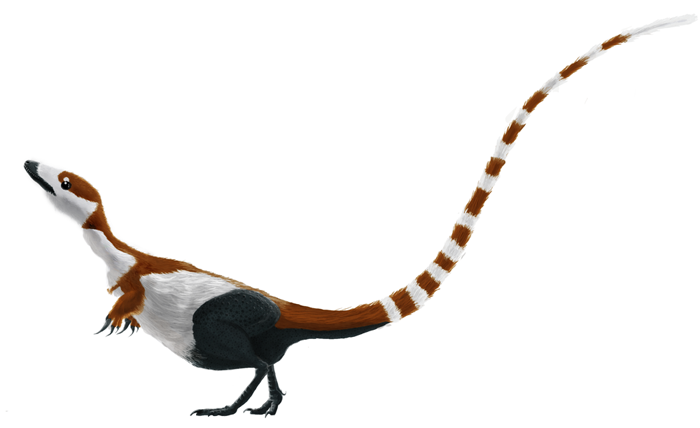 |
| Sinosauropteryx prima with tarsal scutes. Image by Matt Martyniuk, licensed. |


Of course, like many paleo-memes that developed during the 1980s, the main idea seems to be using this as a flourish to make otherwise scaly dinosaurs seem more bird-like. And thanks to skin impressions, we know that many dinosaurs had scales, right?
Monday, August 19, 2013
Follow-Up: Judith River Formation = Oldman Formation
In a previous post, I hung my tentative re-identification of the holotype teeth of Deinodon horridus on a rough correlation between the Judith River and Oldman formations, the latter of which is more precisely dated and, more importantly, contains Daspletosaurus torosus, which is a candidate for the owner of Deinodon teeth.
While researching a different topic, I stumbled across a more definitive published correlation of these two formations I wasn't previously aware of. In their 2001 paper on the stratigraphy of the Two Medicine Formation, Horner et al. discuss the correlation of parts of that formation with the Judith River. Horner et al. note that the Judith River can be separated into two basic units divided by a disconformity, corresponding with a marine transgression (when the terrestrial ecosystem was swamped by the rising of the Western Interior Seaway, the sediments deposited by which appear to have been lost in this instance).
Helpfully, Horner et al. note that it is from the lower unit that Hay collected numerous dinosaur teeth which were later described by Leidy as the infamous tooth taxa such as Deinodon, Aublysodon, Trachodon, and Troodon. More helpful still, the paper provides a handy chart showing the arrangement of the strata and including points at which radiometric dates have been taken. The base of the lower Deinodon-bearing unit is dated at about 78 million years old. The next available date is from just above the disconformity (i.e. after the seaway had retreated again) and shows an age of 75.4 million years ago. That's narrowing it down, but there's no date from within the formation from just below the disconformity, which would give us an upper boundary for the Deinodon strata.
But, there's hope. Horner et al. note that Rogers (1998) suggested the disconformity itself probably correlates to around the Willow Creek Anticline in the middle Two Medicine Formation (which contains the famous Egg Mountain Maiasaura nesting site). This segment of the TMF has been dated to 76.7 Ma ago, which may give us a rough upper boundary for the age of Hay's fossil tooth collection.
So, based on this paper at least, it looks like Deinodon and friends were collected from rocks aged somewhere between 78 and 76.7 million years old. Which is about the same age range as the Oldman Formation to the north. So, Deinodon horridus and Daspletosaurus torosus did indeed live at about the same time and in the same region (there were no checkpoints at the US-Canadian border back then!), making it more likely that they represent the same species, and the possibility that Deinodon actually represents Gorgosaurus less likely.
Looks like I'm going to have to create a new tag for Arcane Biostratigraphy and Geology Stuff...
Oh, and somebody in the comments last time asked me to get into Trachodon. This is definitely a subject for a longer blog post, though I'm a bit less excited about it because I'm more pessimistic that it's identity is knowable. But maybe this new info can help us get started. I already mentioned that the Trachodon teeth appear to come from the same strata as Maiasaura (and it's well known that Trachodon's contemporary Troodon formosus is reported from Egg Mountain as well, though T. formosus is also reported from pretty much everywhere and everywhen else...). Could Maiasaura be Trachodon? Perhaps! But it could also be Brachylophosaurus, or maybe even Gryposaurus. And... there's been a rumor going around for a while now that Trachodon teeth are referable to Lambeosaurinae. Which lambeosauines are known from this time and place that could fit the bill? Both Parasaurolophus and Corythosaurus have been reported from the uppermost Oldman, though these may be too young. Hypacrosaurus sp. seems to have been contemporary with Maiasaura, so that could be it...
Yeah, you can see why I'm pessimistic. Tyrannosaurids are rare, and there tend to be only one or two species of tyrannosaurids present in any given ecosystem. Hadrosaurids are... the opposite.
References
Horner, J. R., Schmitt, J. G., Jackson, F., & Hanna, R. (2001). Bones and rocks of the Upper Cretaceous Two Medicine-Judith River clastic wedge complex, Montana. In Field trip guidebook, Society of Vertebrate Paleontology 61st Annual Meeting: Mesozoic and Cenozoic Paleontology in the Western Plains and Rocky Mountains. Museum of the Rockies Occasional Paper (Vol. 3, pp. 3-14).
While researching a different topic, I stumbled across a more definitive published correlation of these two formations I wasn't previously aware of. In their 2001 paper on the stratigraphy of the Two Medicine Formation, Horner et al. discuss the correlation of parts of that formation with the Judith River. Horner et al. note that the Judith River can be separated into two basic units divided by a disconformity, corresponding with a marine transgression (when the terrestrial ecosystem was swamped by the rising of the Western Interior Seaway, the sediments deposited by which appear to have been lost in this instance).
Helpfully, Horner et al. note that it is from the lower unit that Hay collected numerous dinosaur teeth which were later described by Leidy as the infamous tooth taxa such as Deinodon, Aublysodon, Trachodon, and Troodon. More helpful still, the paper provides a handy chart showing the arrangement of the strata and including points at which radiometric dates have been taken. The base of the lower Deinodon-bearing unit is dated at about 78 million years old. The next available date is from just above the disconformity (i.e. after the seaway had retreated again) and shows an age of 75.4 million years ago. That's narrowing it down, but there's no date from within the formation from just below the disconformity, which would give us an upper boundary for the Deinodon strata.
But, there's hope. Horner et al. note that Rogers (1998) suggested the disconformity itself probably correlates to around the Willow Creek Anticline in the middle Two Medicine Formation (which contains the famous Egg Mountain Maiasaura nesting site). This segment of the TMF has been dated to 76.7 Ma ago, which may give us a rough upper boundary for the age of Hay's fossil tooth collection.
So, based on this paper at least, it looks like Deinodon and friends were collected from rocks aged somewhere between 78 and 76.7 million years old. Which is about the same age range as the Oldman Formation to the north. So, Deinodon horridus and Daspletosaurus torosus did indeed live at about the same time and in the same region (there were no checkpoints at the US-Canadian border back then!), making it more likely that they represent the same species, and the possibility that Deinodon actually represents Gorgosaurus less likely.
Looks like I'm going to have to create a new tag for Arcane Biostratigraphy and Geology Stuff...
Oh, and somebody in the comments last time asked me to get into Trachodon. This is definitely a subject for a longer blog post, though I'm a bit less excited about it because I'm more pessimistic that it's identity is knowable. But maybe this new info can help us get started. I already mentioned that the Trachodon teeth appear to come from the same strata as Maiasaura (and it's well known that Trachodon's contemporary Troodon formosus is reported from Egg Mountain as well, though T. formosus is also reported from pretty much everywhere and everywhen else...). Could Maiasaura be Trachodon? Perhaps! But it could also be Brachylophosaurus, or maybe even Gryposaurus. And... there's been a rumor going around for a while now that Trachodon teeth are referable to Lambeosaurinae. Which lambeosauines are known from this time and place that could fit the bill? Both Parasaurolophus and Corythosaurus have been reported from the uppermost Oldman, though these may be too young. Hypacrosaurus sp. seems to have been contemporary with Maiasaura, so that could be it...
Yeah, you can see why I'm pessimistic. Tyrannosaurids are rare, and there tend to be only one or two species of tyrannosaurids present in any given ecosystem. Hadrosaurids are... the opposite.
References
Horner, J. R., Schmitt, J. G., Jackson, F., & Hanna, R. (2001). Bones and rocks of the Upper Cretaceous Two Medicine-Judith River clastic wedge complex, Montana. In Field trip guidebook, Society of Vertebrate Paleontology 61st Annual Meeting: Mesozoic and Cenozoic Paleontology in the Western Plains and Rocky Mountains. Museum of the Rockies Occasional Paper (Vol. 3, pp. 3-14).
Tuesday, August 13, 2013
Did Jurassic Park Name T. rex?
 |
| T. rex illustration by Matt Martyniuk, licensed. |
Sunday, July 14, 2013
Deinodon's Identity Revisited
Subscribe to:
Posts (Atom)